JBL 6230/6260 Power Amplifiers (mid-1980s)
Two rack-mount workhorses built for studios and touring rigs - conservatively rated, brutally reliable, and still trading hands for pocket change.
Overview
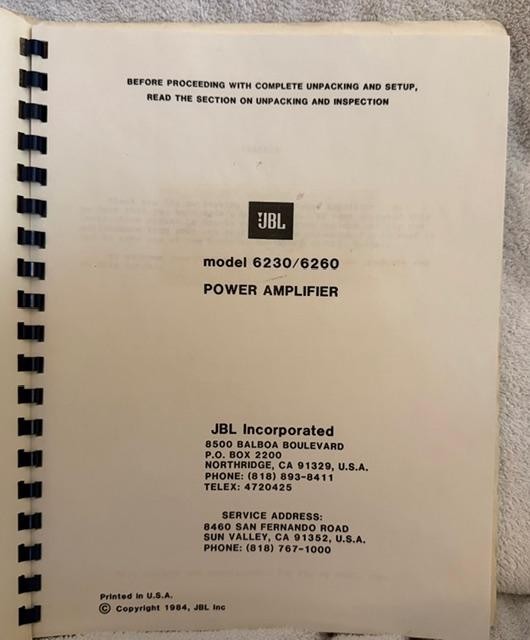
The JBL 6230 and 6260 are a matched pair of professional two-channel power amplifiers. They share one instruction manual and one design philosophy. The manual's introduction states the goal plainly: these amplifiers "have been designed to meet the most critical professional sound requirements." That's marketing language, but the circuit description backs it up. The 6230 is the smaller of the two, rated at 75 watts per channel into 8Ω in stereo, or 300 watts into 8Ω bridged to mono. The 6260 is rated at 150 watts per channel into 8Ω stereo, and 600 watts bridged into 8Ω. Both are dual-channel designs that switch to monaural operation by bridge connection. That made them popular in biamp setups, where one amp handles the high split and the other drives the low end.
These amplifiers came out of the mid-1980s, when JBL was firmly established in both studio monitoring and touring reinforcement. The 6230 is documented as a "dual channel power amplifier developed from acoustic technology and amplifier theory in SR" - SR meaning sound reinforcement. They weren't audiophile boutique pieces. They were tools for professionals who needed reliable power in racks that got moved, patched, and run hard.
The two models differ physically. The 6230 occupies 133 mm of rack height (about 5-1/4 inches) and weighs 10.4 kg. The 6260 has a large finned heatsink at the back and no fan. That means silent operation, but it also needs ventilation. Ignore that and the protection relay will open until things cool down.
Key Features
Conservative Power Ratings That Hold Up Under Load
The 6230's rated output is 75 watts per channel into 8Ω, both channels driven, across the full 20 Hz to 20 kHz band. That's a minimum continuous sine wave rating, not a peak music power number. One source lists 100W RMS per channel, but the great majority of documentation, including the manual and multiple dealer listings, settles on 75W. The 6260 is rated at 150 watts per channel into 8Ω stereo. One source adds that it will do 300 watts per channel into 4Ω and bridge at 600 watts into 8Ω. The 4Ω figure comes from a single source, so treat it as reported rather than confirmed.
Reactive loads, the kind real speakers present, are where lesser amplifiers get into trouble. The 6230 and 6260 were designed for that.
Bridging and Multi-Mode Operation
Both amplifiers run in normal stereo, dual mono, or bridged mono mode. The mode switching is on the rear panel, so no patch cords or external adapters are needed. The 6230 bridges to 300 watts into 8Ω, and the 6260 bridges to 600 watts into 8Ω. That suits a biamp system: one 6230 on the highs, one 6260 on the lows, both fed from a single crossover. A forum poster on AudioHeritage described that setup, with a JBL/UREI M552 active crossover feeding a 6230 for the high split and a 6260 for the low split.
Input Flexibility and Connector Options
The 6230's input impedance is listed as 40kΩ balanced or 20kΩ unbalanced. A forum question about whether the JBL/UREI amps share the same 3XLR connection design as the M553 crossover suggests these were commonly used together in professional racks.
Protection Circuitry That Actually Protects
The manual details a comprehensive protection scheme.
Build Quality and Serviceability
These amps have a reputation for long life.
Historical Context
The 6230 dates to the mid-1980s, with one source citing "around 1987" and an original Japanese price of ¥210,000. The 6260's release date is not documented in available sources, though it appears alongside the 6230 in the same manual and product lineup. Both carry JBL/Urei branding.
These amplifiers sit in a product family that includes the JBL 6290, 6233, 6007, 6008, PMX1200, 6011, 6012, 6021, 6022, SR6670, M Series, 212E, 6010B, 6001, MP418SP1, 6020, 6215, 6015, 6006B, SR6630, and the SA600 & 660. A forum thread titled "JBL/UREI 6290 and 6260 Amps" suggests owners considered the 6290, 6260, and 6230 part of the same lineup. The 6290 has fans. A forum poster observed that it "sounds the most musical used full range (but it has fans)," implying the fanless 6260 was preferred for quieter applications.
Collectibility & Value
These amplifiers are not collector's items the way a Marantz tube amp is. They're working tools, and they're priced accordingly. Forum discussions describe them as "available at what seem to be very reasonable prices," and the general consensus is that they offer solid build quality for the money. One poster summed it up: "6230/60 are good amps, if they have not been abused."
Listings show the full range of condition, from "JBL/Urei 6230 stereo power amp in excellent condition" to an eBay listing titled "Junk! !! JBL 6230 Power Amplifier" with condition noted as "for parts or not working." Minor scratch and scuff marks are common and consistent with use. The service manual is available. No common failure modes are explicitly documented beyond the general caution about abuse, though a forum poster noted that used amps "could use some attention" - which is true of any 35-year-old professional amplifier.
One source describes the 6230's sound as "exceptionally quick, detailed, and punchy" and says it "rivals the boutique brands that sell for nearly 5" - presumably meaning five times the price. Another user found the 6260's low end to "lack fullness and punch," though that's a single opinion and could reflect the condition of that particular unit. The 6260 is described elsewhere as "very heavy but backs it up with an excellent sound quality."
Before buying, check that the protection relay isn't stuck, verify that both channels work, and confirm the heatsink isn't clogged with dust. These amps are simple enough to service, but they're old enough that capacitors and relays may need attention.
eBay Listings
As an eBay Partner, we earn from qualifying purchases. This helps support our independent vintage technology research.