JBL 4350 Legendary Large Studio Monitor
The JBL 4350 stands as one of the most influential studio monitors in recording history—a massive, four-way system that defined the sound of popular music throughout the 1970s and early 1980s. As the predecessor to the legendary 43xx series, the 4350 established the design philosophy that would guide JBL's professional monitor development for decades, becoming the reference standard in major recording studios worldwide and earning its place in audio folklore.
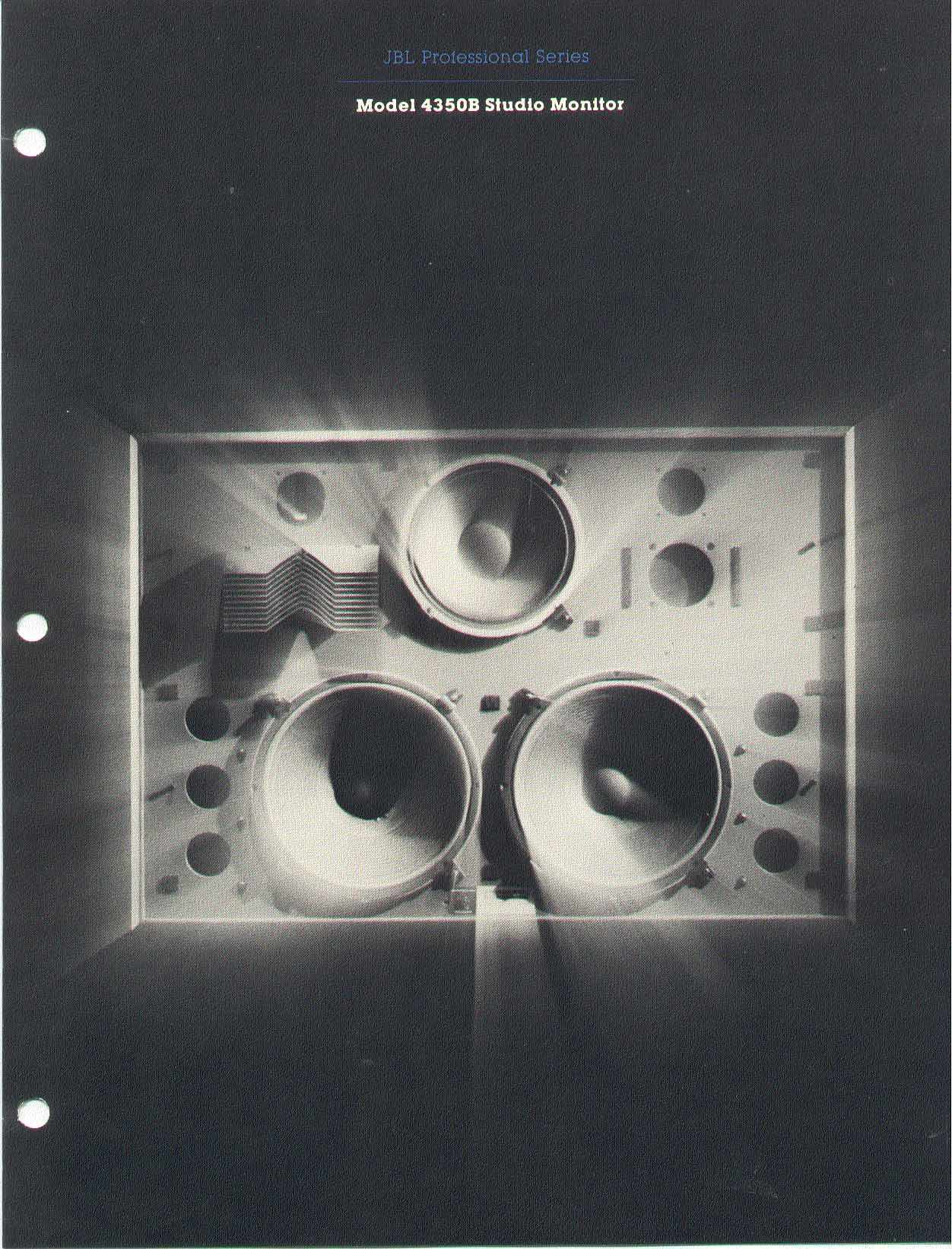
Overview
| Specification | Details |
| Production Years | 1975 - 1979 |
| Type | Four-way, five-driver large format studio monitor |
| Dimensions | 1092 × 1460 × 483 mm (W × H × D) |
| Weight | 140 kg (308 lbs) per speaker |
| Impedance | 8 Ω nominal |
| Sensitivity | 93 dB/W/m |
| Frequency Response | 32 Hz - 20 kHz (±3 dB) |
| Power Handling | 250 watts continuous program |
| Crossover Frequencies | 300 Hz, 1.2 kHz, 10 kHz |
Driver Configuration
The 4350's driver array established the template for all subsequent large-format JBL monitors:
Low Frequency: Two 15-inch 2230 woofers mounted in a massive bass-reflex enclosure. These drivers featured JBL's then-revolutionary Alnico V magnet structures, providing exceptional magnetic stability and power handling. The dual woofer configuration delivered both extension and dynamic capability unmatched in its era.
Mid-Bass: A 10-inch 2121 mid-bass driver operating in its own sealed chamber. This critical component handled the transition between woofers and midrange with remarkable clarity, avoiding the "hole in the middle" that plagued many multi-way systems.
Midrange: The 2420 compression driver mounted to the 2307 horn with 2308 lens assembly. This combination delivered midrange with a presence and clarity that became the JBL signature sound. The 2420's aluminum diaphragm and massive magnet structure provided low distortion and exceptional dynamic range.
High Frequency: The 2405 slot tweeter, a design so successful it remained in production for decades. Its unique dispersion pattern provided smooth, extended high frequencies without beaminess or harshness.
Crossover Design: The 4350's passive crossover network was a masterpiece of analog engineering, carefully balancing driver response while providing adjustable high-frequency level to accommodate different room acoustics and engineer preferences.
History
Introduced in 1975, the 4350 arrived at a pivotal moment in recording history. The multi-track revolution was in full swing, with studios moving from 8-track to 16-track and eventually 24-track recording. This technological advancement demanded monitors with greater resolution to reveal the complexities of dense mixes.
The 4350 was JBL's answer to this challenge. It represented the company's first attempt to create a monitor that could serve as a true reference across all musical genres. Previous JBL monitors had excelled in specific applications, but the 4350 aimed for universal excellence.
What made the 4350 special was its immediate adoption by the most important recording studios of the era. From Criteria Studios in Miami (where the Eagles recorded "Hotel California") to The Record Plant in Los Angeles (home to Fleetwood Mac's "Rumours"), the 4350 became the monitor of choice for engineers working on landmark albums.
The monitor's influence extended beyond professional circles. Its reputation for accuracy and dynamic capability made it highly sought after by audiophiles, creating a bridge between professional and consumer audio that had rarely existed before.
Sound Character
Recording engineers cherished the 4350 for characteristics that defined the "West Coast sound":
Authoritative Presence - The 4350 had a commanding presence that filled control rooms with sound that was both powerful and detailed. Engineers described it as "having weight"—instruments sounded substantial and real, not like reproductions.
Dynamic Truth - The monitor's ability to handle massive dynamic swings without compression made it ideal for rock and pop production. Drum kits had visceral impact, electric guitars snarled with appropriate aggression, and vocal crescendos maintained clarity and emotion.
Midrange Magic - The 2420 compression driver delivered midrange with a combination of clarity and warmth that became legendary. Vocals were rendered with palpable presence—engineers could hear the emotion in a singer's performance, not just the technical accuracy.
Bass Foundation - The dual 2230 woofers provided bass that was both deep and articulate. Unlike many large speakers that produced amorphous low frequencies, the 4350's bass was tuneful and precise, allowing engineers to properly balance kick drums and bass guitars.
Mix Translation - Perhaps the 4350's greatest strength was its ability to produce mixes that translated perfectly to other playback systems. Engineers who learned to work on 4350s found their mixes sounded "right" on car stereos, home systems, and radio broadcasts.
The monitor's character has been described as "musically honest"—it revealed what was actually on tape without editorializing, yet remained engaging and listenable. Engineers found they could work for extended periods without ear fatigue, a critical consideration in marathon recording sessions.
Collector's Notes
For collectors pursuing this piece of recording history, several considerations are essential:
As the oldest of the 43xx series, 4350s require particularly careful inspection. All foam surrounds will need replacement—the original foam has certainly deteriorated. Compression driver diaphragms should be checked for integrity.
Verify all drivers are original JBL components. The 2230 woofers with Alnico V magnets are particularly desirable. The 2420 compression drivers are legendary—ensure they haven't been replaced with later models. Original 2405 tweeters are essential for value.
The crossover networks in 4350s are now approaching 50 years old. All electrolytic capacitors will need replacement, and resistors may have drifted from their original values. Professional restoration is essential but should preserve the original circuit design and sonic character.
These massive cabinets are prone to various issues. Check for water damage, veneer separation, and baffle board integrity. The professional gray finish is most common, but some were finished in wood veneer for high-end installations. Original grilles are often missing or damaged.
The 4350's value lies not just in its performance but in its historical importance. Documentation showing studio provenance significantly increases value. Monitors from famous studios or used on landmark recordings are particularly desirable.
When restoring a 4350, the goal should be to return it to its original glory while acknowledging its age. These monitors represent a specific era in audio history, and their restoration should respect that heritage. Use period-correct or superior-quality components that maintain the intended sonic signature.
As the foundation of the legendary 43xx series, the 4350 represents a significant piece of audio history. While not as rare as later models, its historical importance ensures continued interest and value appreciation. Properly restored pairs offer performance that rivals modern monitors at a fraction of the cost.
Be prepared for the 4350's scale—these are not monitors for small rooms. They require proper placement and adequate amplification to reveal their full capabilities. When properly set up, they offer a listening experience that is both historically significant and musically rewarding.
The JBL 4350 remains a touchstone in studio monitor history—a design that defined an era and influenced everything that followed. Its combination of technical excellence, musical integrity, and historical significance ensures its place in the pantheon of audio legends.
eBay Listings



As an eBay Partner, we earn from qualifying purchases. This helps support our independent vintage technology research.
Related Models
- JBL 4310 (1970)
- JBL 4315 Control Monitor (1977)
- JBL L110A (1975)
- JBL 4311B (1975)
- JBL 4408 (1975)
- Akai AM-2850 (1975)
- Akai AP-206 (1975)
- Nakamichi BX-1 (1985)
- Acoustic Research research-ar-17 (1978)
- Acoustic Research AR-19 (1994)