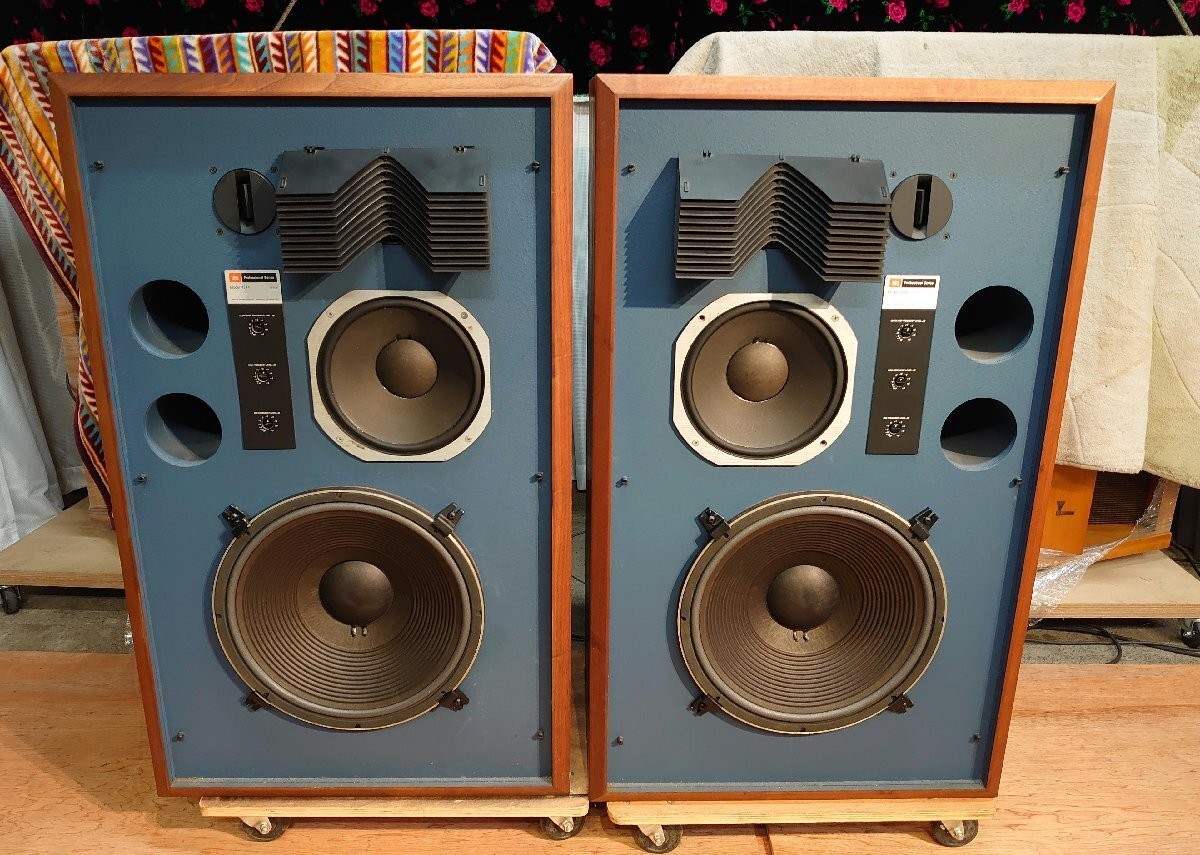
JBL 4345 Ultimate Large Format Monitor
The JBL 4345 represents the culmination of large-format studio monitor design—a system so capable, so authoritative, and so revealing that it became the reference standard for major recording studios worldwide. As the bridge between the legendary 4343 and the ultimate 4355, the 4345 incorporated groundbreaking technologies that redefined what was possible in monitor performance, establishing itself as the monitor against which all others were measured throughout the 1980s.
Overview
| Specification | Details |
| Production Years | 1979 - 1984 |
| Type | Four-way, five-driver large format studio monitor |
| Dimensions | 1092 × 1460 × 483 mm (W × H × D) |
| Weight | 148 kg (326 lbs) per speaker |
| Impedance | 8 Ω nominal (bi-amplifiable) |
| Sensitivity | 95 dB/W/m |
| Frequency Response | 28 Hz - 20 kHz (±2.5 dB) |
| Power Handling | 400 watts continuous program |
| Crossover Frequencies | 290 Hz, 1.2 kHz, 10 kHz |
Driver Configuration
The 4345's driver complement represents JBL's most advanced technology of its era:
Low Frequency: Two 15-inch 2235H woofers featuring JBL's revolutionary Symmetrical Field Geometry (SFG) magnet system. This technology reduced second-harmonic distortion by 10-15 dB compared to conventional designs, resulting in cleaner, more articulate bass reproduction.
Mid-Bass: A 10-inch 2202H mid-bass driver operating in its own acoustically isolated chamber. This driver featured JBL's "Diamond" surround—a proprietary design that maintained linearity across the entire excursion range while offering exceptional durability.
Midrange: The 2421B compression driver mounted to the 2307/2308 bi-radial constant directivity horn. This combination delivered midrange with unprecedented clarity and dispersion control, maintaining consistent frequency response across a 140° horizontal by 40° vertical coverage pattern.
High Frequency: The 2405 slot tweeter, renowned for its smooth, extended response and precise imaging characteristics. In the 4345, this driver was optimally integrated to provide seamless transition from the midrange.
Crossover Innovation: The 4345 introduced JBL's most sophisticated passive crossover network to date, featuring time-aligned driver compensation, adjustable high-frequency level control, and components selected for minimal loss and phase coherence.
History
Introduced in 1979, the 4345 emerged during a transformative period in recording technology. The transition from 16-track to 24-track and eventually 48-track recording demanded monitors with greater resolution to reveal the complexities of dense mixes. Simultaneously, the rise of digital recording exposed limitations in existing monitor designs.
The 4345 was JBL's response to these challenges. It represented not just an evolution of existing designs, but a rethinking of what a studio monitor should be. The engineering team, led by Greg Timbers, focused on reducing distortion across the entire frequency spectrum while maintaining the dynamic capabilities that had made JBL monitors legendary.
What made the 4345 special was its adoption by the most prestigious recording facilities in the world. From Abbey Road's Studio Two to Sunset Sound's legendary rooms, the 4345 became the monitor of choice for engineers working on landmark recordings. Its ability to handle the massive sound pressure levels of rock music while revealing the subtle nuances of acoustic recordings made it uniquely versatile.
The monitor's influence extended beyond professional studios. High-end audiophiles recognized that the 4345 offered performance unattainable by consumer speakers, leading to a secondary market that continues to thrive today.
Sound Character
Recording engineers revered the 4345 for characteristics that became the benchmark for professional monitoring:
Authoritative Bass - The dual 2235H woofers delivered bass that was both deep and incredibly fast. Kick drums had visceral impact, bass guitars maintained pitch definition during complex passages, and orchestral low strings had proper weight and texture. The SFG technology eliminated the "one-note" bass characteristic of many large speakers.
Pristine Midrange - The 2421B compression driver delivered midrange with a transparency that became legendary. Vocals were rendered with palpable presence—engineers could hear breath control, vocal strain, and emotional nuance. Instruments maintained their natural timbre regardless of volume.
Effortless Dynamics - The 4345 could reproduce the full dynamic range of any recording without compression or strain. From the whisper of a brushed cymbal to the crash of a full drum kit, the monitor maintained composure and clarity.
Revealing Detail - Perhaps the 4345's most celebrated characteristic was its ability to reveal recording details. Engineers could hear microphone placement, room acoustics, tape saturation, and processing artifacts with uncanny clarity. This made mixing decisions more confident and accurate.
Stable Imaging - Despite its massive size, the 4345 created a precise, stable soundstage. Instruments were precisely localized in three-dimensional space, with exceptional separation even in complex arrangements.
The monitor's character has been described as "powerfully transparent"—it combined the dynamic capability of a large system with the resolution of a miniature monitor. Engineers found they could work longer hours without fatigue, as the 4345's balanced presentation reduced listening stress.
Collector's Notes
For collectors seeking the ultimate large-format monitor, the 4345 requires careful evaluation:
Given the 4345's age, assume all foam surrounds need replacement. Professional refoaming with correct materials is essential. The ferrofluid in the compression drivers likely requires replacement for optimal performance.
Verify all drivers are original JBL components. The 2235H woofers should have SFG magnets (identifiable by the distinctive magnet structure). The 2421B compression drivers are particularly valuable—counterfeits exist, so verify through serial numbers and physical inspection.
The sophisticated crossover network is critical to the 4345's performance. Original capacitors will have degraded and require replacement. Restoration should use high-quality film capacitors that match or exceed the original specifications. Preserve the original adjustable level control for the tweeter.
These massive cabinets are prone to edge damage and veneer issues. Check for water damage, especially on the bottom. Original professional gray finish is most common, but wood veneer versions exist and command a premium. Complete with original grilles is rare and valuable.
The 4345 was designed for bi-amplification with an active crossover at 290 Hz. This capability adds flexibility and value. Documentation of this feature and any original bi-amp wiring should be preserved.
When restoring a 4345, focus on preserving its original character. These monitors represent a specific sonic philosophy that should be maintained. Use restoration techniques and materials that respect the original design intent.
The 4345 occupies a sweet spot in the vintage monitor market—more attainable than the ultra-rare 4344 or 4355, yet offering nearly equivalent performance. Properly restored pairs represent excellent value compared to modern monitors of similar capability.
Documentation showing studio history, maintenance records, or original purchase paperwork significantly enhances value. Monitors from famous studios or with known engineering history are particularly desirable.
The JBL 4345 remains one of the most significant studio monitors ever created—a perfect balance of technological innovation, musical integrity, and historical importance that continues to define reference monitoring decades after its introduction.
eBay Listings


As an eBay Partner, we earn from qualifying purchases. This helps support our independent vintage technology research.
Related Models
- JBL 4310 (1970)
- JBL 4315 Control Monitor (1977)
- JBL L110A (1975)
- JBL 4311B (1975)
- JBL 4408 (1975)
- Akai AM-2850 (1975)
- Akai AP-206 (1975)
- Nakamichi BX-1 (1985)
- Acoustic Research research-ar-17 (1978)
- Acoustic Research AR-19 (1994)