JBL 4344: The Audiophile's Studio Monitor from the Golden Age of Hi-Fi
In the mid-1970s, JBL stood at the forefront of professional and consumer audio innovation, bridging the gap between the recording studio and the living room. Among its most distinctive offerings during this era was the JBL 4344, a high-efficiency, horn-loaded loudspeaker system designed to bring the raw power and clarity of professional studio monitoring to the discerning home listener. Though less widely known than its siblings in the 4300 series, the 4344 holds a special place in the hearts of vintage audio enthusiasts for its bold engineering, commanding presence, and unapologetic sound signature.
Born from JBL’s deep roots in cinema and broadcast sound, the 4344 was part of a lineage that included iconic models like the 4310, 4311, and 4320—monitors that defined the “West Coast sound” in studios across America. However, the 4344 diverged from the compact nearfield format of those models, instead embracing a larger, more powerful design aimed at full-range performance in larger rooms. It was not just a speaker—it was a statement.
Technical Specifications
The JBL 4344 was engineered for high sensitivity and robust power handling, making it ideal for use with lower-powered tube amplifiers as well as high-output solid-state designs. Its horn-loaded architecture ensured exceptional efficiency, a hallmark of JBL’s professional-grade designs.
| Specification | Detail |
| Model | JBL 4344 |
| Year Introduced | 1975 |
| Type | 3-way, passive, horn-loaded loudspeaker |
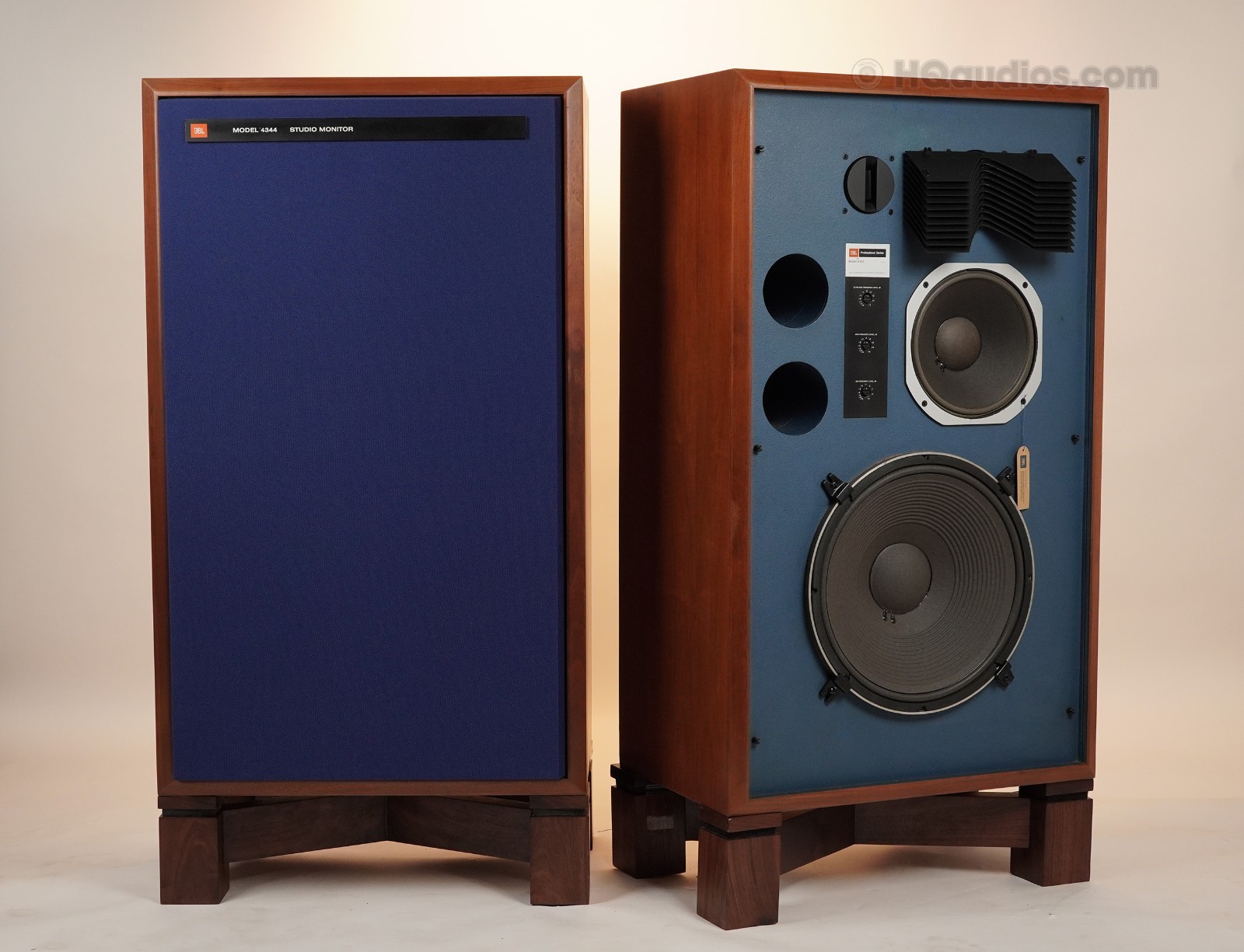
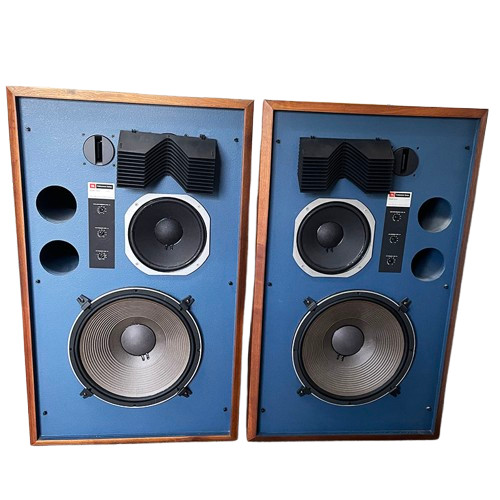
| Driver Complement | 15" low-frequency driver, 8" midrange with elliptical oblate spheroidal horn, 1" titanium dome compression driver with bullet-profile high-frequency horn |
| Crossover Frequency | ~500 Hz (low/mid), ~3.5 kHz (mid/high) |
| Sensitivity | 98 dB (1W/1m) |
| Nominal Impedance | 8 ohms (compatible with most amplifiers) |
| Frequency Response | 45 Hz – 20 kHz (±3 dB) |
| Power Handling | 200 watts (program) |
| Enclosure Type | Bass-reflex (ported) with front-firing port |
| Dimensions (H×W×D) | 38" × 16" × 18" (96.5 × 40.6 × 45.7 cm) |
| Weight | 85 lbs (38.6 kg) per cabinet |
| Finish Options | Walnut veneer, black ash |
| Recommended Placement | Free-standing, away from rear walls |
The heart of the 4344’s design lies in its dual-horn configuration: a large, flared high-frequency horn for precise dispersion and an elliptical midrange horn that delivers JBL’s signature vocal clarity. The 15-inch low-frequency driver, coupled with a front-firing port, provides deep, articulate bass—unusual for a speaker of its era without a dedicated subwoofer.
Sound Characteristics and Performance
The JBL 4344 delivers a sound that is dynamic, immediate, and uncolored—true to JBL’s studio-monitor philosophy. With a sensitivity of 98 dB, these speakers come alive even with modest amplifier power, making them a favorite among tube-audio aficionados. They are particularly responsive to high-current amplifiers, which can fully control the large bass driver and exploit the speaker’s wide dynamic range.
In practice, the 4344 excels in reproducing percussive transients and vocal presence. The horn-loaded midrange ensures that voices and lead instruments cut through the mix with lifelike immediacy, while the titanium dome tweeter provides crisp, extended highs without harshness—when properly set up. The bass, while not subsonic by modern standards, is tight and punchy, with excellent integration into the midrange.
These speakers thrive on open, energetic music: classic rock, jazz, blues, and orchestral recordings from the 1960s and 70s. They are less forgiving of poor recordings or compressed modern mixes, which can highlight their forward upper-midrange character. But for well-recorded material, the 4344 offers a thrilling, engaging listening experience that few vintage speakers can match.
Notable Features and Innovations
The JBL 4344 was more than just a repackaged studio monitor—it incorporated several design elements that set it apart:
- Dual Horn Loading: The use of separate horns for midrange and high frequencies was derived from JBL’s professional cinema speakers, allowing for controlled dispersion and high output with low distortion.
- High Efficiency: At 98 dB sensitivity, the 4344 can achieve concert-level volumes with as little as 10–20 watts, making it ideal for use with vintage tube amplifiers like those from McIntosh, Marantz, or Fisher.
- Modular Crossover Design: The internal crossover uses high-quality components and is accessible for servicing or upgrading—a boon for restorers and modders.
- Professional Build Quality: Constructed with thick MDF panels and durable grille cloth, the 4344 was built to withstand the rigors of studio use while maintaining aesthetic appeal in home environments.
Though not as compact as the 4310, the 4344 was marketed as a home studio monitor, appealing to semi-professionals, broadcasters, and serious audiophiles who wanted a taste of the “real” studio sound.
Common Issues and Maintenance
As with any vintage speaker, the JBL 4344 requires careful attention to maintain optimal performance:
- Surround Rot: The foam surrounds on the 15" woofer and 8" midrange driver are prone to drying and disintegration after 40+ years. Re-foaming or full reconing is often necessary.
- Tweeter Diaphragm Fatigue: The titanium dome tweeters are robust, but older units may suffer from fatigue or misalignment, leading to harshness or distortion at high volumes.
- Crossover Component Aging: Paper capacitors and older resistors in the crossover network may drift in value or fail. Upgrading to modern metal-film resistors and polypropylene capacitors can significantly improve clarity and reliability.
- Grille and Finish Wear: Original walnut or black ash veneers may be scratched or faded. The foam grille inserts often degrade and should be replaced with modern acoustically transparent materials.
Fortunately, due to JBL’s widespread use of standardized drivers, replacement parts and reconing kits are readily available from specialty vendors like Parts Express, WGS, or Simply Speakers.
Current Market Value and Collectibility
The JBL 4344 is not as commonly encountered as the 4310 or L100, but it has developed a loyal following among vintage audio collectors and studio monitor enthusiasts. Pairs in good cosmetic and working condition typically sell between $600 and $1,200, depending on restoration status, finish, and originality.
Fully restored pairs with upgraded crossovers and reconed drivers can command higher prices, especially when paired with matching JBL stands or original documentation. Their large size and directional dispersion make them less ideal for small rooms, but in spacious environments with proper setup, they remain a compelling choice.
While not yet considered “ultra-rare,” the 4344’s unique position as a bridge between studio and home audio gives it enduring appeal. It’s a speaker for those who value authenticity, power, and presence over neutral, recessed sound.
Conclusion and Legacy
The JBL 4344 stands as a bold expression of 1970s audio engineering—uncompromising, powerful, and deeply musical. It embodies JBL’s philosophy that speakers should reproduce sound with lifelike dynamics and clarity, not just flat frequency response. While it may not suit every listener or room, its impact on those who experience it is undeniable.
Today, the 4344 serves as a reminder of a time when speakers were built to last, designed for performance, and celebrated for their sonic character. For the vintage audio enthusiast seeking a taste of professional monitoring heritage with serious home-audio presence, the JBL 4344 remains a compelling and rewarding choice—a true giant of its era.
eBay Listings


As an eBay Partner, we earn from qualifying purchases. This helps support our independent vintage technology research.
Related Models
- JBL 4310 (1970)
- JBL 4315 Control Monitor (1977)
- JBL L110A (1975)
- JBL 4311B (1975)
- JBL 4408 (1975)
- Akai AM-2850 (1975)
- Akai AP-206 (1975)
- Nakamichi BX-1 (1985)
- Acoustic Research research-ar-17 (1978)
- Acoustic Research AR-19 (1994)