JBL 4343B: The Legendary Studio Monitor That Shaped Professional Sound
The JBL 4343B stands as one of the most revered studio monitors of the late 1970s and early 1980s, representing a pivotal moment in JBL’s legacy of professional audio innovation. Designed for critical listening in broadcast, mastering, and recording environments, the 4343B was not merely a loudspeaker—it was a precision instrument trusted by engineers who demanded accuracy, durability, and dynamic range above all else. Though technically a consumer-available model, its lineage and performance firmly place it in the pantheon of professional-grade monitors that influenced how music was mixed and mastered during a transformative era in audio.
Historical Context and Release Background
Introduced in 1978, the JBL 4343B was a direct evolution of the earlier 4343 model, itself derived from the iconic JBL 4310 and 4311 studio monitors. However, the 4343B was a significant departure in scale and application. Unlike the compact near-field monitors that dominated control rooms, the 4343B was a full-range, floorstanding design intended for midfield and far-field monitoring. It was engineered to deliver flat frequency response and high sound pressure levels (SPL) in larger studios and mastering suites, where engineers needed to hear how music would translate in real-world listening environments.
The 4343B was part of JBL’s "Professional Series" and shared key components with other high-end models like the 4310 and 4315. It was widely adopted in radio stations, television broadcast facilities, and recording studios across North America and Europe. Notably, it became a favorite in mastering studios during the transition from analog tape to early digital formats, where its clarity and neutrality helped engineers assess the sonic impact of new technologies.
Technical Specifications
| Specification | Detail |
| Type | 3-way, bass reflex, floorstanding |
| Drivers | 12" woofer (D130F), 5" midrange (2226J), 1" compression driver (2405) with Tractrix horn |
| Crossover Frequencies | 500 Hz (woofer/midrange), 3.5 kHz (midrange/tweeter) |
| Impedance | 8 ohms nominal |
| Sensitivity | 94 dB (1W/1m) |
| Frequency Response | 45 Hz – 20 kHz (±3 dB) |
| Recommended Amplifier Power | 25–200 watts |
| Enclosure Material | Medium-density fiberboard (MDF) with real wood veneer |
| Dimensions (H×W×D) | 36" × 14.5" × 15.5" (914 × 368 × 394 mm) |
| Weight | 78 lbs (35.4 kg) per speaker |
| Finish Options | Walnut, black ash |
| Production Years | 1978–1985 |
Sound Quality Characteristics
The JBL 4343B is renowned for its dynamic, punchy, and transparent sound. With a sensitivity of 94 dB, it is highly efficient and responds well to both tube and solid-state amplifiers, though it truly shines with clean, high-current solid-state designs that can control the large 12-inch woofer.
- Bass: The D130F 12-inch woofer delivers tight, articulate low end with excellent transient response. While not sub-bass deep (rolls off below 45 Hz), it provides authoritative mid-bass presence ideal for rock, jazz, and orchestral music.
- Midrange: The 2226J midrange driver is a hallmark of JBL’s professional line—fast, detailed, and neutral. Vocals and instruments are rendered with exceptional clarity, making the 4343B ideal for critical listening.
- Treble: The 2405 compression driver paired with a Tractrix horn offers extended high-frequency response with controlled dispersion. The result is a crisp, articulate top end without harshness when properly set up.
Overall, the 4343B presents a slightly forward midrange and elevated presence region—typical of JBL’s “house sound”—which enhances detail but may require careful room placement to avoid listener fatigue.
Notable Features and Innovations
The 4343B incorporated several advanced features for its time:
- Compression Driver with Tractrix Horn: The 2405 tweeter was a professional-grade unit used in JBL’s flagship cinema and studio monitors. The Tractrix horn design improved high-frequency dispersion and reduced distortion.
- Modular Crossover Design: The internal crossover used high-quality components and was designed for serviceability—crucial in professional environments where downtime was unacceptable.
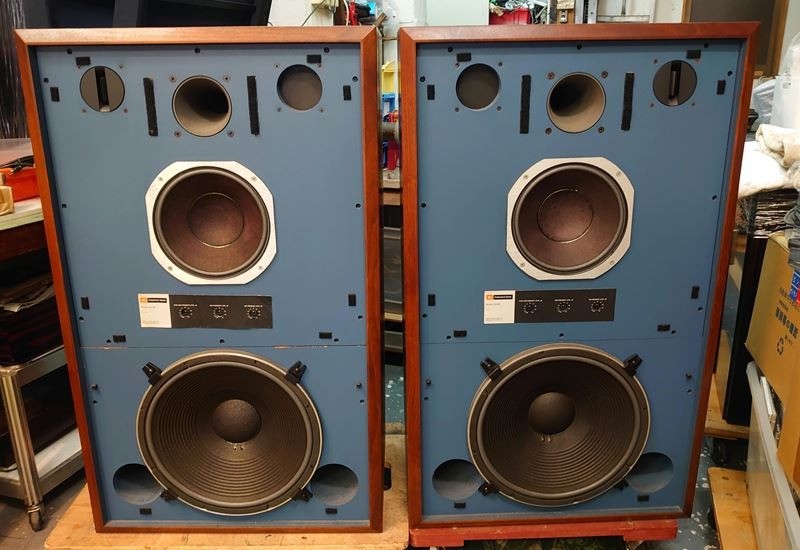
- Robust Cabinet Construction: Built with thick MDF and real wood veneer, the cabinet was heavily braced to minimize resonance. The rear-firing bass reflex port allowed for flexible placement while enhancing low-end efficiency.
- Professional Connectivity: Equipped with heavy-duty input terminals capable of accepting banana plugs or bare wire, suitable for high-power studio amplifiers.
Market Value and Collectibility
Today, the JBL 4343B is a sought-after collector’s item, particularly among vintage audio enthusiasts, studio memorabilia collectors, and audiophiles seeking the “JBL sound” in a full-range format. In excellent condition—with original grilles, undamaged veneer, and functional drivers—pairs typically sell for $1,200 to $2,000 on the secondary market. Fully restored units with reconed woofers and upgraded crossovers can command even higher prices.
Collectibility is enhanced by the speaker’s association with legendary studios. Units from famous facilities like Capitol Records, Motown, or BBC broadcast centers carry premium value. However, due to their age, original condition is rare, and many units on the market require restoration.
Common Issues and Maintenance
Given their age, vintage 4343Bs often require attention to maintain optimal performance:
- Woofer Surround Deterioration: The foam surrounds on the D130F drivers commonly disintegrate after 40+ years. Reconing or surround replacement is often necessary and highly recommended.
- Capacitor Aging in Crossovers: Electrolytic capacitors in the crossover network can dry out, leading to distorted midrange or tweeter failure. A capacitor rebuild using modern metalized polypropylene types is a common and worthwhile upgrade.
- Grille Fabric and Foam: Original grilles often have torn fabric or degraded foam backing. Replacement grille kits are available from specialty vendors.
- Cabinet Scratches and Veneer Damage: While structurally sound, cosmetic wear is common. Refinishing should be done carefully to preserve vintage value.
Maintenance tip: Always check driver alignment and phase before use. A simple 1 kHz tone test can ensure all drivers are in phase, preserving the speaker’s imaging integrity.
Comparison to Similar Models
| Model | Key Differences |
| JBL 4310 | Smaller 10" woofer, near-field design. Less bass extension but more common. 4343B offers fuller range and higher SPL. |
| JBL L100 (Century) | Consumer-focused, with foam surrounds and lower efficiency. 4343B is more accurate and durable, built for professional use. |
| Tannoy 1500A | Dual concentric design with softer bass. Tannoy offers smoother midrange, but 4343B has superior dynamics and clarity. |
| Altec 604E | Ribbon tweeter, different tonal balance. Altec is warmer; 4343B is more neutral and extended. |
| JBL 4344 | Successor to 4343B with improved crossover and updated drivers. Rarer and more expensive, but 4343B remains more accessible. |
Final Thoughts
The JBL 4343B is more than a vintage speaker—it’s a piece of audio history. Its combination of professional engineering, robust construction, and dynamic sound reproduction makes it a standout even among today’s high-end monitors. While not as refined as modern designs with computer-optimized crossovers and exotic materials, the 4343B delivers an engaging, lifelike presentation that continues to captivate listeners.
For collectors, restorers, or audiophiles seeking the authentic studio monitor experience of the late 1970s, the 4343B remains a top-tier choice. With proper care and restoration, it can deliver decades more of exceptional sound—proving that true engineering excellence never goes out of style.
eBay Listings


As an eBay Partner, we earn from qualifying purchases. This helps support our independent vintage technology research.
Related Models
- JBL 4310 (1970)
- JBL 4315 Control Monitor (1977)
- JBL L110A (1975)
- JBL 4311B (1975)
- JBL 4408 (1975)
- Akai AM-2850 (1975)
- Akai AP-206 (1975)
- Nakamichi BX-1 (1985)
- Acoustic Research research-ar-17 (1978)
- Acoustic Research AR-19 (1994)