JBL 4343 Four-Way Studio Monitor
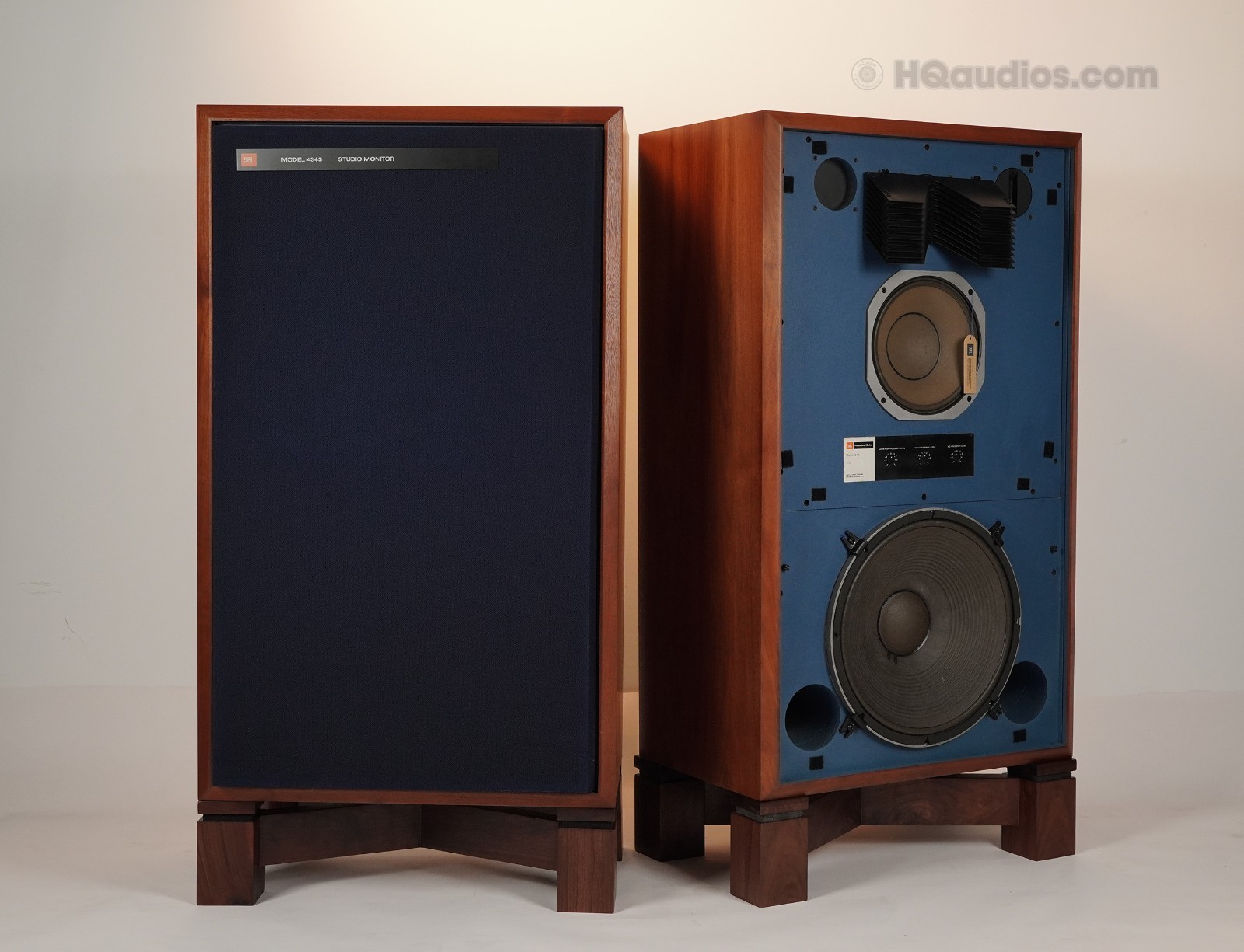
The JBL 4343 stands as one of the most significant studio monitors in audio history, representing the pinnacle of four-way loudspeaker design from the golden age of analog recording. Introduced in the late 1970s, this massive floor-standing monitor was engineered for the world's most demanding recording studios, where absolute accuracy and uncompromising dynamic range were non-negotiable requirements.
Overview
| Specification | Details |
| Production Years | 1978 - 1982 |
| Type | Four-way, five-driver studio monitor |
| Dimensions | 1092 × 1460 × 483 mm (W × H × D) |
| Weight | 145 kg (320 lbs) per speaker |
| Impedance | 8 Ω nominal |
| Sensitivity | 94 dB/W/m |
| Frequency Response | 30 Hz - 20 kHz (±3 dB) |
| Power Handling | 300 watts continuous program |
Driver Configuration
The 4343's legendary sound begins with its meticulously engineered driver complement:
Low Frequency: Two 15-inch 2231H woofers handle the foundation, mounted in a massive bass-reflex enclosure tuned to 30 Hz. These drivers feature JBL's Symmetrical Field Geometry (SFG) magnets for reduced distortion and exceptional transient response.
Mid-Bass: A dedicated 10-inch 2122H mid-bass driver operates from 290 Hz to 1.2 kHz, housed in its own sealed chamber to eliminate interference from the woofers' backwave. This critical transition region is where many speakers fail, but the 4343 excels with remarkable clarity.
Midrange: The heart of the system is the 2421B compression driver mounted to the 2307/2308 bi-radial horn. This combination delivers pristine midrange from 1.2 kHz to 10 kHz with exceptional dispersion and minimal coloration.
High Frequency: At the top end, the 2405 slot tweeter extends the response to 20 kHz with its characteristic "bullet" dispersion pattern, providing sparkling yet never harsh highs.
Crossover: The sophisticated four-way network operates at 290 Hz, 1.2 kHz, and 10 kHz, with carefully selected components and adjustable tweeter level to accommodate different room acoustics.
History
Introduced in 1978, the 4343 was JBL's response to the recording industry's demand for monitors that could handle the increasing dynamic range and frequency extremes of modern multi-track recording. It represented a significant evolution from the earlier 4320 and 4330 series, incorporating lessons learned from years of studio use.
What made the 4343 special was its holistic approach to monitor design. Unlike many competitors who focused on individual driver performance, JBL engineers understood that true accuracy required seamless integration between drivers. The 4343's crossover network was the result of thousands of hours of listening tests and measurements in actual studio environments.
The monitor quickly became a favorite in major recording studios worldwide, including Abbey Road, Capitol Studios, and Electric Lady Studios. Its ability to reveal minute details in mixes while handling massive sound pressure levels made it indispensable for engineers working on everything from rock to classical recordings.
Sound Character
Studio engineers loved the 4343 for its uncompromising honesty and remarkable dynamic capabilities:
Transparent Midrange - The 2421B compression driver delivered midrange with a clarity and presence that became the reference standard. Vocals sat perfectly in the mix, instruments maintained their natural timbre, and complex arrangements remained intelligible even at high volumes.
Effortless Dynamics - With dual 15-inch woofers, the 4343 could reproduce the full impact of kick drums, bass guitars, and orchestral crescendos without compression or distortion. Engineers could hear exactly how their mixes would translate to large sound systems.
Precise Imaging - Despite its massive size, the 4343 created a stable, three-dimensional soundstage with precise localization of instruments. The bi-radial horn provided consistent dispersion across a wide listening area.
Revealing Detail - The 4343 was famously unforgiving—it revealed every flaw in a recording or mix. This made it challenging to work with initially, but engineers who mastered it could create mixes that translated perfectly to any playback system.
The monitor's character has been described as "authoritative but never aggressive," with a balance of warmth and detail that made long mixing sessions less fatiguing than with many competing monitors.
Collector's Notes
For collectors seeking a pair of 4343s, several considerations are essential:
Carefully inspect the foam surrounds on all drivers—original foam will have deteriorated by now. Professional refoaming is essential. Check the condition of the ferrofluid in the compression drivers, which may need replacement.
The original capacitors in the crossover network will likely need replacement to restore proper performance. Look for signs of leaking or bulging capacitors, and consider a full recap with high-quality film capacitors.
These massive cabinets are prone to edge damage and veneer issues. Check for water damage, especially on the bottom edges. Original grilles are often missing or damaged—complete sets command a premium.
Ensure all drivers are original JBL components with matching serial numbers. The 2421B compression drivers are particularly sought after and expensive to replace.
A fully restored pair of 4343s represents one of the best values in vintage studio monitors. While restoration can be costly, the resulting performance rivals modern monitors costing many times more. Properly restored, these monitors will provide another lifetime of service.
Documentation showing studio provenance significantly increases value. Monitors from famous studios or with known engineering history are particularly desirable.
The JBL 4343 remains a benchmark against which all studio monitors are measured. Its combination of technical excellence, musicality, and historical significance ensures its place in the pantheon of audio legends.
eBay Listings


As an eBay Partner, we earn from qualifying purchases. This helps support our independent vintage technology research.
Related Models
- JBL 4310 (1970)
- JBL 4315 Control Monitor (1977)
- JBL L110A (1975)
- JBL 4311B (1975)
- JBL 4408 (1975)
- Akai AM-2850 (1975)
- Akai AP-206 (1975)
- Nakamichi BX-1 (1985)
- Acoustic Research research-ar-17 (1978)
- Acoustic Research AR-19 (1994)