JBL 4343: The Forgotten Powerhouse of Studio Monitoring
In the pantheon of vintage professional loudspeakers, few names command as much respect as JBL. Known for their robust engineering, high output capabilities, and signature sonic clarity, JBL studio monitors have graced countless recording studios, broadcast facilities, and mastering rooms since the 1960s. Among their most formidable yet underappreciated designs is the JBL 4343, a high-powered studio monitor developed during the mid-1970s as part of JBL’s 4300-series professional lineup. Though less celebrated than the iconic 4310 or 4311, the 4343 stands as a testament to JBL’s commitment to accuracy, durability, and sonic authority in professional audio environments.
Historical Context and Development
Introduced around 1975, the JBL 4343 emerged during a golden era of analog recording and broadcast engineering. At the time, JBL was already a dominant force in professional audio, supplying monitors to major studios and radio stations worldwide. The 4300-series was engineered to meet the demanding needs of mastering engineers and broadcast technicians who required flat frequency response, high SPL handling, and long-term reliability.
The 4343 was not a consumer product — it was designed explicitly for professional studio and broadcast use, often found in mastering suites, large mixing rooms, and high-end radio stations. Its design philosophy prioritized neutrality and power over the compact form factor of nearfield monitors like the 4310. As such, the 4343 was intended as a main monitor or control room speaker, capable of delivering full-range audio at reference levels without distortion.
While exact production numbers remain elusive, the 4343 was never mass-produced like its smaller siblings. Its niche application and substantial size limited its adoption to high-budget facilities, making it a rare find on the vintage market today.
Technical Specifications
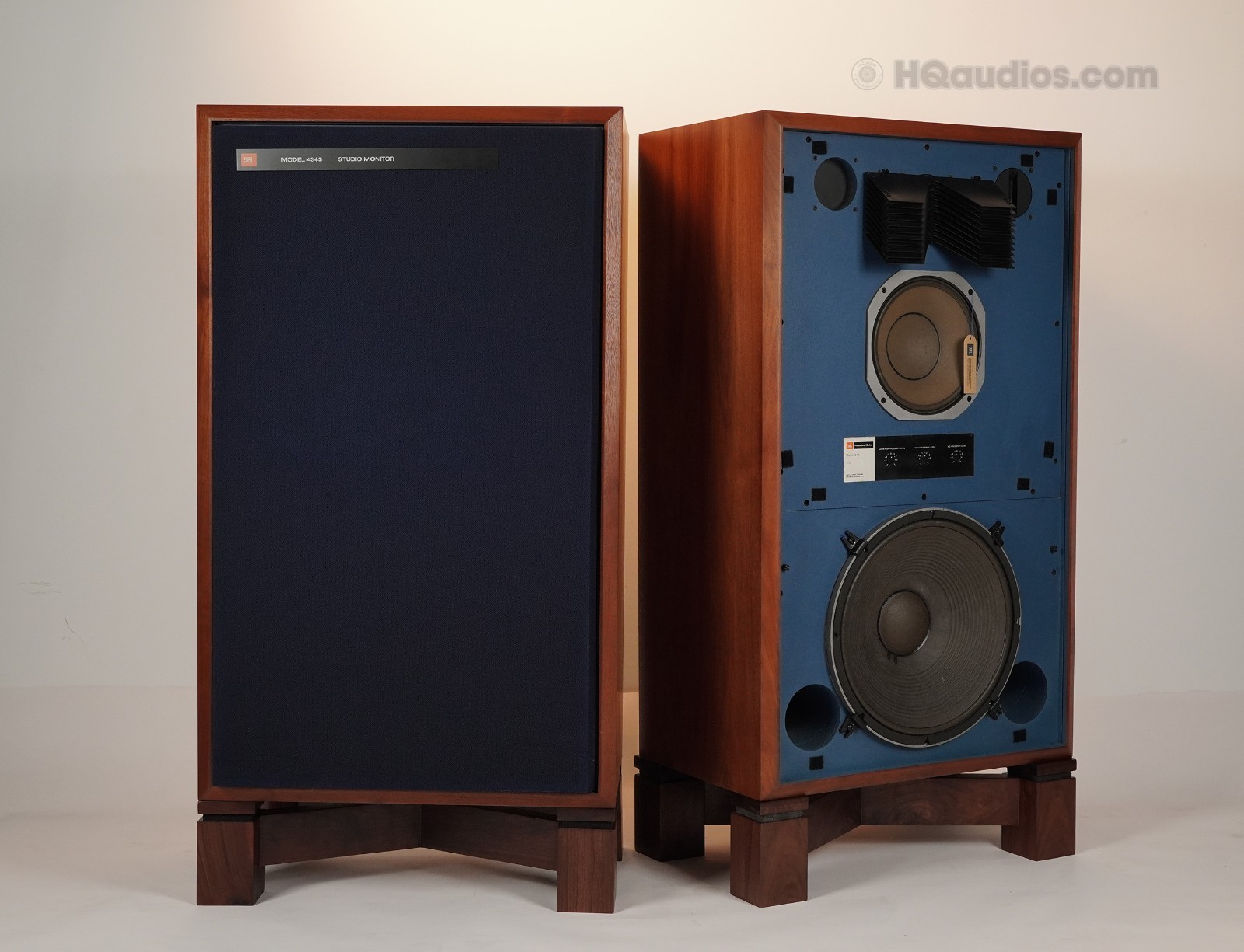
The JBL 4343 is a three-way, bass-reflex loudspeaker system built around JBL’s proven component technology of the era. It features a large cabinet designed to support deep bass extension and high acoustic output, making it suitable for large control rooms.
| Specification | Detail |
| Model | JBL 4343 |
| Year Introduced | 1975 |
| Type | Three-way, passive, bass-reflex |
| Drivers | 15" low-frequency, 5" midrange, 1" titanium dome tweeter |
| Frequency Response | 35 Hz – 20 kHz (±3 dB) |
| Crossover Frequencies | 700 Hz, 3.5 kHz |
| Sensitivity | 98 dB (1W/1m) |
| Nominal Impedance | 8 ohms |
| Power Handling | 250 watts (program) |
| Cabinet Material | Medium-density fiberboard (MDF) with reinforced bracing |
| Dimensions (H×W×D) | 36" × 15" × 18" (91.4 × 38.1 × 45.7 cm) |
| Weight | 98 lbs (44.5 kg) per cabinet |
| Finish | Black textured vinyl wrap, black cloth grille |
The 15-inch low-frequency driver (likely derived from the D130 lineage) provides authoritative bass response, essential for monitoring full-range mixes. The 5-inch midrange ensures vocal clarity and instrumental definition, while the titanium-dome tweeter delivers JBL’s signature crisp, extended highs — a hallmark of their professional monitors from this era.
The crossover network is robustly built with high-quality components, designed to handle sustained high power levels. Unlike consumer-grade crossovers, the 4343’s internal network emphasizes reliability and precision, with point-to-point wiring and metal-film resistors.
Sound Characteristics and Performance
The JBL 4343 is not a speaker designed for "pleasant" or "warm" sound — it’s built for accuracy. In a professional setting, this monitor tells you exactly what’s on the tape, warts and all. Its tonal balance is relatively flat, though it carries the slight upper-midrange lift typical of JBL’s house sound, which enhances vocal presence and cut-through in a mix.
Bass response is deep and tight, thanks to the large cabinet and efficient porting. The 15-inch woofer can move serious air, making the 4343 ideal for monitoring orchestral works, film scores, or any material requiring low-frequency authority. The midrange is transparent and detailed, allowing engineers to hear subtle nuances in vocal performances or instrument timbres.
The titanium tweeter is fast and revealing, capable of exposing sibilance or harshness in a recording. While some may find it aggressive compared to modern soft-dome tweeters, this characteristic was intentional — it ensured that mixes translated well to consumer systems, where high-frequency peaks could become fatiguing.
Overall, the 4343 excels in transient response, dynamic range, and dispersion. It was designed to operate at high SPLs for extended periods, making it ideal for critical listening in large rooms.
Notable Features and Innovations
- Professional-Grade Build: Unlike consumer speakers, the 4343 was built to endure the rigors of daily studio use. The cabinet is heavily braced, and all drivers are mounted with industrial-grade fasteners.
- High Sensitivity: At 98 dB, the 4343 is extremely efficient, allowing it to achieve high volume levels with moderate amplifier power — a crucial feature in the pre-high-power-amplifier era.
- Modular Design: Like other JBL studio monitors, the 4343 uses standardized drivers and crossover components, simplifying repairs and replacements in professional settings.
- Neutral Voicing: While not as hyped as some broadcast monitors of the time, the 4343 aimed for a balanced response suitable for mastering and critical evaluation.
Common Issues and Maintenance
Due to their age, surviving JBL 4343 units often require restoration. Common issues include:
- Aged Foam Surrounds: The 15" woofer and 5" midrange typically used foam surrounds, which degrade over time. Re-foaming or reconing is often necessary.
- Capacitor Drift in Crossovers: Electrolytic capacitors in the crossover network may dry out, leading to tonal imbalances or tweeter damage. A full recapping is recommended.
- Grille Fabric and Finish Wear: The vinyl wrap can crack, and grilles may be missing or torn. Replacement parts are scarce but can be custom-made.
- Tweeter Fatigue: While durable, the titanium dome tweeter can suffer from voice coil misalignment if overdriven. Careful biasing and protection from clipping are essential.
Restoration is feasible thanks to the availability of JBL replacement parts and the modular nature of the design. Many vintage audio specialists can source drivers or rebuild crossovers to original specs.
Current Market Value and Collectibility
The JBL 4343 remains a rare and under-the-radar collectible. Unlike the 4310, which enjoys cult status among vintage audio enthusiasts, the 4343 is largely unknown outside professional circles. This obscurity works in favor of collectors — clean, restored units can often be found for $800–$1,500 per pair, depending on condition.
However, interest is growing among studio restoration projects and vintage monitor aficionados. As more engineers seek the "JBL sound" in its purest form, the 4343’s value may appreciate, especially as fully restored examples become scarcer.
Conclusion and Legacy
The JBL 4343 may not be a household name, but it represents the pinnacle of JBL’s 1970s professional monitor engineering. Built for accuracy, power, and endurance, it served as a silent guardian in high-end studios where sonic truth mattered most. While overshadowed by smaller, more famous siblings, the 4343 deserves recognition as a serious tool of the trade — a no-compromise monitor for those who demanded nothing less than full-range clarity at reference levels.
Today, the 4343 is a hidden gem for vintage audio collectors, studio restorers, and audiophiles seeking a taste of authentic 1970s JBL sound in a large-room environment. For those willing to invest in restoration, the payoff is a monitor that doesn’t just play music — it reveals it.
eBay Listings


As an eBay Partner, we earn from qualifying purchases. This helps support our independent vintage technology research.
Related Models
- JBL 4310 (1970)
- JBL 4315 Control Monitor (1977)
- JBL L110A (1975)
- JBL 4311B (1975)
- JBL 4408 (1975)
- Akai AM-2850 (1975)
- Akai AP-206 (1975)
- Nakamichi BX-1 (1985)
- Acoustic Research research-ar-17 (1978)
- Acoustic Research AR-19 (1994)