JBL 4333B Studio Monitor
1980 - 1983
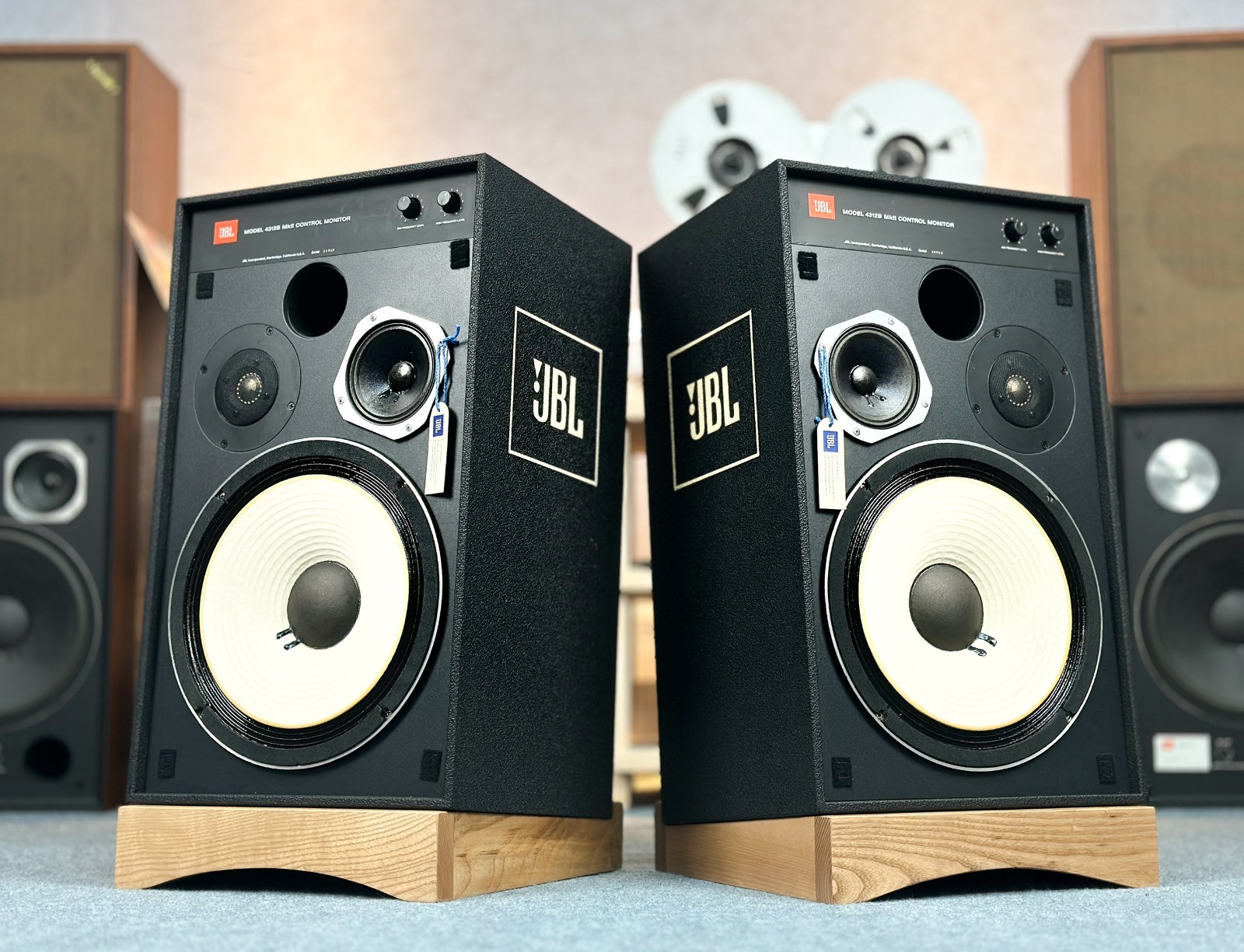
The JBL 4333B Studio Monitor represents the definitive evolution of the impressive 4333 platform, incorporating refinements that elevated an already exceptional three-way design to its highest expression. Introduced in 1980, this "B" version refined the crossover network and upgraded to the titanium-diaphragm 2421B compression driver, creating a monitor that many consider the ultimate realization of JBL's three-way, 15-inch woofer concept.
Overview
| Type | Three-way studio monitor |
|---|---|
| Enclosure | Bass reflex (ported) |
| Dimensions | 32" H × 22" W × 16" D (813 × 559 × 406 mm) |
| Weight | 106 lbs (48 kg) |
| Impedance | 8 ohms |
| Sensitivity | 93 dB (1W/1m) |
| Power Handling | 150 watts RMS |
| Frequency Response | 35 Hz - 20 kHz (±3dB) |
| Crossover Frequencies | 800 Hz and 5,000 Hz |
Driver Configuration
- Woofer: 15" JBL 2231H with Alnico V magnet and Symmetrical Field Geometry
- Midrange: JBL 2421B compression driver with 2307 horn and 2308 lens
- Tweeter: JBL 2405 slot tweeter for ultra-high frequencies
History & Design Evolution
The 4333B emerged from three years of intensive professional use of the original 4333, with JBL engineers carefully analyzing feedback from studios worldwide to identify areas for meaningful improvement:
- Compression Driver Upgrade: The 2421B with titanium diaphragm replaced the aluminum 2420, offering enhanced reliability and performance
- Crossover Refinement: Revised network component values improved phase coherence and driver integration
- Power Handling: Enhanced thermal management allowed higher continuous SPL capability
- Professional Enhancements: Upgraded terminals and improved cabinet damping for demanding studio environments
The transition to the titanium-diaphragm 2421B was the most significant change. This advanced compression driver offered several advantages over its aluminum predecessor: improved transient response, more extended high-frequency reproduction, and enhanced durability under professional use conditions. The titanium diaphragm's superior stiffness-to-weight ratio provided faster acceleration and reduced breakup modes.
The 4333B arrived as the recording industry stood at the threshold of the digital revolution. Engineers needed monitors capable of revealing both the best qualities of analog recording and the emerging clarity of digital formats. The 4333B's refined character proved ideally suited to this transitional period, providing the resolution required for digital while maintaining the musical engagement that analog demanded.
Sound Character
The 4333B refines the already impressive 4333 sound with meaningful enhancements:
- Enhanced Midrange Clarity - The 2421B's titanium diaphragm provides faster transient response and greater detail
- Improved High-Frequency Extension - Cleaner, more extended treble reproduction
- Refined Integration - Crossover improvements create more seamless driver blending
- Authoritative Bass - The 2231H continues to deliver exceptional low-frequency performance
- Dynamic Capability - High sensitivity ensures effortless dynamic reproduction
Compared to the original 4333, the "B" version offers improved resolution and slightly smoother overall presentation. The titanium compression driver provides a more refined midrange character—detailed and immediate like its predecessor, but with enhanced clarity and reduced coloration.
The 4333B excels at revealing the subtlest details in complex recordings while maintaining the ability to reproduce massive dynamic swings without strain. The three-way design ensures that each driver operates in its optimal range, minimizing distortion and maximizing coherence.
Studio Applications
The 4333B continued and expanded upon the 4333's professional success:
- Primary Monitoring: Served as main monitors in medium to large control rooms
- Mastering Excellence: Valued for full-range accuracy and detail retrieval
- Film Sound: Handled dialogue, effects, and orchestral scoring with equal capability
- Broadcast: Used in critical quality control and monitoring applications
Technical Improvements
The 4333B incorporated several meaningful technical refinements:
- 2421B Compression Driver: Titanium diaphragm with improved reliability and performance
- Enhanced Crossover: Optimized component values for better phase response
- Improved Ferrofluid: Better thermal management for extended driver life
- Professional Terminals: Upgraded binding posts for studio reliability
Collector's Notes
The 4333B is among the most desirable vintage JBL monitors:
- Refined Performance: Meaningful improvements over the already excellent 4333
- Alnico Woofer: The 2231H remains highly sought after by enthusiasts
- Titanium Compression Driver: The 2421B offers enhanced performance and reliability
- Legendary Tweeter: The 2405 adds significant value and capability
- Rarity: Shorter production run increases desirability
Common Issues to Check:
- Woofer foam surrounds (will need refoaming)
- Titanium diaphragm condition in compression driver (check for damage)
- Ferrofluid condition (may need replacement after decades)
- 2405 slot tweeter integrity
- Crossover capacitor condition (likely needs replacement)
- Horn and lens for cracks or damage
- Cabinet structural integrity
Bi-amplification: The 4333B fully supports bi-amplification, allowing optimization of amplifier selection for each driver section. This capability can significantly enhance performance when properly implemented with appropriate crossovers and amplification.
Listening Tips: The 4333B requires proper setup to realize its full potential. Allow adequate space from walls for bass response optimization. Careful positioning is essential for the horn-loaded midrange. Quality amplification with excellent current delivery and low noise is essential given the monitor's high sensitivity and revealing nature.
eBay Listings



As an eBay Partner, we earn from qualifying purchases. This helps support our independent vintage technology research.
The 4333B stands as the definitive expression of JBL's three-way, 15-inch woofer monitor concept. By incorporating the titanium-diaphragm compression driver and refined crossover network, engineers created a monitor that offered genuine performance advantages while preserving the essential character that made the 4333 successful. For collectors seeking the ultimate vintage JBL three-way monitor, the 4333B represents a worthy pinnacle—combining Alnico woofer heritage, titanium driver technology, and legendary 2405 tweeter performance in a package that remains sonically competitive decades after its introduction.
Related Models
- JBL 4310 (1970)
- JBL 4315 Control Monitor (1977)
- JBL L110A (1975)
- JBL 4311B (1975)
- JBL 4408 (1975)
- Akai AM-2850 (1975)
- Akai AP-206 (1975)
- Nakamichi BX-1 (1985)
- Acoustic Research research-ar-17 (1978)
- Acoustic Research AR-19 (1994)