JBL 4333B: The Legendary Studio Monitor That Shaped Professional Sound
The JBL 4333B is more than just a vintage loudspeaker—it’s a landmark in professional audio history. Introduced in 1977 as a refined version of the original 4333, the 4333B was designed for critical listening in broadcast studios, mastering facilities, and high-end home audio environments. As part of JBL’s revered 4300 series, the 4333B represented the company’s commitment to accuracy, durability, and sonic transparency during the golden era of analog recording. Even today, decades after its discontinuation in 1985, the 4333B remains a sought-after monitor among audiophiles and studio engineers who value its raw, uncolored sound and legendary build quality.
Historical Context and Release Background
JBL (James B. Lansing Sound, Inc.) had already cemented its reputation in the professional audio world by the 1970s, thanks to iconic models like the 4310 and 4311, which became staples in recording studios. The 4333, launched in 1972, was JBL’s first large-format, three-way studio monitor aimed at the high-fidelity and broadcast markets. The 4333B, released five years later, was a significant upgrade incorporating improvements in driver materials, crossover design, and cabinet construction.
The “B” revision addressed early reliability concerns and refined the frequency response for flatter, more neutral performance. It was widely adopted by radio stations, TV networks, and mastering houses—places where sonic accuracy was non-negotiable. The BBC, for instance, used variants of the 4333 series in their monitoring chain, and many top-tier studios in Los Angeles, New York, and London relied on them during the analog recording peak.
Technical Specifications
| Specification | Detail |
| Type | 3-way, bass-reflex passive monitor |
| Impedance | 8 ohms (nominal) |
| Sensitivity | 94 dB (1 watt @ 1 meter) |
| Frequency Response | 45 Hz – 20 kHz (±3 dB) |
| Crossover Frequencies | 700 Hz (woofer/midrange), 3.5 kHz (mid/tweeter) |
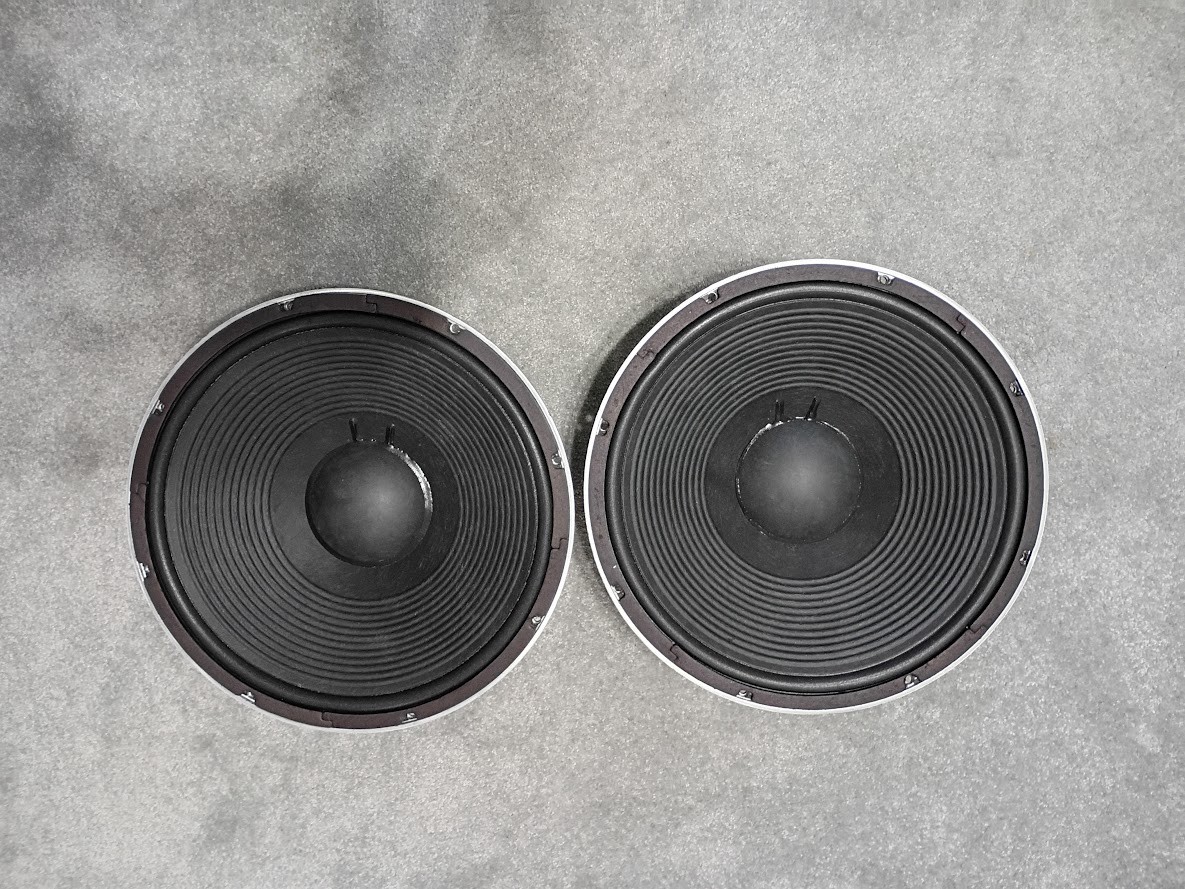
| Woofer | 12" JBL D130F-8 with doped cone |
| Midrange | 5" JBL 2405-8 compression driver |
| Tweeter | 1" JBL 2406-8 compression driver |
| Horn | 2412-8 Tractrix Horn (90° x 60° dispersion) |
| Enclosure | Vented (ported) with internal bracing |
| Dimensions (HxWxD) | 24.5" x 14.5" x 12.5" (62.2 x 36.8 x 31.8 cm) |
| Weight | 62 lbs (28.1 kg) per speaker |
| Finish | Walnut veneer with black cloth grille |
| Recommended Amp Power | 50–200 watts per channel |
Sound Quality Characteristics
The JBL 4333B is renowned for its dynamic, punchy, and highly revealing sound signature. Unlike modern speakers that often emphasize warmth or bass extension, the 4333B was engineered for neutrality and transparency—making it an ideal tool for critical listening and audio production.
The 12-inch D130F-8 woofer delivers tight, articulate bass with excellent transient response, reaching down to 45 Hz with authority. While not as deep as modern subwoofers, its bass is fast and well-controlled, avoiding the bloat common in many vintage designs.
The 5-inch 2405-8 midrange driver, mounted on a Tractrix horn, provides exceptional clarity in the vocal and instrumental midband. This compression driver design ensures high efficiency and low distortion, allowing the speaker to handle high SPLs without compression or fatigue—crucial in studio environments.
The 1-inch 2406-8 tweeter extends smoothly to 20 kHz, offering crisp but not harsh highs. Some users describe the top end as “analytical” rather than “sweet,” which is by design—engineers needed to hear every detail, including flaws in recordings.
Overall, the 4333B presents a wide soundstage with precise imaging. Its horn-loaded design provides high sensitivity and excellent dispersion, making it effective in both near-field and mid-field monitoring setups.
Notable Features and Innovations
The 4333B was packed with professional-grade features:
- Tractrix Horn Technology: JBL’s proprietary horn design minimized reflections and improved time alignment, resulting in cleaner high-frequency reproduction.
- Compression Drivers: Both midrange and tweeter used compression driver technology, offering higher efficiency and lower distortion than conventional dome or cone drivers.
- Robust Cabinet Construction: The heavily braced MDF cabinet reduced resonance and panel vibration, critical for accurate sound reproduction.
- Industrial-Grade Binding Posts: Gold-plated, dual banana-compatible terminals ensured reliable connections and bi-wiring capability.
- Modular Design: Drivers and crossovers were designed for serviceability—common in professional gear of the era.
Market Value and Collectibility
Today, the JBL 4333B is a prized collectible. In excellent condition, a matched pair typically sells for $1,200 to $2,000, with prices rising for units that have been professionally restored or come with original packaging and documentation. Fully refurbished models with reconed woofers and updated crossovers can command upwards of $2,500.
Collectibility is driven by several factors:
- Studio Provenance: Units from famous studios or broadcast stations are especially valuable.
- Driver Authenticity: Original JBL D130F, 2405, and 2406 drivers significantly increase value.
- Cosmetic Condition: Walnut veneer with minimal wear and intact grilles boosts appeal.
While not as ubiquitous as the 4310, the 4333B’s larger size and professional orientation make it a niche but passionate collector’s item.
Common Issues and Maintenance
Like all vintage gear, the 4333B requires care:
- Woofer Foam Rot: The original foam surrounds on the D130F-8 often degrade after 30+ years, leading to flapping or no bass. Solution: Recone with modern rubber surrounds (~$150–$200 per driver).
- Capacitor Aging: Crossover capacitors can dry out, causing brightness or imbalance. Solution: Replace with modern metal-film or polypropylene caps.
- Horn Driver Diaphragms: The 2405 and 2406 drivers may suffer from oxidized or fatigued diaphragms. Solution: Rebuild by specialists like The Speaker Exchange or Simply Speakers.
- Cabinet Damage: Check for cracks or water damage, especially in older units. Refinishing is possible but affects resale value.
Regular cleaning, avoiding high humidity, and using a surge protector are essential for longevity.
Comparison to Similar Models
| Model | Key Differences |
| JBL 4310 | Smaller (10"), less bass, more common in studios; warmer sound |
| JBL 4311 | Similar to 4310 but with improved bass and tweeter; still less powerful than 4333B |
| Altec 604E | Ribbon tweeter, smoother midrange, but less dynamic and efficient |
| Tannoy Dual Concentric | Coaxial design, “honky” midrange, different dispersion pattern |
| UREI 813 | Similar size and purpose, but with different horn design and voicing |
The 4333B stands out for its combination of size, efficiency, and neutrality. While the 4310 series defined the “near-field monitor” category, the 4333B was built for mid-field accuracy—a true “big brother” in the JBL lineup.
Final Thoughts
The JBL 4333B is not just a speaker—it’s a piece of audio history. Its no-compromise design, professional pedigree, and enduring performance make it a benchmark for vintage studio monitors. Whether you're a collector, a restoration enthusiast, or a purist seeking uncolored sound, the 4333B delivers with authority and integrity.
For those lucky enough to own a well-maintained pair, the experience is revelatory: dynamic, detailed, and utterly honest. In an age of digital modeling and DSP correction, the 4333B remains a testament to analog engineering at its finest—where every component was chosen for performance, not cost. If you find a good pair, don’t hesitate. These monitors aren’t just vintage—they’re timeless.
eBay Listings

As an eBay Partner, we earn from qualifying purchases. This helps support our independent vintage technology research.
Related Models
- JBL 4310 (1970)
- JBL 4315 Control Monitor (1977)
- JBL L110A (1975)
- JBL 4311B (1975)
- JBL 4408 (1975)
- Akai AM-2850 (1975)
- Akai AP-206 (1975)
- Nakamichi BX-1 (1985)
- Acoustic Research research-ar-17 (1978)
- Acoustic Research AR-19 (1994)