JBL 4315B (1980)
That moment when you fire up a pair and suddenly hear every layer in a mix like it’s the first time—this is why engineers trusted the 4315B.
Overview
The JBL 4315B isn’t just another vintage monitor—it’s a full-on studio artifact from the golden age of analog broadcasting, the kind of speaker that sat on console bridges in Tokyo, Paris, and New York, telling engineers exactly what their mixes were doing, warts and all. Released in 1980 as a refined version of the 4315A, this 4-way, bass-reflex bookshelf-type system was built for accuracy, durability, and serious sonic authority. It’s not flashy, not forgiving, but brutally honest—exactly what you want when you’re making final calls on a master. The 4315B and its walnut-finished sibling, the 4315BWX, were priced around ¥400,000 and ¥410,000 respectively in 1981, a steep cost that reflected their professional pedigree. These weren’t living-room showpieces; they were tools, and they looked the part—gray vinyl veneer, black grille, and a no-nonsense presence that said, “I’m here to work.”
Owners report a sound that’s crystal clear in the vocal and high-frequency ranges, with one user swearing they hear instruments in familiar tracks that had gone unnoticed on other systems. Another called their setup with the 4315Bs “nothing short of enchanting.” But it’s not all magic—some find the upper midrange and treble a bit forward, often dialing them back with the front-panel L-pads by about -2dB to keep the sound rounded and balanced. That tweakability is part of the charm: these speakers were designed to be dialed in, not just plugged in and admired.
Specifications
| Manufacturer | JBL (James B. Lansing Sound, Incorporated) |
| Model | 4315B / 4315BWX |
| Type | 4-way, 4-speaker, bass reflex system, bookshelf type speaker system |
| Drivers | Low range: 30 cm cone type woofer 2203H; Middle range: 20 cm cone type mid-woofer 2108H; Middle and high range: 13 cm cone type 2105H; High range: Horn type tweeter 2405 |
| Frequency Response | 35 Hz to 20 kHz ± 3 dB |
| Crossover Frequencies | 400 Hz, 2 kHz, 8 kHz |
| Nominal Impedance | 8 Ω |
| Sensitivity | 89 dB/W/m |
| Power Handling | 60W (network) |
| Enclosure Volume | Woofer: 91L; Mid-Woofer: 2.8L |
| Dimensions (W x H x D) | 521 x 854 x 327 mm |
| Weight | 47.6 kg |
Key Features
Four-Way Driver Array with Targeted Upgrades
The 4315B is a 4-way system, meaning it splits the audio signal across four distinct drivers—woofer, mid-woofer, mid/high, and tweeter—each handling a specific slice of the spectrum. This design allows for greater control and reduced distortion across the board. It was developed as a unit modification of the 4315A, with three of the four drivers updated. The low end now uses the 2203H 30 cm cone woofer, the midrange gets the 2108H 20 cm mid-woofer, and the mid/high duties fall to the 2105H 13 cm cone driver. Only the high-frequency horn, the 2405, carries over unchanged—a testament to its enduring performance.
Tractrix Horn with Acoustic Lens
The 2405 horn-type tweeter isn’t just bolted on—it’s fronted by an acoustic lens (also called a diffraction lens), a subtle but critical feature that helps smooth high-frequency dispersion and reduce edge diffraction. This ensures a more consistent off-axis response, which matters in control rooms where reflections can muddy the sound. The horn’s directional pattern is rated at 80° x 60° at 16 kHz, giving engineers a focused sweet spot without being overly narrow.
Modular Cabinet with Professional Mounting
Built as a bass-reflex system, the cabinet uses a ported design to extend low-frequency response and efficiency. It’s constructed from wood with a vinyl veneer—practical, durable, and easy to maintain in studio environments. The 4315B comes in a gray finish with a black grille, while the BWX variant offers a walnut finish and blue grille, a nod to higher-end installations. On the back, metal support fittings allow the speaker to be suspended, a feature that made it adaptable to different studio layouts, from console mounting to wall rigging.
Historical Context
The 4315B arrived in 1980 as part of JBL’s 4300 Series, which was originally launched in 1973. It belongs to the broader '43xx' series of studio monitors, a lineage known for no-compromise engineering and broadcast-grade reliability. While the fact sheet doesn’t detail the design goals or competitive landscape, the 4315B’s specs and build suggest it was aimed at professional users who needed a compact yet full-range monitor capable of handling high SPLs with precision. Its adoption by serious users—evident in passionate testimonials—confirms its role as a trusted reference tool during a pivotal decade in audio production.
Collectibility & Value
Today, the JBL 4315B commands attention in the vintage audio market, with asking prices ranging from $1,200 to $1,800, though some listings go much higher—up to $4,750 or even $10,000 in exceptional cases. Condition is everything: original, unmodified units with intact drivers and clean grilles hold the most value. The gray-finish 4315B is common, but the walnut-finished BWX often draws a premium.
Common issues include degraded foam surrounds on the woofers and mid-woofers, which are prone to rot after decades of use. Replacement foam kits are widely available, making this a manageable restoration. The L-pads on the front panel, used to adjust treble and upper midrange levels, can become scratchy or intermittent over time and may need cleaning or replacement. Another known failure point is the 10-watt power resistors in the crossover—owners report broken leads due to vibration-induced metal fatigue, a flaw that can be fixed but requires careful soldering. Despite these quirks, the 4315B’s reputation for great sound and build quality keeps demand steady among collectors and studio nostalgics.
eBay Listings

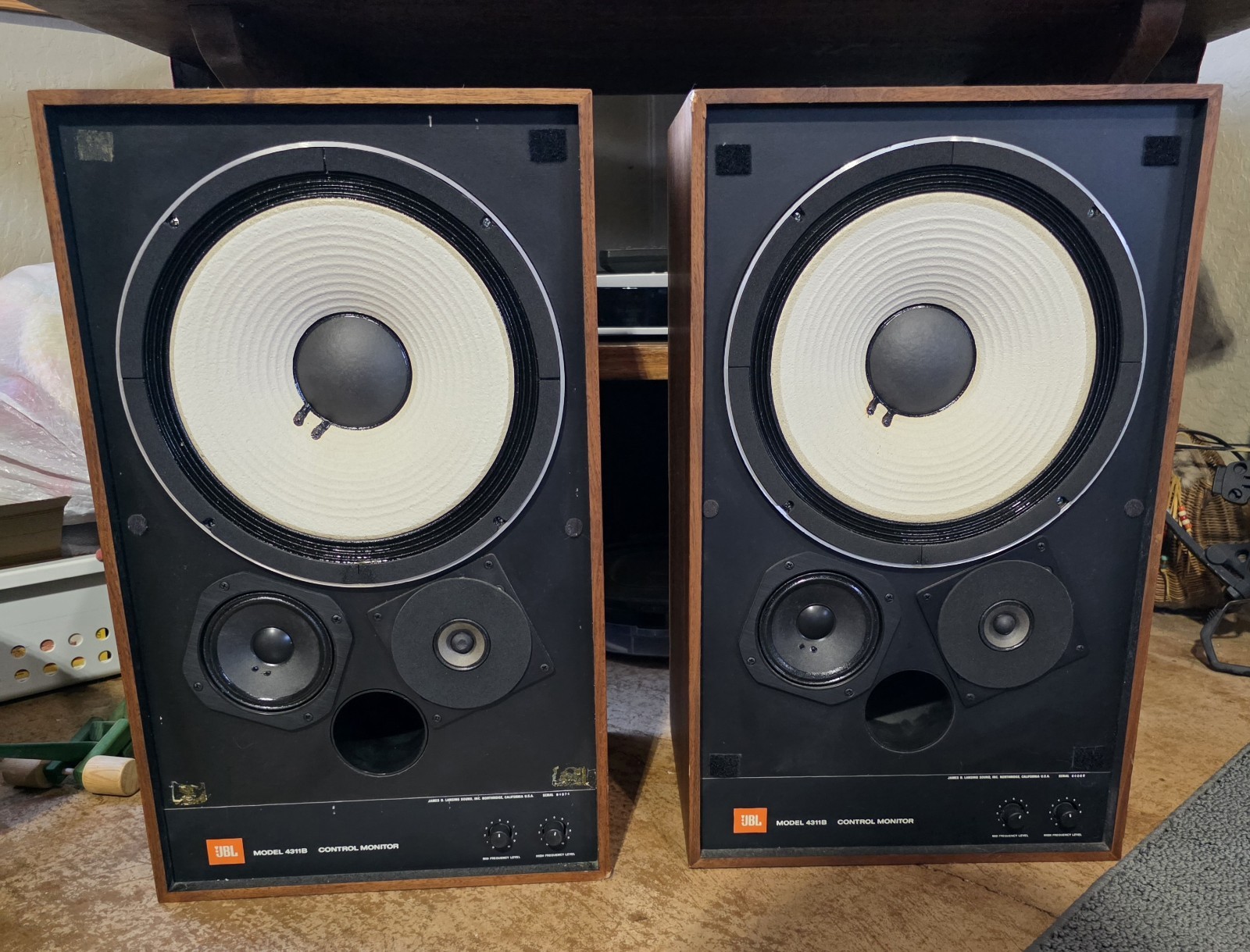
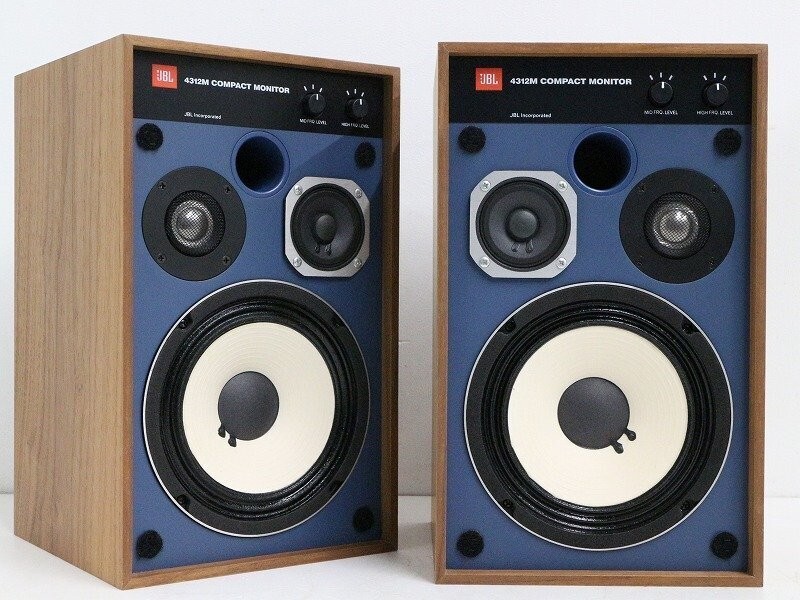

As an eBay Partner, we earn from qualifying purchases. This helps support our independent vintage technology research.
Related Models
- JBL 4310 (1970)
- JBL 4315 Control Monitor (1977)
- JBL L110A (1975)
- JBL 4311B (1975)
- JBL 4408 (1975)
- Akai AM-2850 (1975)
- Akai AP-206 (1975)
- Nakamichi BX-1 (1985)
- Acoustic Research research-ar-17 (1978)
- Acoustic Research AR-19 (1994)