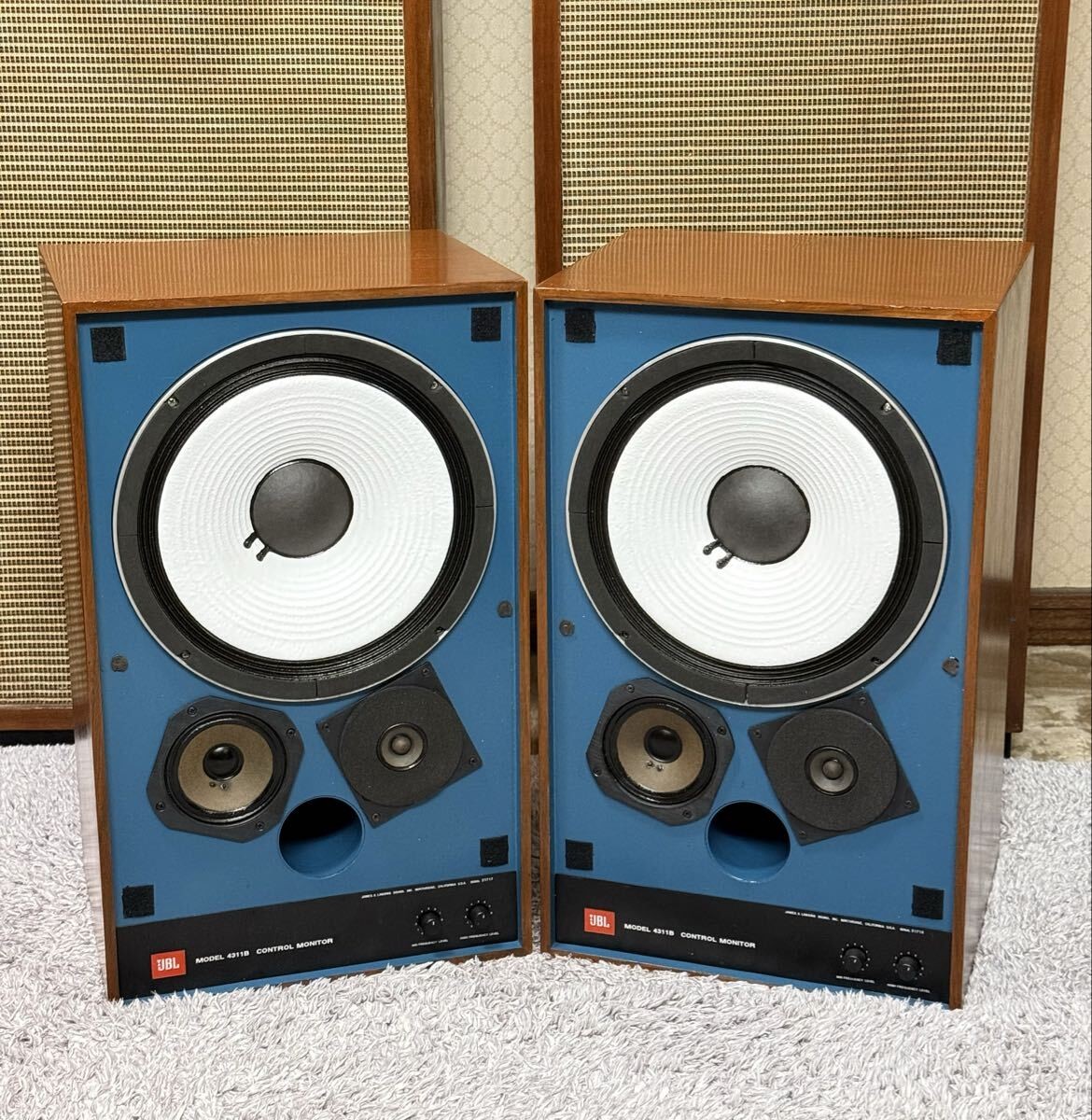
JBL 4311 Control Monitor
1971 - 1975
The JBL 4311 Control Monitor represents the evolutionary step between the legendary 4310 and the popular 4312. Introduced in 1971, this three-way studio monitor refined the successful formula of its predecessor with improved driver technology and crossover design, creating what many consider to be the sweet spot in JBL's compact monitor lineup.
Overview
| Type | Three-way studio monitor |
|---|---|
| Enclosure | Sealed (acoustic suspension) |
| Dimensions | 24.5" H × 14" W × 12" D (622 × 356 × 305 mm) |
| Weight | 46 lbs (21 kg) |
| Impedance | 8 ohms |
| Sensitivity | 91 dB (1W/1m) |
| Power Handling | 75 watts RMS |
| Frequency Response | 45 Hz - 15 kHz (±3dB) |
| Crossover Frequencies | 1,500 Hz and 6,000 Hz |
Driver Configuration
- Woofer: 10" JBL 123A-3 with improved suspension and magnet structure
- Midrange: 5" JBL LE5-2 phenolic ring radiator
- Tweeter: JBL LE25-4 1" dome tweeter
History & Design Evolution
The 4311 was born from JBL's commitment to continuous improvement in their studio monitor line. Building on the overwhelming success of the 4310, engineers at JBL identified areas for refinement:
- Woofer Upgrade: The 123A-3 woofer featured a more robust suspension system that improved linearity and reduced distortion at higher excursion levels
- Crossover Refinement: Subtle adjustments to the crossover network improved phase coherence between drivers
- Cabinet Damping: Enhanced internal damping materials reduced cabinet resonances
- Terminal Improvements: More robust binding posts for professional studio use
What makes the 4311 particularly interesting is its transitional nature. It retains the classic Alnico magnet structure of the 4310 era while incorporating design lessons that would lead to the ferrite-magnet 4312. This gives the 4311 a unique sonic character that blends the warmth of early JBL designs with the improved technical performance of later models.
Sound Character
The 4311 delivers what many engineers describe as the "classic JBL monitor sound" - a balanced presentation with several distinctive characteristics:
- Forward Midrange - The LE5-2 midrange driver provides exceptional clarity and presence in the critical vocal range
- Extended Bass - Despite its compact size, the 4311 delivers surprisingly deep and articulate bass response
- Smooth Highs - The LE25 tweeter offers detailed but non-fatiguing high-frequency reproduction
- Dynamic Punch - High sensitivity allows the 4311 to deliver explosive transients and uncompressed dynamics
- Wide Dispersion - Excellent off-axis response makes the 4311 forgiving of less-than-ideal listening positions
Compared to the 4310, the 4311 offers slightly better bass control and lower distortion. Compared to the 4312, it has a touch more midrange warmth and a slightly more forgiving high end. This makes the 4311 particularly well-suited for long mixing sessions where fatigue can be an issue.
Studio Legacy
The 4311 found favor in many professional studios during its production run. Its balanced character made it excellent for:
- Critical Mixing: The revealing midrange helped engineers make precise EQ decisions
- Tracking: Musicians appreciated the 4311's ability to reveal subtle performance nuances
- Broadcast: Radio stations valued its consistent performance and reliability
While not as ubiquitous as the 4310 or 4312, the 4311 developed a loyal following among engineers who appreciated its refined balance between technical accuracy and musical engagement.
Collector's Notes
Today, the 4311 occupies a special place in the vintage audio world:
- Relative Rarity: With a shorter production run than the 4310 or 4312, well-preserved 4311s are less common
- Restoration Considerations: Like all vintage JBLs, the 4311 may need crossover recapping and L-pad cleaning/replacement
- Driver Compatibility: Many 4311 components are interchangeable with 4310 and early 4312 models
- Value Proposition: Often overlooked in favor of its more famous siblings, the 4311 can represent excellent value for vintage monitor enthusiasts
Common Issues to Check:
- Foam surrounds on the 123A-3 woofer (later replaced with rubber in some units)
- L-pad controls for midrange and tweeter levels
- Crossover capacitors (electrolytics dry out over time)
- Cabinet corners and veneer condition
Listening Tips: The 4311 responds well to quality amplification and benefits from proper placement. Allow at least 12 inches from walls for optimal bass response, and consider using isolation pads or stands to decouple from surfaces.
eBay Listings


As an eBay Partner, we earn from qualifying purchases. This helps support our independent vintage technology research.
The 4311 represents a fascinating chapter in JBL's studio monitor history - a refined iteration that captures the essence of the classic JBL sound while pointing toward future developments. For those who appreciate vintage studio monitors, the 4311 offers a compelling blend of historical significance and enduring sonic excellence.
Related Models
- JBL 4310 (1970)
- JBL 4315 Control Monitor (1977)
- JBL L110A (1975)
- JBL 4311B (1975)
- JBL 4408 (1975)
- Akai AM-2850 (1975)
- Akai AP-206 (1975)
- Nakamichi BX-1 (1985)
- Acoustic Research research-ar-17 (1978)
- Acoustic Research AR-19 (1994)