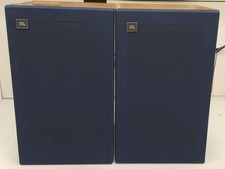
JBL 4301B Broadcast Monitor
1979 - 1981
The JBL 4301B Broadcast Monitor represents a specialized evolution of JBL's renowned studio monitor technology, engineered specifically for the demanding environments of broadcast and quality control applications. Introduced in 1979, this compact two-way monitor delivered the accuracy and reliability that broadcast professionals required, packaged in a space-efficient format perfect for OB trucks, remote recording setups, and compact control rooms.
Overview
| Type | Two-way broadcast monitor |
|---|---|
| Enclosure | Sealed acoustic suspension |
| Dimensions | 15.5" H × 10" W × 9.5" D (394 × 254 × 241 mm) |
| Weight | 22 lbs (10 kg) |
| Impedance | 8 ohms |
| Sensitivity | 90 dB (1W/1m) |
| Power Handling | 60 watts RMS |
| Frequency Response | 50 Hz - 20 kHz (±3dB) |
| Crossover Frequency | 2,500 Hz |
Driver Configuration
- Woofer: 8" JBL 116H-3 with ferrite magnet and coated paper cone
- Tweeter: JBL 035Ti 1" dome tweeter with titanium diaphragm
History & Design Philosophy
The 4301B was born from JBL's deep understanding of broadcast professionals' unique needs. Unlike studio recording environments with carefully treated acoustics and ample space, broadcast facilities often faced challenging constraints:
- Space Limitations: Mobile production trucks and remote recording setups demanded compact, portable monitoring
- Environmental Durability: Equipment needed to withstand constant relocation and varied environmental conditions
- Consistent Accuracy: Broadcast engineers required absolute confidence in their monitoring regardless of location
- Magnetic Shielding: Essential for use near video monitors and other sensitive equipment
JBL engineers responded with a design that prioritized portability without compromising the sonic integrity that made the company's monitors legendary. The 4301B incorporated magnetically shielded drivers—a critical feature for broadcast use—while maintaining the smooth, wide-range response that audio professionals expected.
The selection of the titanium dome tweeter was particularly forward-thinking for its era. While many competing monitors used conventional soft dome designs, JBL's titanium implementation offered superior transient response and extended high-frequency detail that helped broadcast engineers identify potential problems in their audio chains.
Sound Character
Despite its compact dimensions, the 4301B delivers a remarkably complete sonic presentation that belies its size:
- Surprising Bass Extension - The sealed enclosure and carefully engineered 8-inch woofer provide surprisingly deep, articulate low frequencies for the cabinet size
- Detailed Highs - The titanium dome tweeter delivers crisp, extended treble that reveals subtle details without harshness
- Smooth Midrange - Vocal frequencies are rendered with natural warmth and clarity, essential for broadcast dialogue monitoring
- Excellent Imaging - Precise driver integration creates a focused stereo image that aids in positioning decisions
- Low Fatigue - The balanced presentation allows for extended monitoring sessions without listener fatigue
The 4301B's sealed acoustic suspension design offered advantages in broadcast environments where predictable bass response was essential. Unlike ported designs that could exhibit boominess in confined spaces, the 4301B maintained consistent low-frequency character regardless of placement constraints.
Broadcast Applications
The 4301B found its way into numerous professional broadcast applications:
- Mobile Production: OB trucks relied on the 4301B's compact size and consistent performance
- Quality Control: Used in audio QC suites for program verification and loudness monitoring
- Remote Recording: Location sound engineers appreciated the portability and accuracy
- Radio Broadcast: On-air studios and production rooms valued the magnetic shielding
Technical Innovations
The 4301B incorporated several technical features that set it apart from consumer speakers of the era:
- Magnetic Shielding: Complete magnetic containment allowed safe placement near CRT monitors
- Professional Terminals: Robust binding posts designed for repeated connection cycles
- Coated Woofer Cone: Specialized coating improved weather resistance and consistency
- Compact Crossover: Sophisticated network design optimized for the two-way configuration
Collector's Notes
The 4301B occupies a unique niche in the vintage JBL market:
- Rarity: Shorter production run and specialized application make well-preserved examples uncommon
- Build Quality: Professional-grade construction ensures durability decades after manufacture
- Modern Utility: Magnetic shielding and compact size make them practical for contemporary desktop audio
- Underrated Performance: Often overlooked in favor of larger JBL monitors, the 4301B offers surprising capability
Common Issues to Check:
- Woofer surround condition (foam surrounds may need replacement)
- Titanium tweeter diaphragm integrity
- Crossover capacitor condition
- Cabinet seal integrity (critical for acoustic suspension performance)
- Professional binding posts for corrosion or damage
Listening Tips: The 4301B excels in nearfield monitoring applications. Place them on sturdy stands at ear level for optimal imaging. While not designed for high-SPL applications, they provide exceptional accuracy at moderate listening levels.
eBay Listings


As an eBay Partner, we earn from qualifying purchases. This helps support our independent vintage technology research.
The 4301B represents JBL's commitment to serving the unique needs of broadcast professionals while maintaining the sonic excellence that defined the brand. For collectors and enthusiasts seeking a compact, historically significant monitor with professional pedigree, the 4301B offers a compelling combination of rarity, build quality, and surprisingly capable performance.
See Also
Related Models
- JBL 4310 (1970)
- JBL 4315 Control Monitor (1977)
- JBL L110A (1975)
- JBL 4311B (1975)
- JBL 4408 (1975)
- Akai AM-2850 (1975)
- Akai AP-206 (1975)
- Nakamichi BX-1 (1985)
- Acoustic Research research-ar-17 (1978)
- Acoustic Research AR-19 (1994)