JBL 2450 (1990s)
A 110 dB compression driver that showed neodymium was more than a gimmick for professional horn loading.
Overview
The JBL 2450 is the kind of driver that makes you understand why so many touring sound companies refused to switch brands in the early 1990s. It's a high-frequency compression driver built on the bones of JBL's legendary 2440/2441 frame and magnet assembly, but with a thoroughly modern heart: a 4-inch titanium diaphragm and a magnet structure that ditched the heavy Alnico of its predecessors for the rare-earth muscle of neodymium. The result is a driver that hits 110 dB SPL at 1 watt, measured at 1 meter — a figure that tells you everything about its professional intent. This isn't a tweeter for the living room; it's a workhorse for arenas.
Per the available database entries, the 2450 was made sometime in the 1990s. The series came in several impedance versions - the 2450H at 8 ohms and the 2450J at 16 ohms, with K and L variants also existing but sparsely documented. The 2450J is the version best covered in surviving documentation. It has a rated impedance of 16 ohms and a DC resistance of 12.2 ohms. It's rated for 80 watts of continuous pink noise with a 300 Hz high-pass filter in front of it, and it reproduces from 500 Hz up to 21 kHz.
What's remarkable about the 2450 is how it bridges two eras of JBL engineering. The frame and magnet assembly are straight out of the 2440/2441 playbook — a legacy design that dates back to the 1970s and powered countless studio monitors and cinema systems. But the motor itself is pure late-1980s innovation, built around a neodymium ring magnet and JBL's "Coherent Wave" phasing plug. It's a hybrid that gives you the proven mechanical platform with modern magnetic efficiency.
Key Features
4-Inch Titanium Diaphragm with 2-Inch Copper Ribbon Voice Coil
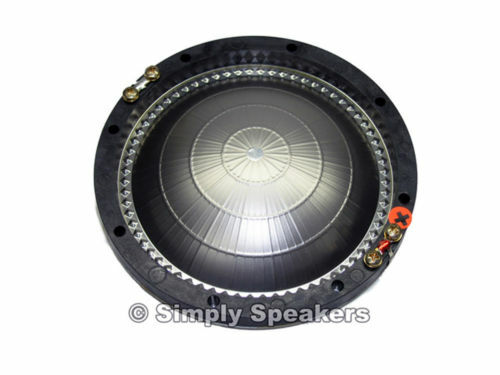
The 2450 uses a 4-inch titanium diaphragm, a dome stiff enough to stay pistonic well into the high frequencies and light enough to keep up with transients. Titanium was JBL's material of choice for this generation of professional drivers. It offered a stiffness-to-mass ratio that aluminum couldn't quite match, and it held up to touring duty. The voice coil is a 2-inch copper ribbon, edge-wound for maximum copper fill in the magnetic gap. More conductor in the gap means better heat dissipation and higher power handling. The moving mass is 3.0 grams, with a compliance of 0.033 mm/N. Those numbers explain how the driver keeps up with a 500 Hz crossover point without strain.
Neodymium Ring Magnet with "Coherent Wave" Phasing Plug
JBL's own marketing material, which ran in Mix Magazine (1989, p.4), said plainly that neodymium was expensive and heat-sensitive when it first appeared in the lab. The company had to solve both problems before the material could power a production driver. The result was a magnet that's dramatically lighter and stronger than the Alnico it replaced, and it let JBL shrink the overall package. As the same Mix (1989, p.4) ad noted, the 2450's smaller size means tighter spacing of horn arrays, which helps when you're flying a line array or packing a tour rack. The flux density is 1.85 tesla, and the BL product is 14.8 T·m, a lot for a 4-inch diaphragm.
The "Coherent Wave" phasing plug is JBL's term for the shaped plug that sits in front of the diaphragm and makes the sound waves arrive at the throat in phase. Get the phasing wrong and you get comb filtering and response peaks that make a driver sound harsh and strained. Get it right and you get the smooth, extended response the 2450 is known for.
Shared 2440/2441 Frame and Magnet Assembly
The 2450 series didn't start from a blank sheet of paper. According to the Lansing Heritage database, the 2450H/J/K/L drivers were built on the 2440/2441 frame and magnet assembly, a design in service since the 1970s and proven in countless professional applications. That cuts both ways. The 2450 inherits the mechanical reliability of a driver that had been around for two decades. It's also physically a large driver, and it needs a horn with a compatible throat and bolt pattern. It isn't a drop-in replacement for a smaller format driver.
Historical Context
The 2440 driver the 2450 is built upon was a well-known workhorse from the 1970s, a staple of studio monitors and cinema sound systems. By the late 1980s, JBL was pushing into neodymium, a rare-earth compound that, as the company's own advertising in Studio Sound (1990, p.116) explained, had to overcome high cost and heat sensitivity first. The 2450 traded the massive Alnico magnets of the past for something smaller, lighter, and stronger.
By 1989, JBL was rolling out a wave of new professional products. The company's ads in Mix (1989, p.124) touted new woofers alongside the 2450. The same Mix piece reported that several sound companies had told JBL the 2450 was "definitely worth checking out." The 2450 series was sometimes referred to as a "professional" series driver, used in JBL Professional products. It was built for the touring rack, the cinema booth, and the installed sound system.
Collectibility & Value
Finding a pair of 2450s today takes patience, but they do surface. A 2011 listing on US Audio Mart asked $450 for a pair of 2450J drivers, which the seller described as "very rare." The condition notes from that listing read "cosmetically they are in excellent shape, original boxes included" and "magnets are strong and the diaphragms are perfect." The diaphragm is the part that wears out on a compression driver, and a 4-inch titanium diaphragm isn't something you can pick up at your local electronics store.
Owners report that the 2450 has the classic JBL sound - forward and present, with the "West Coast" voicing that made the brand famous. One Audiokarma member described them as "bright and forward" with a particular crossover, while another noted they "work well" when crossed at 800 Hz with a 12 dB/octave slope. JBL's own engineering data recommends a minimum 12 dB/octave slope when used in a 2-driver system crossed at 800 Hz. Push it lower or use a gentler slope and, as one owner put it, "it will sound harsh."
If you're considering a pair, factor in the cost of horns and crossovers. The 2450 is a driver, not a complete speaker. As with any vintage compression driver, check the diaphragms before you commit. A perfect pair with original boxes at $450 is a fair deal. A pair with blown diaphragms is a parts project.
eBay Listings


As an eBay Partner, we earn from qualifying purchases. This helps support our independent vintage technology research.