JBL 2445J
A two-inch-throat compression driver heavy enough to anchor a workbench, and the reason so many theater and touring rigs from the eighties still sound like they mean it.
Overview
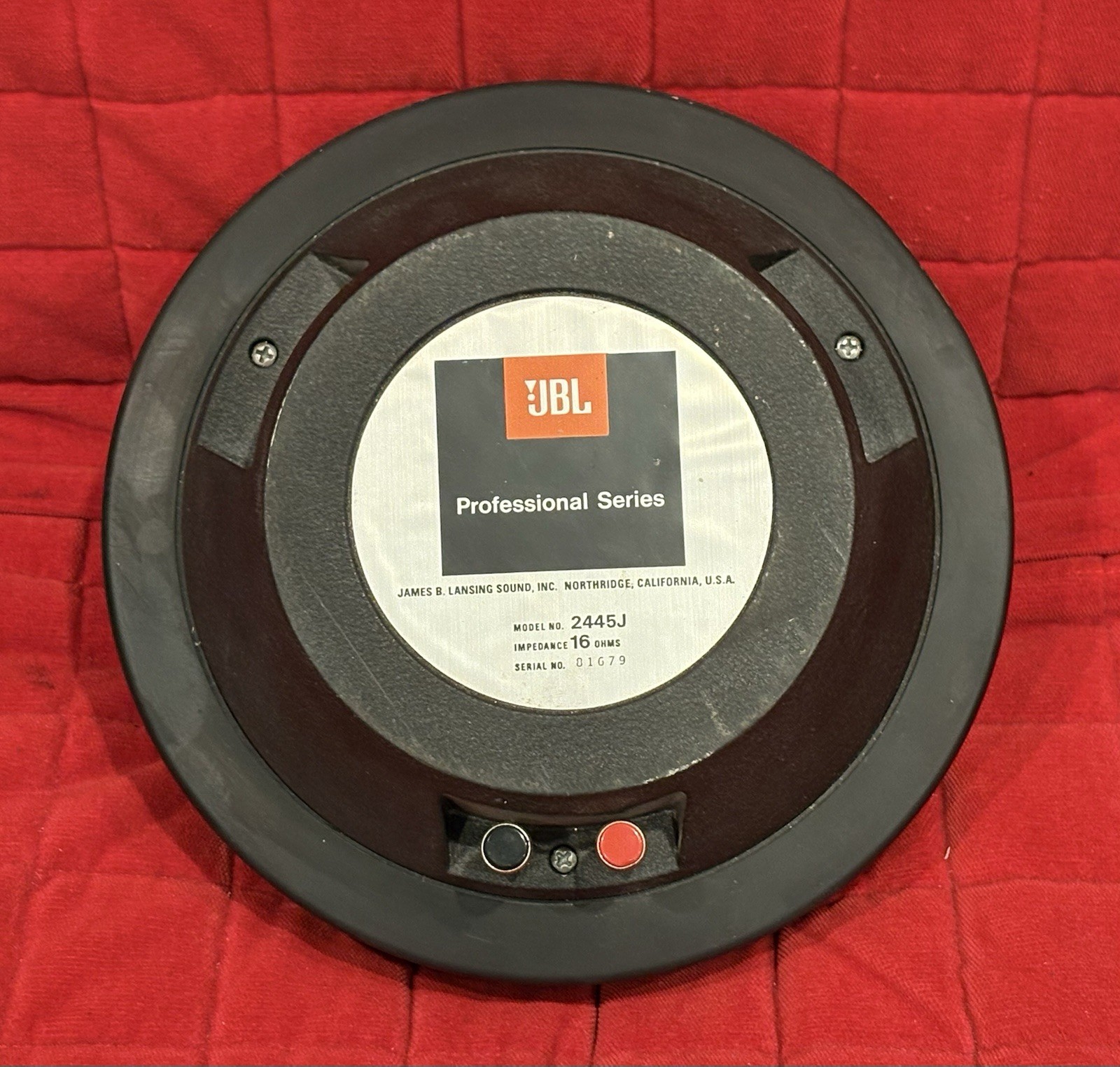
Pick one up and the first thing you notice is the mass. At 13.8 kg, the 2445J is not a component you swap casually between cabinets. It is a cast-and-machined lump of ceramic-magnet motor that JBL built to sit behind a two-inch horn and stay there for decades. The figure comes from an academic comparison of compression drivers that used the 2445J as a reference point alongside an Altec 290 and a neodymium-boron prototype JBL was developing at the time. In that same table, the 2445J's moving mass is listed at 0.015 kg, its voice coil diameter at 9.98 cm, its voice coil DC resistance at 7.1 Ω, and its magnetic induction at 1.97 Tesla. The Bl product, the motor's driving force figure, works out to 18.5 N/A. That adds up to a four-inch voice coil, a substantial ceramic magnet structure, and a throat section long enough that the researchers measuring it flagged it as excess weight for their own application.
The throat geometry tells you where the 2445J fits. It is a two-inch-throat compression driver. The reference chart of JBL professional components places it in the 2400-series, and its gap gauge specification of .036 inch groups it with the 375, 376, 2440, and 2441. That is useful for anyone doing diaphragm work: the 2445J shares its gap dimension with those earlier large-format drivers, which tells a technician something about the tolerances before they ever open the back cap. The diaphragm itself is titanium. According to the same research document, the neodymium prototype JBL built for that project accepted the identical voice coils as the 2445J - four-inch diameter, aluminum wire, titanium suspension and diaphragm. So the consumable parts that matter most are shared across JBL's large-format driver family of that period.
The 2445J lived inside JBL's professional sound reinforcement and cinema systems. The April 1989 JBL component listing shows it turning up again and again across the theater and concert lines. The 4670B two-way system paired it with a pair of 2225H woofers behind a 2380A Bi-Radial horn. The 4673 used a single 2225H with the same 2380A/2445J combination. The 4674A and 4675A both specified it. The 4676B-1 and 4676B-2 used it with the larger 2360A and 2365A horns respectively. In the 4800 Concert Series it appeared in the 4850, 4851, 4852, and 4853 columns, in the 4860 through 4866 road cabinets, and across the 4870/4871/4872/4873 full-range boxes. The 4900 series packaged systems drew on it as well. It was one of the workhorses JBL specified when a system needed to get loud and stay intelligible in a room the size of a small aircraft hangar.
The horn pairings show the intended coverage. The 2380A is a smaller two-inch-throat flat-front Bi-Radial with 90 by 40 degree dispersion. The 2385A is the same format at 60 by 40, and the 2386 is the tight 40 by 20 version. The 2360A and 2365A are the larger-format Bi-Radials at 90x40 and 60x40. Pairing a 2445J with those horns was how JBL built systems with predictable pattern control. The driver feeds a well-defined wavefront into a horn that then aims it. The 2395 slant-plate horn/lens is listed in the same 1989 document as specifically intended for the 2445J, and the 2390 serpentine lens horn is noted as a two-inch driver option as well. A 3105 passive crossover - 7000 Hz, 70 W, designed for the 2426J or 2445J feeding a 2402H, 2404H, or 2405H - was the standard way to add a UHF ring radiator on top of a 2445J-based two-way.
The academic comparison is candid about the driver's strengths and compromises. The 2445J's Bl/Rm ratio, a rough efficiency indicator combining motor force against mechanical resistance, is listed at 1230 m/Coul-kg. That is notably higher than the Altec 290's 510 but lower than the neodymium prototype's 1410. Its moving mass is essentially identical to the Altec at 0.015 kg, but its voice coil is substantially larger at 9.98 cm versus 7.22 cm. The mechanical resistance figure of approximately 1.0 kg/s sits between the two competitors. The document also notes that the 2445J's throat section adds weight that a purpose-built driver could eliminate, which is exactly what JBL did when it agreed to build the neodymium 2450J variant for that research project.
The JBL professional catalog material from the late eighties shows the driver as an active, current component. The component listing is dated April 20, 1989, and the 2445J appears throughout as a specified part rather than an obsolete one. Several of the horns it mated to (the 2390, 2395, and 2397) are flagged as obsolete in the same document. That gives a rough sense of the production window: the driver was still being specified in systems as of that April 1989 listing, even as some of its companion horns were being phased out.
Sound & Communication (January 1988, p.32) published a JBL Professional component price list that included the smaller 2402H ring radiator at $165.00 and the 2404H Bi-Radial tweeter, confirming that JBL's professional driver line was actively marketed through dealer channels in that period. The 2445J itself does not appear with a listed price in the available chunks, but the presence of its companion drivers in a published price list is a useful marker of how the line was sold — as individual components to system builders, not just as finished boxes.
What does the 2445J sound like? It sounds like whatever horn you bolt it to. A 2445J on a 2380A is a different animal from the same driver on a 2360A, and both are different again from the 2395 slant-plate. The driver's contribution is a low-distortion, high-output midrange and lower-treble foundation with enough headroom to be crossed over relatively low - 500 Hz in several of the theater systems, using the 3115A or 3160 network. That is low for a two-inch driver, and it is why the 2445J was the go-to choice for systems that needed to cover the vocal range with a single horn-loaded source rather than a multi-way stack.
Know the maintenance picture before buying one. The gap gauge spec of .036 inch is specific to the 2445J, and the titanium diaphragm assemblies that fit it are the same ones used across the large-format family. The 1989 JBL service document notes that older compression drivers can have narrow gap top plates that will not accept current diaphragms without factory modification. The available material does not say whether the 2445J falls into that category, so check before ordering a replacement diaphragm. The driver is heavy enough that shipping costs are a real factor, and the ceramic magnet structure is not something you want to drop. These are not fragile components in normal use, but they are not light, and they are not cheap to ship.
Collectibility for the 2445J is tied almost entirely to the systems it lived in. Complete 4670B, 4673, 4675A, and 4870-series cabinets still turn up, and the drivers inside them are often the most valuable single components. Buyers looking to restore a theater system or build a large-format home rig frequently seek out the 2445J because it is the two-inch driver that mates with the widest range of JBL horns from that era. The 2441 and 2440 are the earlier large-format drivers with the same .036 gap. The 2445J is the later ceramic version that stayed in production through the period when JBL was transitioning toward neodymium. That makes it late ceramic, still current in 1989, and still specified in new systems.
The 2445J is not a pretty component. It is a heavy, functional, slightly overbuilt piece of American professional audio engineering, and the fact that JBL's own researchers noted the excess throat weight while still using the driver as a benchmark tells you something about how seriously it was taken. If you find one at a reasonable price, the question is not whether it works — it is whether you have a horn, a crossover, and a cabinet heavy enough to do it justice.
eBay Listings


As an eBay Partner, we earn from qualifying purchases. This helps support our independent vintage technology research.