Infinity SL-40: The Compact Electrostatic Statement
In the early 1980s, as high-end audio began embracing more exotic transducer technologies, Infinity Systems—already renowned for its innovative speaker designs—introduced the SL-40, a compact electrostatic loudspeaker that offered a taste of high-resolution, low-distortion sound in a more accessible format. While not as large or imposing as its flagship ES-1 or the legendary IRS series, the SL-40 carved out a niche among audiophiles seeking the unique sonic signature of electrostatics without the spatial or financial commitment of full-sized panels.
The SL-40 arrived during a golden era for electrostatic speaker development. Companies like Quad, MartinLogan, and Acoustat were pushing the boundaries of planar sound reproduction, and Infinity—co-founded by loudspeaker pioneers Arnold Schwarz and Benjamin B. Olney—was no stranger to advanced driver technology. The SL-40 was part of Infinity’s Electrostatic Series, designed to bring the clarity and transparency of electrostatic design to a broader audience.
Though not a full-range electrostat (it relied on a conventional dynamic woofer for bass), the SL-40 combined a dipole electrostatic panel for midrange and treble with a ported bass enclosure, creating a hybrid system that balanced the best of both worlds: the speed and precision of electrostatics with the low-end authority of cone drivers.
Technical Specifications
| Specification | Detail |
| Type | Hybrid electrostatic / dynamic speaker |
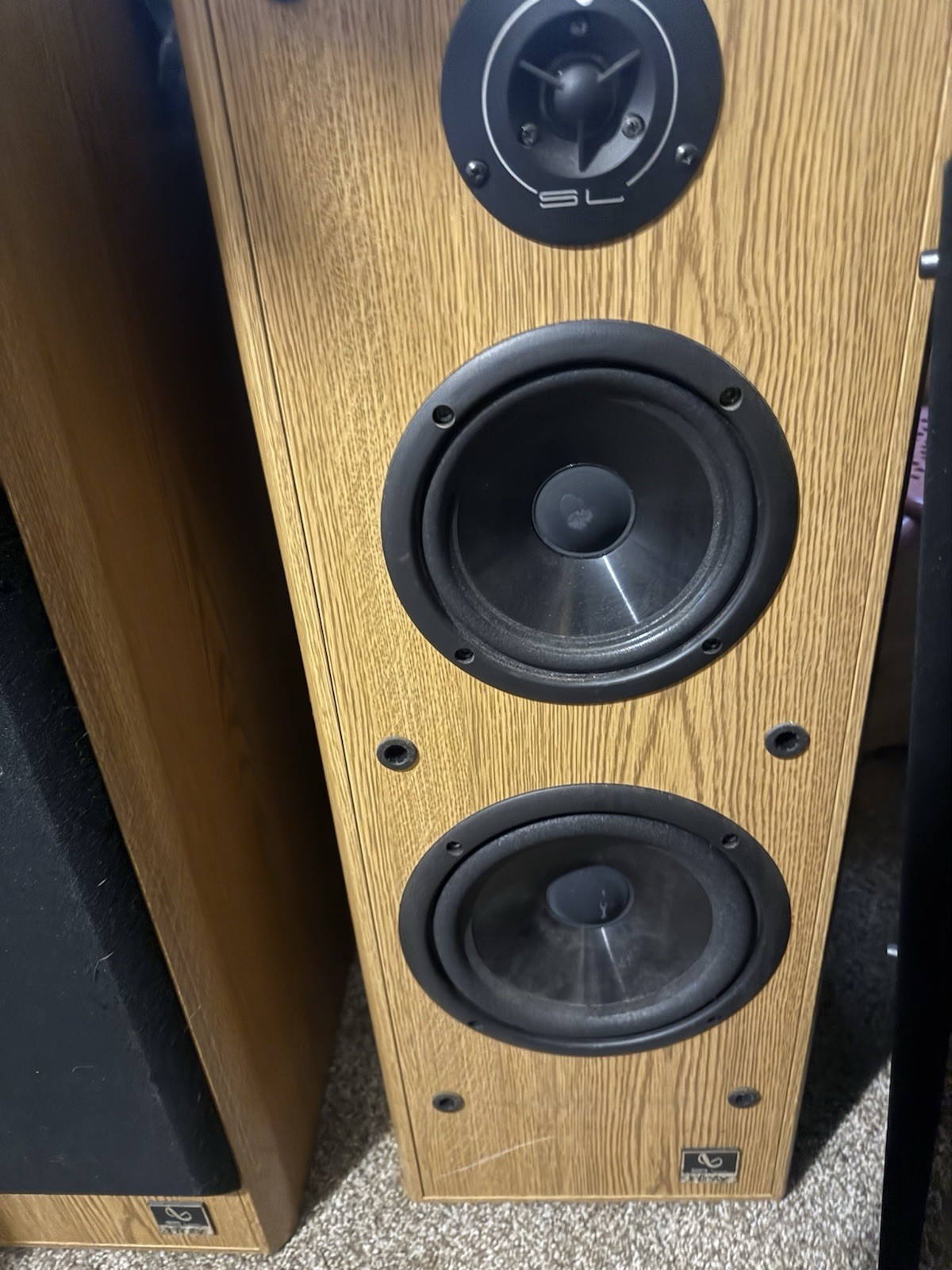
| Driver Configuration | 1 x electrostatic panel (mid-treble), 1 x 8" dynamic woofer |
| Frequency Response | 45 Hz – 20 kHz (±3 dB) |
| Crossover Frequency | 450 Hz (electrostatic to woofer) |
| Impedance | 8 ohms (nominal) |
| Sensitivity | 86 dB (2.83V/1m) |
| Recommended Amp Power | 20–100 watts |
| Enclosure Type | Ported bass cabinet with dipole panel |
| Dimensions (H×W×D) | 42" × 16" × 8" (each) |
| Weight | 45 lbs (20.4 kg) per speaker |
| Finish Options | Black ash vinyl, walnut veneer |
The electrostatic panel used a thin, conductive diaphragm suspended between perforated metal stators, charged with a high-voltage bias (supplied by an internal power supply). This design enabled near-massless movement, resulting in exceptionally low distortion and rapid transient response. The 8-inch woofer in a bass-reflex enclosure handled frequencies below 450 Hz, ensuring the SL-40 could deliver room-filling bass without requiring external subwoofers in modestly sized listening spaces.
Sound Characteristics and Performance
The Infinity SL-40 is best known for its ethereal midrange clarity and pinpoint stereo imaging—hallmarks of electrostatic design. The panel’s dipole radiation pattern produces a spacious, open soundstage with minimal cabinet coloration. Vocals and acoustic instruments are rendered with startling realism, and the absence of cone breakup in the mid-treble range eliminates harshness, even at high volumes.
Treble extension is smooth and detailed, avoiding the "etched" quality sometimes found in early dome tweeters. The electrostatic panel disperses high frequencies in a controlled, vertical line source pattern, which enhances vertical dispersion while maintaining tight horizontal focus—ideal for creating a stable phantom center image.
The dynamic woofer, while competent, is the system’s most conventional element. Bass is tight and well-defined but not overly deep or powerful. In rooms larger than 200 square feet, the SL-40 may benefit from a subwoofer for full orchestral or electronic music. However, for jazz, vocals, and chamber music, the bass integration is generally seamless, thanks to a well-executed crossover and time-aligned drivers.
One of the SL-40’s most praised qualities is its low distortion, especially in the critical midrange. Electrostatics inherently produce lower harmonic and intermodulation distortion than dynamic drivers, and the SL-40 delivers on this promise with a "see-through" transparency that reveals subtle recording details often masked by conventional speakers.
Notable Features and Innovations
The SL-40 stood out for several reasons:
- Hybrid Design Philosophy: At a time when full-range electrostats were expensive and room-hungry, the SL-40 offered a practical compromise. The integration of a dynamic woofer allowed for smaller panel size and lower cost while preserving electrostatic virtues in the critical midrange.
- Built-in Bias Supply: Unlike some electrostatics that required external power supplies or high-voltage generators, the SL-40 housed its bias supply internally, simplifying setup and reducing clutter.
- Time-Aligned Crossover: Infinity paid attention to phase coherence, aligning the acoustic centers of the panel and woofer to minimize time smearing and improve imaging accuracy.
- Stylish, Low-Profile Aesthetics: With a tall, narrow profile and minimalist grille, the SL-40 was visually striking without dominating a room. The walnut and black ash finishes gave it a premium look that complemented 1980s hi-fi furniture.
- Dipole Radiation: The open-back panel design created a natural, room-filling sound but required careful placement—ideally at least 3 feet from rear walls to avoid bass cancellation.
Common Issues and Maintenance
Like all vintage electrostatics, the SL-40 requires some attention to remain in top condition:
- Diaphragm Sag or Damage: Over decades, the ultra-thin Mylar diaphragm can develop wrinkles or tears, especially if exposed to high humidity or physical contact. A sagging panel produces uneven frequency response and distortion.
- Stator Corrosion: The perforated metal stators can corrode in humid environments, leading to arcing or "crackling" sounds. Cleaning with electronic contact cleaner and a soft brush can help, but severe corrosion may require professional re-lacing.
- Bias Supply Failure: The internal high-voltage power supply (typically generating 1–2 kV) can fail over time. Symptoms include weak output, lack of treble, or complete silence from the panel. Replacement capacitors or full supply rebuilds are sometimes necessary.
- Woofer Aging: The 8-inch woofer’s surround may dry out and disintegrate after 30+ years. Re-foaming or reconing is a common restoration step.
Owners are advised to keep the speakers in dry, climate-controlled environments and to avoid placing them where pets or children might touch the panels. Regular dusting with a soft brush or electrostatic-safe cloth is recommended.
Current Market Value and Collectibility
The Infinity SL-40 is not as widely collected as the Quad ESL-57 or MartinLogan Monolith, but it holds a loyal following among vintage electrostatic enthusiasts. Well-maintained pairs typically sell for $400–$800 in today’s market, depending on condition, finish, and whether they’ve been restored.
Fully refurbished units—especially those with re-laced panels and rebuilt bias supplies—can command higher prices, particularly if paired with original documentation or stands. While not a "blue chip" collectible, the SL-40 is increasingly recognized for its historical significance as one of the few hybrid electrostatics from a major American brand.
Its relative rarity (compared to Quads or early MartinLogans) and unique blend of engineering make it a rewarding project for DIY-savvy audiophiles.
Conclusion and Legacy
The Infinity SL-40 may not have achieved the legendary status of its larger siblings, but it remains an important chapter in the evolution of electrostatic loudspeakers. It demonstrated that high-resolution, low-distortion sound didn’t require massive panels or six-figure price tags. By combining electrostatic clarity with practical bass performance, the SL-40 offered a compelling entry point into planar sound.
Today, it stands as a testament to Infinity’s engineering ambition during the 1980s—a time when speaker design was rapidly evolving, and the pursuit of sonic purity led to bold, innovative forms. For the listener who values transparency, imaging, and a touch of vintage flair, the SL-40 remains a quietly impressive performer.
If you’re exploring the world of vintage electrostatics, the Infinity SL-40 deserves a listen. It may just surprise you with its grace, detail, and timeless elegance.
eBay Listings



As an eBay Partner, we earn from qualifying purchases. This helps support our independent vintage technology research.
Related Models
- Infinity RS-1B (1975)
- Infinity SM-102 (1979)
- Infinity SM-125 (1975)
- Infinity RS-6 (1976)
- Infinity SM-112 (1975)
- Akai AM-2850 (1975)
- Akai AP-206 (1975)
- Nakamichi BX-1 (1985)
- Acoustic Research research-ar-17 (1978)
- Acoustic Research AR-19 (1994)