Infinity SL-30: Compact Precision from the Golden Era of Hi-Fi
The Infinity SL-30, introduced in the late 1970s, stands as a testament to Infinity’s early commitment to innovative loudspeaker design and accessible high-fidelity sound. While not as widely celebrated as the company’s flagship IRS or Beta series, the SL-30 carved out a loyal following among audiophiles seeking a compact, accurate-sounding speaker with the engineering pedigree of a high-end brand. As a bookshelf model released during a period of rapid advancement in speaker technology, the SL-30 reflects Infinity’s signature approach—particularly its use of Controlled Dispersion Sound (CDSTM) waveguides and high-efficiency driver design.
Historical Context and Design Philosophy
Infinity, founded in 1968 by Arnie Nudell and Cary Christie, quickly gained a reputation for boundary-pushing speaker systems that combined advanced materials, precision engineering, and novel acoustic concepts. By the late 1970s, the company was already known for its servo-controlled subwoofers and large floor-standing models. The SL-30 emerged as part of Infinity’s effort to bring some of that innovation into a more compact, affordable format suitable for smaller listening environments.
The SL-30 was positioned as a high-performance bookshelf speaker, ideal for nearfield listening, desktop setups, or secondary systems where space was limited. Despite its modest size, it was engineered to deliver a balanced, detailed sound with excellent dispersion characteristics—thanks largely to Infinity’s proprietary CDSTM horn-loaded tweeter design. This technology, first introduced in the early 1970s, was designed to control high-frequency dispersion, reducing room reflections and improving imaging and clarity.
Technical Specifications
| Specification | Detail |
| Model | SL-30 |
| Manufacturer | Infinity (US) |
| Year Introduced | 1978 |
| Type | 2-way bookshelf speaker |
| Driver Configuration | 1 x 5.25" mid-bass, 1 x 1" CDSTM tweeter |
| Frequency Response | 60 Hz – 20 kHz (±3 dB) |
| Sensitivity | 89 dB (2.83V/1m) |
| Nominal Impedance | 8 ohms (compatible with most receivers) |
| Crossover Frequency | ~3.5 kHz |
| Enclosure Type | Sealed (acoustic suspension) |
| Dimensions (H×W×D) | 13" × 8" × 9.5" (33 × 20.3 × 24.1 cm) |
| Weight | 18 lbs (8.2 kg) per speaker |
| Finish Options | Walnut vinyl, black ash |
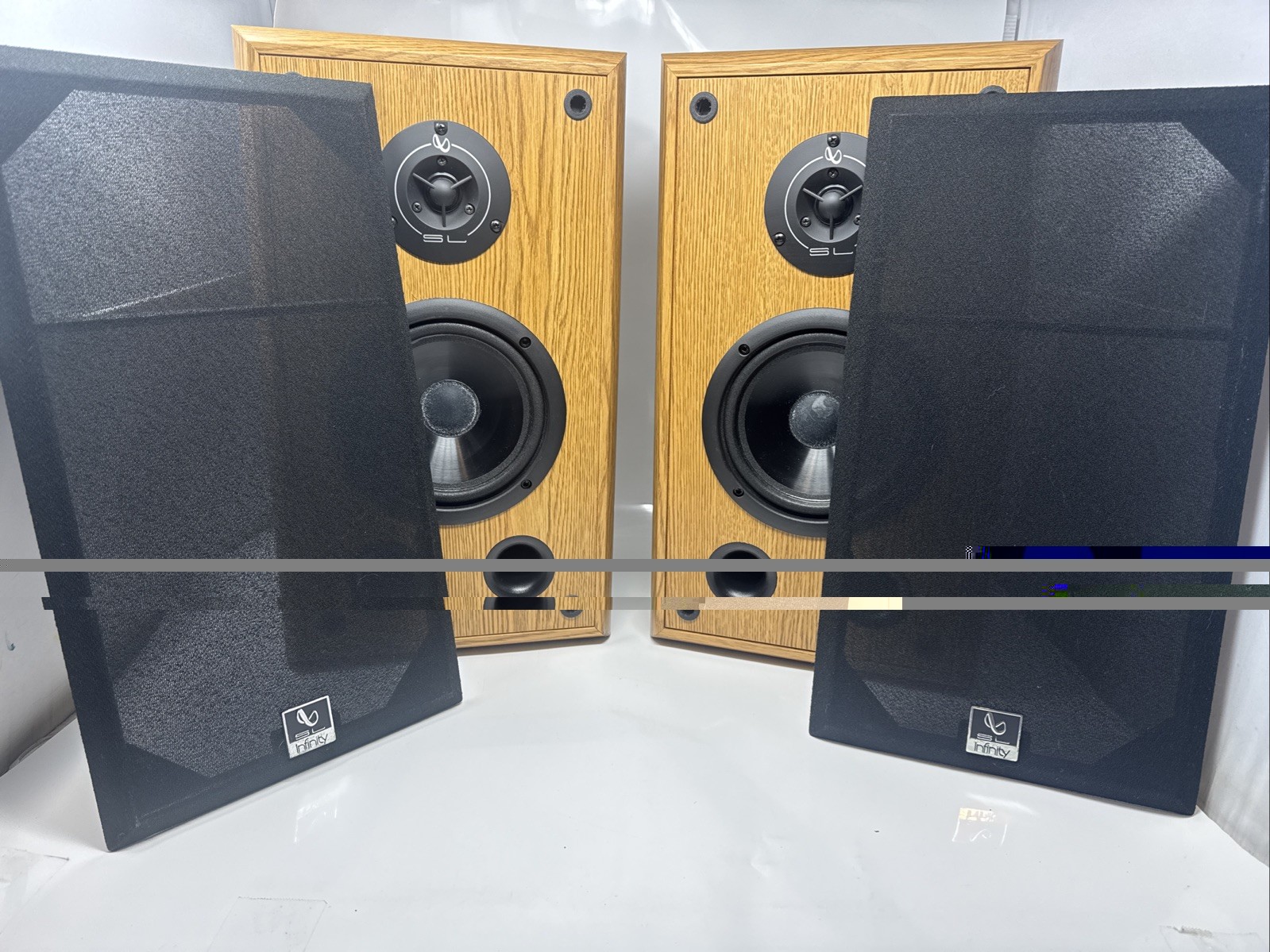
The SL-30 features a 5.25-inch woven fiberglass cone mid-bass driver, chosen for its rigidity and low distortion. Paired with the horn-loaded CDSTM tweeter, this configuration delivers a smooth transition between drivers and a surprisingly wide sweet spot. The sealed enclosure design ensures tight, accurate bass response—though not deep extension—making the SL-30 well-suited to pairing with a subwoofer in full-range systems.
Sound Characteristics and Performance
The Infinity SL-30 is best described as a transparent, articulate speaker with a neutral tonal balance. Its CDSTM tweeter provides a clean, extended high end without the harshness sometimes associated with early dome tweeters. The dispersion control ensures that high frequencies are focused toward the listener, minimizing ceiling and wall reflections that can cloud imaging.
Midrange clarity is a standout feature. Vocals and acoustic instruments are rendered with lifelike presence and detail, making the SL-30 an excellent choice for jazz, classical, and vocal-centric recordings. The mid-bass driver handles transients with agility, though bass extension is limited by the small cabinet size—expect usable output down to around 60 Hz, with a gradual roll-off below that.
With a sensitivity of 89 dB, the SL-30 is relatively easy to drive and pairs well with low-to-mid-powered tube or solid-state amplifiers. Its 8-ohm impedance makes it compatible with most vintage receivers from the 1970s and 1980s, including models from Marantz, Pioneer, and Sansui.
Notable Features and Innovations
The defining feature of the SL-30 is its CDSTM (Controlled Dispersion Sound) tweeter. Unlike conventional dome tweeters, the CDSTM design uses a small horn-like waveguide to control the dispersion pattern of high frequencies. This innovation was originally developed to improve the coherence and imaging of large speaker systems, but Infinity successfully miniaturized it for compact models like the SL-30.
Other notable aspects include:
- High-efficiency design for excellent performance with low-power amplifiers
- Rigid MDF cabinet with internal bracing to reduce resonance
- Low-distortion driver materials, including the fiberglass cone and ferrofluid-cooled tweeter
- Simple, elegant crossover with high-quality components for its era
The SL-30 also features a minimalist front baffle with flush-mounted drivers, contributing to a clean aesthetic and reduced diffraction effects.
Common Issues and Maintenance
As with any vintage speaker, the Infinity SL-30 may require maintenance after decades of use. Common issues include:
- Aging foam surrounds on the mid-bass driver, which can dry out and crumble over time. Replacement with modern rubber or foam surrounds is a common and effective restoration.
- Tweeter degradation, though the CDSTM units are generally robust. If the tweeter sounds dull or distorted, it may need refoaming or replacement.
- Crossover component drift, particularly in capacitors, which can affect tonal balance. Recapping with modern film capacitors can restore original performance.
- Cabinet wear, especially on the vinyl veneer. While not structural, refinishing or veneer repair can improve appearance.
Finding original replacement parts can be challenging, but the SL-30’s driver sizes and design are similar to other Infinity models of the era, allowing for some cross-compatibility. DIY speaker enthusiasts often report success restoring SL-30s to like-new condition.
Current Market Value and Collectibility
The Infinity SL-30 is not a highly sought-after collector’s item like the IRS V or Beta series, but it maintains a quiet reputation among vintage audio enthusiasts. Pairs in good working condition typically sell for $150–$300, depending on cosmetic condition and whether they’ve been restored.
Their value lies more in performance than rarity. For listeners building a vintage desktop system or looking for compact speakers with authentic 1970s engineering, the SL-30 offers excellent value. They’re particularly popular in retro-modern setups, where their vintage sound is paired with modern DACs and amplifiers.
While not a “blue chip” vintage speaker, the SL-30 is appreciated for its build quality, innovative tweeter design, and balanced sonic character—qualities that continue to resonate with discerning listeners.
Conclusion and Legacy
The Infinity SL-30 may not have the star power of Infinity’s flagship models, but it embodies the brand’s core values: innovation, precision, and a commitment to accurate sound reproduction. As a compact speaker from the late 1970s, it delivers performance that belies its size, thanks to thoughtful engineering and the unique CDSTM tweeter.
Today, the SL-30 serves as a reminder that high-fidelity audio doesn’t always require large cabinets or massive price tags. For vintage audio enthusiasts, it represents a smart, understated choice—a speaker that prioritizes clarity and coherence over sheer power. Restored and properly paired, the SL-30 remains a compelling option for those who appreciate the craftsmanship of a bygone era, and a fine example of Infinity’s enduring influence on loudspeaker design.
eBay Listings



As an eBay Partner, we earn from qualifying purchases. This helps support our independent vintage technology research.
Related Models
- Infinity RS-1B (1975)
- Infinity SM-102 (1979)
- Infinity SM-125 (1975)
- Infinity RS-6 (1976)
- Infinity SM-112 (1975)
- Akai AM-2850 (1975)
- Akai AP-206 (1975)
- Nakamichi BX-1 (1985)
- Acoustic Research research-ar-17 (1978)
- Acoustic Research AR-19 (1994)