Infinity SERVO-STATIK-1A: The Pioneering Hybrid Electrostatic Loudspeaker
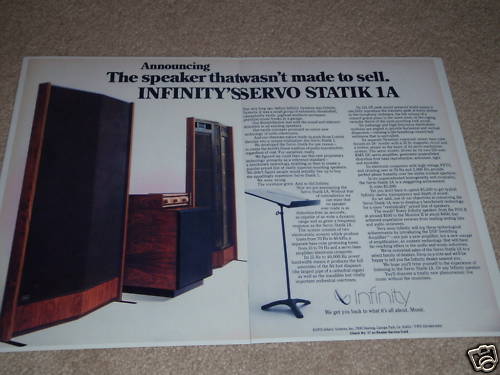
The Infinity SERVO-STATIK-1A, introduced in 1968 by the fledgling but visionary company Infinity Systems (founded by Arnie Nudell and Cary Christie), stands as a landmark achievement in loudspeaker design. More than just a speaker, it was a bold statement of engineering ambition—a hybrid electrostatic/dynamic loudspeaker that pushed the boundaries of what was possible in home audio at the time. As one of the first commercially available speakers to combine electrostatic midrange and treble reproduction with a servo-controlled dynamic woofer, the SERVO-STATIK-1A laid the groundwork for Infinity’s reputation as an innovator and helped redefine high-fidelity sound reproduction in the late 1960s and 1970s.
At a time when most high-end speakers relied on conventional cone drivers and passive crossovers, the SERVO-STATIK-1A introduced radical concepts borrowed from laboratory-grade audio research. Its design addressed two persistent challenges in speaker engineering: the limited bass extension and distortion of early electrostatics, and the phase and dispersion inconsistencies of traditional dynamic speakers. By integrating a large electrostatic panel with a servo-driven woofer system, Infinity created a speaker that offered both the transparency of electrostatics and the authority of dynamic bass—ushering in a new era of hybrid loudspeaker development.
Technical Specifications
| Specification | Detail |
| Model | SERVO-STATIK-1A |
| Manufacturer | Infinity Systems |
| Year Introduced | 1968 |
| Type | 3-way hybrid (electrostatic/dynamic) |
| Frequency Response | 30 Hz – 18 kHz |
| Crossover Points | 400 Hz (woofer to midrange), 4 kHz (midrange to tweeter) |
| Electrostatic Panel | Full-range electrostatic transducer for midrange and treble |
| Woofer | 12-inch dynamic cone driver with servo feedback control |
| Servo System | Feedback loop monitoring cone movement for reduced distortion |
| Sensitivity | 86 dB (1W/1m) |
| Nominal Impedance | 8 ohms (compatible with most tube and solid-state amplifiers) |
| Recommended Amplifier | 20–100 watts |
| Crossover Type | Passive, with active servo circuit for woofer |
| Dimensions (H×W×D) | 48" × 24" × 10" (122 × 61 × 25 cm) |
| Weight | 75 lbs (34 kg) |
| Finish Options | Walnut veneer cabinet with white electrostatic panel |
Sound Characteristics and Performance
The sonic signature of the SERVO-STATIK-1A was unlike anything available at the time. The large electrostatic panel delivered an exceptionally clear, detailed, and spacious midrange and high-frequency response. Listeners were immediately struck by the panel’s speed, low distortion, and lack of resonance—qualities that gave vocals and acoustic instruments a lifelike presence. The panel’s dipole radiation pattern produced a wide, open soundstage with excellent imaging, though it required careful room placement to manage bass reinforcement and rear-wall reflections.
The real breakthrough, however, was in the bass. Unlike traditional electrostatics (such as the Quad ESL-57), which struggled with deep bass output and required large panels, the SERVO-STATIK-1A employed a 12-inch dynamic woofer with a closed-box design and, most importantly, a servo feedback system. This system used a sensor (typically a coil or accelerometer) to monitor the actual movement of the woofer cone and compared it to the input signal. Any deviation—indicative of distortion or lag—was corrected in real time by the amplifier circuit. This servo control dramatically reduced harmonic and intermodulation distortion, particularly in the critical lower midrange and bass, resulting in tight, articulate, and dynamic low-end performance.
The integration between the electrostatic panel and the woofer was not seamless by modern standards—some listeners noted a slight discontinuity in tonal balance around the 400 Hz crossover—but the overall coherence was impressive for its era. With sufficient amplifier power and proper setup, the SERVO-STATIK-1A could deliver a dynamic, transparent, and emotionally engaging listening experience that few speakers of the time could match.
Notable Features and Innovations
The SERVO-STATIK-1A was packed with innovations that would influence loudspeaker design for decades:
- Servo-Controlled Bass: This was the speaker’s defining feature. By applying closed-loop feedback to the woofer, Infinity achieved unprecedented control over cone motion, minimizing distortion and improving transient response. This concept predated modern digital room correction and active speaker management by decades.
- Hybrid Electrostatic Design: While full-range electrostatics were known for their clarity, they were often weak in bass and fragile in construction. The SERVO-STATIK-1A sidestepped these limitations by using the electrostatic panel only for midrange and treble, leaving the bass to a robust dynamic driver.
- Modular Construction: The speaker was built in a large floor-standing cabinet with a sealed enclosure for the woofer and a dedicated chamber for the electrostatic panel. This minimized interaction between the two systems and improved overall performance.
- High Build Quality: Despite its experimental nature, the SERVO-STATIK-1A was built to last, with a real wood veneer cabinet, robust internal wiring, and high-quality passive components in the crossover.
Common Issues and Maintenance
Today, surviving SERVO-STATIK-1A units are rare and require careful attention to maintain:
- Electrostatic Panel Degradation: The stators and diaphragms in the electrostatic panel can deteriorate over time. Moisture, dust, and high voltage stress can lead to arcing, reduced output, or complete failure. Re-lacing or re-statoring is possible but requires specialized skills.
- Servo Circuit Failures: The analog servo circuitry, often built with discrete transistors and op-amps of the era, is prone to component drift and failure. Capacitors dry out, resistors drift, and transistors fail. Restoring the servo system often requires recalibration and replacement of obsolete parts.
- Woofer Condition: The original 12-inch woofer may suffer from surround disintegration or voice coil damage. Replacement parts are scarce, though some enthusiasts have successfully rebuilt or replaced the driver with modern equivalents.
- High Voltage Supply: The electrostatic panel requires a high-voltage bias supply (typically 1–2 kV). These power supplies can fail or become dangerous if not properly maintained. Safety precautions are essential when servicing.
Owners are advised to consult specialists in vintage electrostatic speakers for restoration. Due to the complexity, many units remain in storage or are used as display pieces.
Current Market Value and Collectibility
The Infinity SERVO-STATIK-1A is a highly collectible piece of audio history. Complete, working pairs in good condition can command $2,500 to $5,000 on the vintage audio market, with exceptional examples fetching more. Units that have been professionally restored—especially those with functional servo systems and healthy electrostatic panels—are particularly prized.
Collectors value the SERVO-STATIK-1A not just for its sound, but for its historical significance. It represents the first major success for Infinity and foreshadows later classics like the IRS V and the EMPIRE series. It also appeals to enthusiasts of electrostatic technology and early active speaker concepts.
Conclusion and Legacy
The Infinity SERVO-STATIK-1A was more than a speaker—it was a proof of concept that bold engineering could overcome the limitations of conventional design. By marrying electrostatic clarity with servo-controlled bass, Infinity created a speaker that was ahead of its time, influencing generations of high-end audio designers.
Though complex and challenging to maintain, the SERVO-STATIK-1A remains a symbol of innovation and ambition in the golden age of hi-fi. For collectors, restorers, and audio historians, it is a treasured artifact—a testament to the vision of Arnie Nudell and Cary Christie, and a pivotal step in the evolution of the modern loudspeaker.
eBay Listings
As an eBay Partner, we earn from qualifying purchases. This helps support our independent vintage technology research.
Related Models
- Infinity RS-1B (1975)
- Infinity SM-102 (1979)
- Infinity SM-125 (1975)
- Infinity RS-6 (1976)
- Infinity SM-112 (1975)
- Akai AM-2850 (1975)
- Akai AP-206 (1975)
- Nakamichi BX-1 (1985)
- Acoustic Research research-ar-17 (1978)
- Acoustic Research AR-19 (1994)