Infinity SERVO-STATIK-1 (1968): Pioneering Electrostatic Excellence
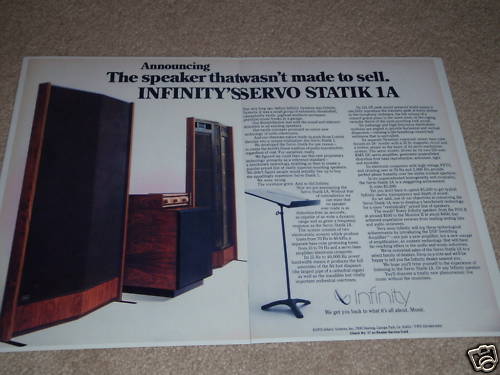
In the late 1960s, the high-fidelity audio landscape was ripe for innovation. Most loudspeakers relied on conventional dynamic drivers—paper cones and magnetic motors—but a handful of visionary engineers sought alternatives that could deliver greater clarity, transparency, and accuracy. Among them were Arnie Nudell and Cary Christie, two Southern California engineers whose garage experiments would give birth to Infinity Systems and one of the most groundbreaking loudspeakers of its era: the SERVO-STATIK-1, introduced in 1968.
Though not a receiver, amplifier, or turntable, the Infinity SERVO-STATIK-1 occupies a hallowed place in vintage audio history. As one of the first commercially available servo-controlled electrostatic loudspeakers, it represented a radical departure from traditional speaker design and set the stage for future innovations in both electrostatic and servo-assisted technologies.
A Revolutionary Concept
The SERVO-STATIK-1 was not a full-range electrostatic like the later Quad ESL or the Acoustat models. Instead, it combined two cutting-edge technologies in one system:
- A large electrostatic panel for midrange and high-frequency reproduction
- A servo-controlled dynamic woofer for bass response
This hybrid approach was revolutionary. The electrostatic panel offered the speed, low distortion, and near-perfect dispersion characteristics that electrostatics are prized for. Meanwhile, the bass section used a conventional 12-inch woofer, but with a critical twist: it was servo-controlled, meaning that a feedback loop monitored the actual movement of the cone and corrected errors in real time.
This servo mechanism was one of the SERVO-STATIK-1’s most significant innovations. By comparing the input signal to the actual cone position (via a sensing coil), the amplifier could adjust the drive signal to minimize distortion and improve transient response. The result was bass that was tighter, more accurate, and more articulate than almost any other speaker of its time.
Technical Specifications
| Specification | Detail |
| Model | SERVO-STATIK-1 |
| Manufacturer | Infinity Systems |
| Year Introduced | 1968 |
| Type | Hybrid electrostatic/dynamic loudspeaker |
| Frequency Response | 35 Hz – 18 kHz (±3 dB) |
| Crossover Type | Passive, 500 Hz |
| Electrostatic Panel | Large-area push-pull electrostatic transducer |
| Bass Driver | 12-inch dynamic woofer with servo feedback |
| Servo System | Closed-loop feedback via sensing coil |
| Impedance | Not applicable (active system with proprietary amp) |
| Power Handling | Not applicable (requires dedicated servo amplifier) |
| Sensitivity | ~86 dB (1W/1m) |
| Dimensions (H×W×D) | Approx. 72" × 24" × 20" |
| Weight | ~120 lbs each |
| Crossover Frequency | 500 Hz |
| Recommended Amplifier | Infinity Servo Statik Amplifier (matching active unit) |
The SERVO-STATIK-1 was not a passive speaker in the conventional sense. It required a dedicated servo amplifier—a separate chassis that housed both the power amp for the woofer and the high-voltage supply for the electrostatic panel. This amplifier also contained the feedback circuitry essential for the servo operation. As such, the system was sold as a matched pair: speakers plus control amplifier.
Sound Characteristics and Performance
The sonic signature of the SERVO-STATIK-1 was nothing short of revelatory in its time. Listeners were struck by the ethereal clarity of the electrostatic midrange and highs—voices and acoustic instruments seemed to float in space with uncanny realism. The panel’s dipole radiation pattern created a wide, open soundstage with excellent depth and imaging precision.
The bass, while not as deep or powerful as modern subwoofers, was remarkably tight and controlled for the era. The servo feedback drastically reduced cone excursion errors, minimizing the "one-note" bloat common in many 1960s bass systems. When properly set up, the SERVO-STATIK-1 delivered a level of bass articulation that few speakers could match—especially in small to medium-sized rooms.
Critics and early adopters praised the system for its low distortion, especially in the critical mid-bass region. The absence of port noise, cabinet resonances, and dynamic driver colorations contributed to a clean, transparent sound that appealed to purists and audiophiles alike.
Notable Features and Innovations
The SERVO-STATIK-1 was packed with forward-thinking engineering:
- Servo-Controlled Bass: The first commercially successful use of real-time cone position feedback in a consumer loudspeaker.
- Push-Pull Electrostatic Panel: Reduced even-order harmonic distortion and improved linearity.
- Active Crossover and Amplification: Allowed precise tuning and optimization of each driver.
- Modular Design: The system was engineered for serviceability and upgrades—a rarity in the 1960s.
Perhaps most importantly, the SERVO-STATIK-1 proved that exotic, laboratory-grade audio technologies could be commercialized. It helped establish Infinity as a serious player in the high-end audio world and paved the way for later models like the Servo Statik 3 and the legendary IRS (Infinity Reference Standard).
Common Issues and Maintenance
Today, the SERVO-STATIK-1 is a rare and prized collector’s item. However, owning one comes with challenges:
- Electrostatic Panel Degradation: Over time, the stators and diaphragms can deteriorate. Moisture, dust, and high voltage stress can lead to arcing or loss of tension in the diaphragm.
- Capacitor Aging: The high-voltage power supply and servo feedback circuits rely on capacitors that may have dried out or failed after 50+ years.
- Woofer Surrounds: The foam surrounds on the 12-inch drivers are likely perished and will need replacement.
- Amplifier Reliability: The original servo amplifiers contain discrete transistors and electrolytic capacitors that may require recapping or full restoration.
Finding original parts is difficult, but a small community of vintage Infinity enthusiasts and restorers exists. Some technicians specialize in refurbishing these systems, often replacing foam, recapping power supplies, and even rebuilding electrostatic panels using modern materials.
Due to the high voltages involved (up to 5,000 volts for the panel), only experienced technicians should service these speakers.
Current Market Value and Collectibility
The SERVO-STATIK-1 is extremely rare on the vintage market. Complete, working systems appear only occasionally on audiophile forums, eBay, or specialized vintage audio dealers. When they do, prices can range from $2,500 to $5,000 or more, depending on condition and completeness.
Collectors value the SERVO-STATIK-1 not just for its sound, but for its historical significance. It represents a bold experiment at the intersection of electrostatic and servo technologies—a precursor to modern active speakers and digital correction systems. For museums, audio historians, and serious vintage enthusiasts, it’s a landmark design.
Restored units with upgraded components (such as modern foam, improved caps, or reinforced panels) are often more desirable than untouched originals, which may be non-functional.
Conclusion: A Legacy of Innovation
The Infinity SERVO-STATIK-1 (1968) was never a mass-market product. It was expensive, complex, and demanding of care. But its impact on high-end audio was profound. It demonstrated that feedback control could improve loudspeaker performance, a concept that would later influence not only Infinity’s own products but also the development of active speakers, DSP correction, and even modern servo-subwoofers.
More than just a speaker, the SERVO-STATIK-1 was a statement of intent—a declaration that high fidelity could be achieved through innovation, not just incremental refinement. It embodied the spirit of the late 1960s: bold, experimental, and unafraid to challenge convention.
Today, the SERVO-STATIK-1 stands as a monument to analog ingenuity—a rare fusion of electrostatic elegance and servo precision that continues to inspire audiophiles and engineers alike. For those lucky enough to hear one in good condition, it’s not just a trip back in time—it’s a glimpse into the future of sound, as imagined over fifty years ago.
eBay Listings
As an eBay Partner, we earn from qualifying purchases. This helps support our independent vintage technology research.
Related Models
- Infinity RS-1B (1975)
- Infinity SM-102 (1979)
- Infinity SM-125 (1975)
- Infinity RS-6 (1976)
- Infinity SM-112 (1975)
- Akai AM-2850 (1975)
- Akai AP-206 (1975)
- Nakamichi BX-1 (1985)
- Acoustic Research research-ar-17 (1978)
- Acoustic Research AR-19 (1994)