Infinity RSM-REFERENCE-STUDIO-MONITOR: The Forgotten Reference Standard
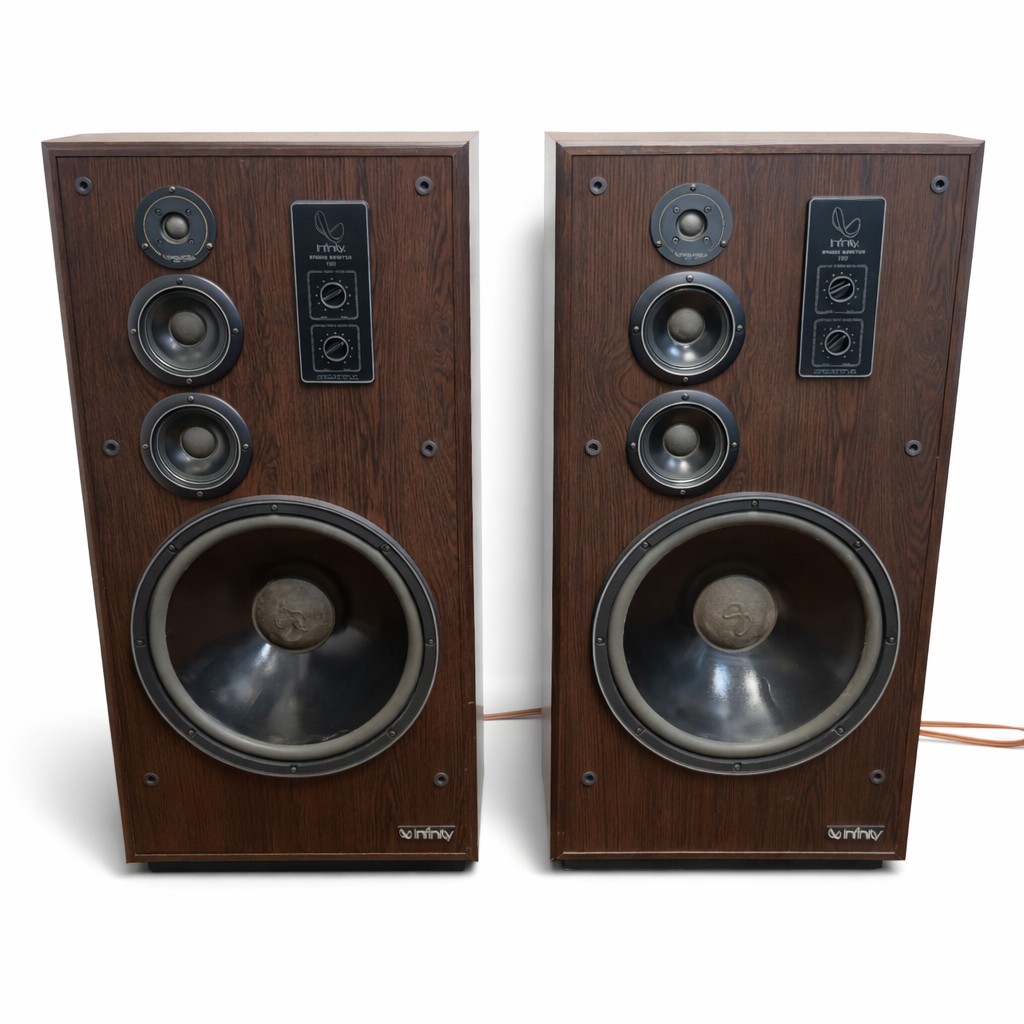
In the late 1970s, as the high-fidelity audio market surged with innovation and competition, Infinity Systems—already renowned for its groundbreaking speaker designs—introduced a model that stood apart in both ambition and engineering: the RSM-REFERENCE-STUDIO-MONITOR, often abbreviated as the RSM. Though not as widely recognized today as some of Infinity’s later models like the IRS or the Beta series, the RSM was a bold statement in the world of professional and high-end domestic audio. Designed as a no-compromise reference monitor, it combined studio-grade accuracy with audiophile refinement, making it a rare hybrid in an era when the lines between professional and consumer audio were more rigidly drawn.
A Legacy of Innovation
Infinity, founded in 1968 by Arnie Nudell and Cary Christie, had already disrupted the speaker world with its servo-controlled subwoofers and later, the revolutionary electromagnetic drive systems. By the late 1970s, the company was pushing the boundaries of what was possible in full-range sound reproduction. The RSM was developed during this golden period, embodying the company’s philosophy of achieving maximum acoustic output with minimal distortion.
The RSM was not intended for the mass market. Instead, it was positioned as a reference-grade monitor for recording studios, mastering engineers, and serious audiophiles who demanded absolute neutrality and transparency. Its design reflected a deep understanding of waveguide theory, cabinet resonance control, and driver integration—concepts that were still in their infancy in consumer audio.
Technical Specifications
| Specification | Detail |
| Model Name | RSM-REFERENCE-STUDIO-MONITOR |
| Manufacturer | Infinity Systems |
| Year Introduced | 1978 |
| Type | 3-way, full-range passive monitor |
| Driver Complement | 12" isobaric woofer pair, 5" midrange, 1" ring radiator tweeter |
| Frequency Response | 35 Hz – 22 kHz (±2 dB) |
| Sensitivity | 96 dB (1W/1m) |
| Nominal Impedance | 8 ohms (compatible with most amplifiers) |
| Crossover Frequencies | 500 Hz (woofer/mid), 4.5 kHz (mid/tweeter) |
| Enclosure Type | Isobaric bass loading with acoustic lens waveguide |
| Cabinet Material | Multi-laminated MDF with constrained layer damping |
| Dimensions (H×W×D) | 42" × 14" × 20" (106.7 × 35.6 × 50.8 cm) |
| Weight | 98 lbs (44.5 kg) per speaker |
| Finish Options | Black ash vinyl, walnut veneer |
| Recommended Amp Power | 50–200 watts (clean RMS) |
Sound Characteristics and Performance
The RSM was engineered for transparency and neutrality, making it an ideal tool for critical listening. Its 96 dB sensitivity allowed it to play loudly with even modest amplification, but it truly came alive when driven by high-current amplifiers capable of controlling its complex isobaric bass system.
The isobaric woofer configuration—two 12" drivers mounted in a push-pull arrangement within a sealed chamber—delivered deep, controlled bass down to 35 Hz without the port noise or resonance issues common in reflex designs. This setup reduced cabinet size while maintaining low-frequency extension, a clever solution for a studio monitor that needed to fit in control rooms without sacrificing bass authority.
The midrange was handled by a 5" aluminum cone driver with a phase-aligned crossover, delivering exceptional vocal clarity and instrumental timbre. But the true star of the RSM was its ring radiator tweeter, a precursor to the designs that would later define Infinity’s high-end lines. Mounted behind a precision acoustic lens, this tweeter provided a wide, coherent dispersion pattern, minimizing "beaming" and ensuring a stable stereo image even off-axis—critical for studio use.
Listeners often describe the RSM’s sound as "effortless" and "three-dimensional." The speaker doesn’t draw attention to itself; instead, it disappears sonically, leaving only the music. Its ability to resolve fine detail without sounding clinical made it a favorite among mastering engineers who needed to hear exactly what was on the tape.
Notable Features and Innovations
- Acoustic Lens Waveguide: One of the earliest implementations of waveguide technology in a consumer/prosumer monitor, this lens improved high-frequency dispersion and time alignment, reducing early reflections and improving imaging.
- Isobaric Bass Loading: A sophisticated engineering solution that allowed for compact cabinet depth while maintaining deep bass response and reducing distortion through opposing driver movement.
- Constrained Layer Damping: The cabinet used multiple layers of MDF with viscoelastic damping material between them, minimizing panel resonances that could color the sound.
- Professional-Grade Binding Posts: Equipped with heavy-duty, gold-plated terminals capable of accepting banana plugs, spades, or bare wire—uncommon in consumer speakers of the era.
- Modular Design: Some versions of the RSM were designed with serviceability in mind, allowing drivers and crossovers to be replaced or upgraded—a rarity in the 1970s.
Common Issues and Maintenance
As with any vintage speaker, the RSM requires careful attention to maintain peak performance:
- Surround Rot: The original foam surrounds on the woofers and midrange drivers are prone to deterioration after 40+ years. Replacement with modern butyl rubber surrounds is highly recommended.
- Capacitor Aging: The crossover network uses electrolytic and film capacitors that may have drifted in value or failed. A full recapping by a qualified technician can restore original performance.
- Tweeter Lubrication: The ring radiator tweeter uses a fluid damping system that can dry out over time, leading to a harsh or fatiguing high end. Re-fluiding is possible but requires expertise.
- Cabinet Integrity: While robustly built, the MDF cabinets can suffer from edge chipping or veneer lifting. Refinishing or touch-up may be needed for cosmetic restoration.
Owners are advised to have the speakers professionally evaluated before extended use, especially if they’ve been in storage.
Current Market Value and Collectibility
The RSM is a rare find today. Unlike Infinity’s more famous Beta or IRS models, the RSM was produced in limited numbers and was never widely distributed. As a result, it has remained under the radar—until recently.
In the past decade, a growing appreciation for vintage studio monitors and high-efficiency designs has driven interest in the RSM. Well-restored pairs in walnut veneer can fetch $1,800 to $3,000 on the secondary market, depending on condition and provenance. Fully serviced units with upgraded crossovers and drivers command even higher prices among collectors and vintage audio enthusiasts.
Its rarity, combined with its technical sophistication and sonic excellence, makes the RSM a sleeper classic—a hidden gem in the Infinity legacy.
Conclusion and Legacy
The Infinity RSM-REFERENCE-STUDIO-MONITOR stands as a testament to a time when audio engineering was driven by passion, innovation, and a relentless pursuit of sonic truth. It bridged the gap between the recording studio and the listening room, offering a level of accuracy and musicality that few speakers of its era could match.
While it never achieved the fame of Infinity’s later flagships, the RSM remains a pioneer in reference monitor design, foreshadowing trends in waveguide technology, cabinet damping, and high-efficiency full-range reproduction. For the discerning collector or vintage audio enthusiast, the RSM is more than just a speaker—it’s a piece of audio history, a forgotten reference standard that deserves to be heard once again.
eBay Listings



As an eBay Partner, we earn from qualifying purchases. This helps support our independent vintage technology research.
Related Models
- Infinity RS-1B (1975)
- Infinity SM-102 (1979)
- Infinity SM-125 (1975)
- Infinity RS-6 (1976)
- Infinity SM-112 (1975)
- Akai AM-2850 (1975)
- Akai AP-206 (1975)
- Nakamichi BX-1 (1985)
- Acoustic Research research-ar-17 (1978)
- Acoustic Research AR-19 (1994)