Infinity RS-6 (1982?)
A floorstanding statement from Infinity’s Kappa era—sealed, refined, and built to impress with EMIT tweeter magic and serious low-end for its time
Overview
The Infinity RS-6 wasn’t just another box in the speaker lineup—it was a flagship statement. Marketed as the top model in the New RS series and part of the prestigious Kappa family, this tall, sealed floorstander carried the weight of Infinity’s engineering ambitions in the early 1980s. Known variously as the RS-6, RS-6 Kappa, RS-6001, or RS-6B, it’s one of those models where the naming gets murky fast—owners report seeing all these variants in the wild, though whether they reflect revisions, regional differences, or marketing tweaks remains unclear. What isn’t debatable is the build: a 3-way, floor-standing “Tall Boy” design that traded ported bass for the tighter, more controlled response of an airtight sealed enclosure. At a time when many were chasing boom, Infinity went the other way—precision, extension, and coherence.
This was high-end stuff. The RS-6 wore its premium status on its sleeve, from the use of Monster cable inside to polypropylene capacitors like Solen in the crossover—components audiophiles still chase today. It was built to be paired with serious amplification, handle 150 watts, and deliver a frequency response that stretched all the way to 45 kHz, well beyond human hearing but hinting at a design optimized for transient accuracy and air. Whether you’re chasing that elusive “live” sound or just want a vintage speaker that doesn’t lean on ported bass to fake it, the RS-6 was engineered to perform.
Specifications
| Manufacturer | Infinity Systems |
| Model | RS-6 |
| Type | 3-Way, Floor-standing (Tall Boy Type) Sealed (Airtight) Speaker System |
| Driver Complement | EMIT-K tweeter, dome midrange, 8-inch (20cm) woofer |
| Impedance | 6 Ω |
| Output Sound Pressure Level | 88dB/W/m |
| Recommended Amplifier Power | 30 ~ 150 Wrms |
| Power Handling | 150W |
| Frequency Response | 39 Hz to 45 kHz ± 3 dB |
| Crossover Frequency | 800 Hz, 4.5 kHz |
| External Dimensions | Width 292 x Height 940 x Depth 238 mm |
| Weight | 19kg |
Key Features
EMIT-K Tweeter: The Crown Jewel
The star of the show is the EMIT-K (Electro Magnetic Induction Tweeter) with its Kapton diaphragm and neodymium magnet in a push-pull configuration. This isn’t your average dome tweeter—EMIT technology was Infinity’s answer to the limitations of traditional soft domes, aiming for lower distortion and faster transient response. The push-pull design cancels out magnetic non-linearities, and the use of neodymium keeps the motor structure compact and powerful. The result? A tweeter that’s detailed without being edgy, extended without fatigue. Owners report the highs as “great,” with a sense of openness that doesn’t scream “vintage harshness.” If you’ve been burned by crispy tweeters from the era, the EMIT-K in the RS-6 might just restore your faith.
Midrange Clarity via Dome Design
Sandwiched between the woofer and tweeter is a dome midrange driver using a polypropylene/graphite composite diaphragm. This isn’t a cone—you’re getting the dispersion benefits of a dome with the stiffness of a reinforced material. The crossover hits at 800 Hz, handing off vocals and instruments to a driver optimized for clarity. Combined with the sealed cabinet, this setup avoids the colorations that can plague ported mid-bass regions. The midrange is described as “very good,” with a natural presence that keeps voices and acoustic instruments front and center. No shout, no dip—just honest reproduction.
IMG Woofer: Stiff, Light, and Fast
The 8-inch (20cm) woofer uses an IMG (Injection Mold Graphite) diaphragm—polypropylene reinforced with graphite fiber. This material combo delivers stiffness without adding mass, which means the cone can start and stop quickly, reducing smearing. In a sealed cabinet tuned for accuracy rather than bass quantity, this is exactly what you want. Despite being “only” an 8-inch driver, owners note it “goes pretty low,” likely due to the cabinet tuning and driver control. It won’t shake walls like a sub, but for a non-ported design, the 39 Hz lower limit is impressive—especially when you consider how clean that bass is likely to be.
Sealed Cabinet with Round Baffle
Infinity opted for a sealed (airtight) enclosure, which trades efficiency for tighter, more time-aligned bass. The cabinet is built from high-density particleboard, and the front baffle is rounded to reduce edge diffraction—something you don’t see often in speakers of this era. That round baffle helps smooth the off-axis response, contributing to a more coherent soundstage. No rear port means you can place these closer to walls without worrying about boundary reinforcement messing with the tuning. It’s a purist’s choice, and it shows.
High-End Internal Execution
Inside, the RS-6 doesn’t cut corners. The crossover uses polypropylene capacitors—Solen being one example noted—and “optimal Q” inductors, suggesting careful attention to filter behavior. The internal wiring is Monster cable, which, love it or hate it, was a premium choice at the time and indicates Infinity wasn’t skimping on signal path integrity. There’s also a level control, likely for the tweeter or midrange, allowing owners to fine-tune the voicing to their room or preference—a nice touch for a speaker of this class.
Collectibility & Value
The RS-6 isn’t a unicorn, but it’s not common. Pairs show up on the used market from time to time, with prices ranging from €125 all the way up to €650 or $399, depending on condition, finish (natural oak vs. wood-grain print), and whether they’ve been serviced. The higher end of that range likely reflects well-maintained or restored units—especially those with recapped crossovers or refoamed woofers.
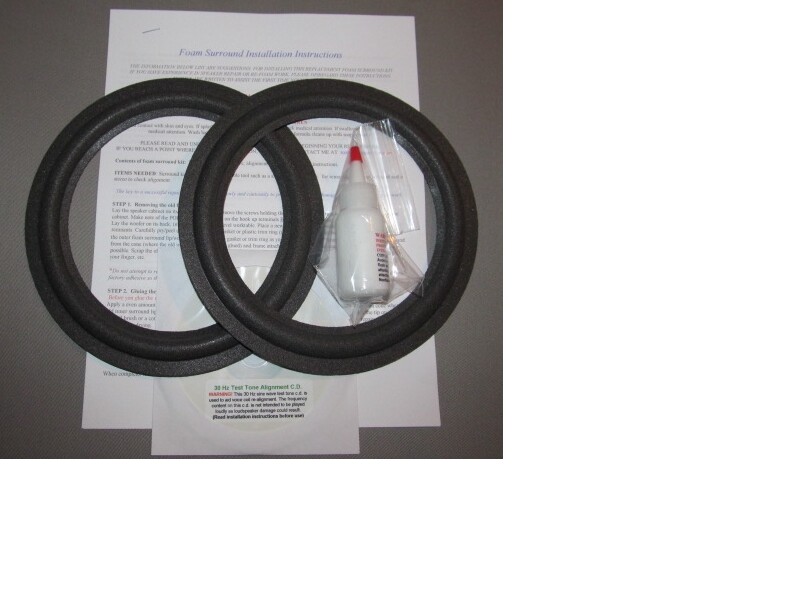
Maintenance is pretty predictable for a speaker this age. The 8-inch woofer surrounds may need refoaming, a standard procedure that can restore punch and eliminate rattles. The crossover capacitors, while high-quality to begin with, are still decades old—owners report that recapping can sometimes improve performance, bringing back clarity and dynamics. The level controls (if present) may need cleaning if they’ve gotten noisy over time.
There’s also an optional stand, the RS-6PED, sold separately—worth tracking down if you want to position them correctly and avoid floor reflections muddying the bass.
Despite the lack of definitive production dates or a clear lineage between the RS-6, RS-6B, and RS-6001, owners are enthusiastic. One reports loving the sound in their living room; another says they “sound really good” with strong bass, excellent midrange, and a top end that delivers. That’s high praise from real-world use—not marketing copy.
eBay Listings



As an eBay Partner, we earn from qualifying purchases. This helps support our independent vintage technology research.
Related Models
- Infinity RS-1B (1975)
- Infinity SM-102 (1979)
- Infinity SM-125 (1975)
- Infinity SM-112 (1975)
- Infinity 1500 (1972)
- Akai AM-2850 (1975)
- Akai AP-206 (1975)
- Nakamichi BX-1 (1985)
- Acoustic Research research-ar-17 (1978)
- Acoustic Research AR-19 (1994)