Infinity RS-2000 (1986)
They sound great even with the foam rot — a backroom bargain that still sings
Overview
Don’t let the badge fool you — the Infinity RS-2000 isn’t some forgotten flagship. It’s a modest bookshelf speaker from the late '80s that slipped through the cracks of audiophile history, quietly doing its job in dorm rooms, dens, and discount bins. Introduced in 1986 as part of the New RS series within the broader Infinity Reference Standard lineup, this little two-way was never meant to wow high-end showrooms. Instead, it was built for volume, aimed at the super stores where impulse buyers grabbed a pair to go with their receiver. And yet, decades later, a surprising number of owners report that these unassuming boxes still deliver a satisfying, musical punch — especially if you don’t mind rolling up your sleeves.
At a time when speaker design was caught between the fading echo of the '70s hi-fi boom and the rise of compact, plastic-clad '90s models, the RS-2000 landed in the middle: a no-frills, sealed-box bookshelf design with a modest frequency range and a sensitivity that won’t punish low-powered amps. It’s not flashy, but it’s honest — and in a world of overhyped relics, that counts for something.
Specifications
| Manufacturer | Infinity |
| Model | RS-2000 |
| Type | 2-Way Bookshelf Speaker System |
| Woofer | 16.5 cm cone type (polypropylene diaphragm) |
| Tweeter | 3 cm Composite Type (Polycell) |
| Frequency Response | 57 Hz – 22 kHz |
| Power Handling | 15W – 75W RMS |
| Sensitivity | 89 dB |
| Impedance | 6 Ω |
| Crossover Frequency | 4.5 kHz |
| Enclosure Type | Airtight (sealed) |
| Dimensions (W×H×D) | 222.5 × 360 × 197.5 mm |
| Weight | 5.4 kg |
| Finish | Oak (vinyl wrap) |
Key Features
The Drivers: Nothing Fancy, But Thoughtful
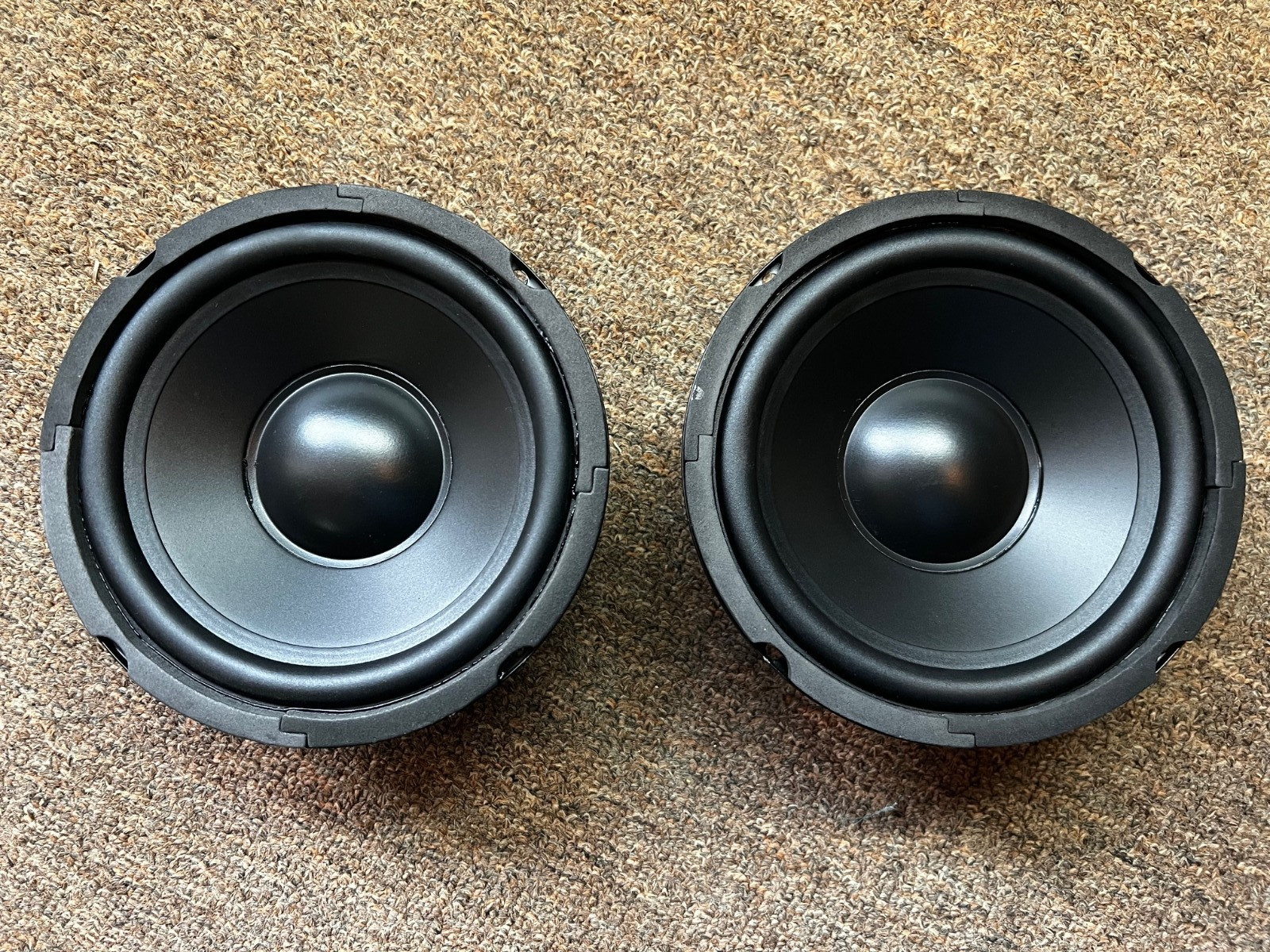
The RS-2000 uses a 16.5 cm (6.5") polypropylene cone woofer — a common material choice by the mid-'80s for its balance of stiffness and damping. What sets it apart slightly is the attention given to impedance matching: Infinity updated the magnet structure, cone shape, and surround edge to help the driver play more efficiently within the crossover’s demands. It’s not a high-excursion monster, but it’s tuned for coherence over raw output.
Up top, a 3 cm (1.2") compound Polycell tweeter handles the highs. The diaphragm is lightweight, which owners say contributes to decent transient response — no smearing on snare hits or plucked strings. It’s not a silk dome or metal tweeter, but Polycell was a budget-conscious material that avoided the harshness some cheaper domes were known for. The 4.5 kHz crossover point keeps the woofer from straining on upper-midrange duties, and the phase characteristics were reportedly fine-tuned during production to ensure alignment between drivers.
Enclosure & Build: Functional, Not Fancy
The cabinet is made from high-density particle board — not the sexiest material, but effective for damping unwanted resonance in a low-cost design. The front baffle features an R-shaped edge, a subtle touch meant to reduce diffraction effects that can cloud imaging. The grille uses a floating mount to minimize reflections that might muddy the sound, though most owners report better clarity with the grilles off.
Despite their modest size, these speakers were originally covered in a vinyl wrap, not real wood veneer. Some owners have since upgraded to real oak veneer for a more premium look, but stock units wear their humble origins on their sleeves. And while they’re sealed (airtight) cabinets — which means tighter bass than a ported box of similar size — don’t expect deep extension. The 57 Hz lower limit means they’ll miss the lowest octave of most music, but they’ll hold their own on vocals, rock, and jazz at moderate volumes.
Historical Context
The RS-2000 was a bookshelf model in the New RS series, part of the broader Infinity Reference Standard family — a name that sounds far more prestigious than the product’s actual market role. These weren’t hand-built flagships; they were cost-effective designs meant to move units in mass retail. One owner put it bluntly: “These were made as a money maker for the super stores.” That explains the particle board, the vinyl wrap, and the modest specs. But it also means they were built in volume, so finding a pair today isn’t impossible — even if they weren’t preserved like museum pieces.
Collectibility & Value
Let’s be real: nobody’s paying top dollar for a pair of RS-2000s. Current market listings show prices between $69 and $130 for a pair, depending on condition. Some sellers highlight recent refoaming jobs — a common and often necessary repair, since the original foam surrounds degrade over time, leading to flapping or distorted bass. Replacing them isn’t hard, and it can breathe new life into a tired set.
One owner’s advice? “Brace the hell out of them and fill them with stuffing.” That DIY tweak suggests the cabinets aren’t perfectly inert — adding internal damping can help control resonance and tighten the sound. And while original pricing is a bit murky (one source claims $200 new, another says they sold for $170), it’s clear these were mid-tier at best. Today, they’re not collectible as artifacts, but they’re valued as functional, affordable vintage monitors — especially for those setting up a secondary system or want a taste of '80s sound without breaking the bank.
They won’t impress purists, and one forum user admitted, “I had a pair, not one of Infinity's better efforts.” But others counter that: “Very nice sounding small bookshelf speaker.” The truth is probably in the middle — they’re competent, not exceptional. But for $70 and a refoam, they might just surprise you.
eBay Listings


As an eBay Partner, we earn from qualifying purchases. This helps support our independent vintage technology research.
Related Models
- Infinity RS-1B (1975)
- Infinity SM-102 (1979)
- Infinity SM-125 (1975)
- Infinity RS-6 (1976)
- Infinity SM-112 (1975)
- Akai AM-2850 (1975)
- Akai AP-206 (1975)
- Nakamichi BX-1 (1985)
- Acoustic Research research-ar-17 (1978)
- Acoustic Research AR-19 (1994)