Infinity RS-1B (1985)
A flagship floor-standing system that married planar clarity with servo-controlled bass—on paper, a masterpiece; in practice, a handful.
Overview
When Infinity dropped the RS-1B in 1985, it wasn’t just releasing a speaker—it was throwing down a gauntlet. This wasn’t some modest bookshelf box or even a conventional floorstander. The RS-1B was a sprawling, modular system of separate treble/midrange panels and woofer columns, tied together by an outboard electronic crossover with servo feedback. It was Infinity’s flagship, the top-of-the-line model in the Reference Standard series, and priced like it: $12,000 per pair, a king’s ransom at the time. And yet, for all its complexity, the goal was pure—achieve near-perfect full-range sound with the transparency of planar magnetics and the authority of servo-controlled bass.
Owners report it could deliver on that promise—when everything was aligned. The EMIT planar tweeter and EMIM planar midrange brought a level of detail and speed that cone drivers simply couldn’t match, and the sealed woofer columns, each housing a 12-inch driver, were meant to deliver tight, articulate bass. But this was no plug-and-play system. It demanded attention: correct polarity, compatible amplifiers, and a large room to breathe. Get it right, and reviewers said the sound was “wide open and dynamic, just superb.” Get it wrong, and the system could oscillate, distort, or simply underperform. It’s the kind of speaker that separates the curious from the committed.
Specifications
| Manufacturer | Infinity |
| Model | RS-1B |
| Type | loudspeaker system with an active controller (electronic crossover) |
| Drivers | One 12" woofer, two 5" midranges, one EMIT planar tweeter, one EMIM planar midrange |
| Enclosure type | Sealed (acoustic suspension) |
| Frequency response | 25 Hz to 32 kHz |
| Crossover frequencies | 150 Hz, 700 Hz, 3 kHz, 8 kHz |
| Impedance | 6 ohms |
| Sensitivity | 86 dB |
| Power handling | 400 watts |
| Dimensions (H×W×D) | 43.5" × 19.5" × 11.5" (1105 × 495 × 292 mm) |
| Weight | 125 lbs (56.7 kg) |
Key Features
Modular Design: Panels and Columns
The RS-1B wasn’t a single cabinet—it was an architecture. Each channel used separate components: a main treble/midrange panel and dual woofer columns. The main towers housed two 5-inch cone midranges, one EMIM planar midrange, and one EMIT planar tweeter, while This physical separation aimed to reduce intermodulation distortion and allow independent placement tuning, though in practice it demanded serious floor space and careful setup.
Planar Magnetic Drivers
The EMIM (Electro-Magnetic Induction Midrange) and EMIT (Electro-Magnetic Induction Tweeter) drivers were the soul of the system. These planar ribbons offered exceptional transient response and low distortion, contributing to the RS-1B’s reputation for transparency and detail. But they weren’t immortal—owners note the mylar diaphragms are prone to deterioration over time, and while replacement kits are available from specialists like MillerSound, restoring them isn’t trivial.
Active Servo Control and Electronic Crossover
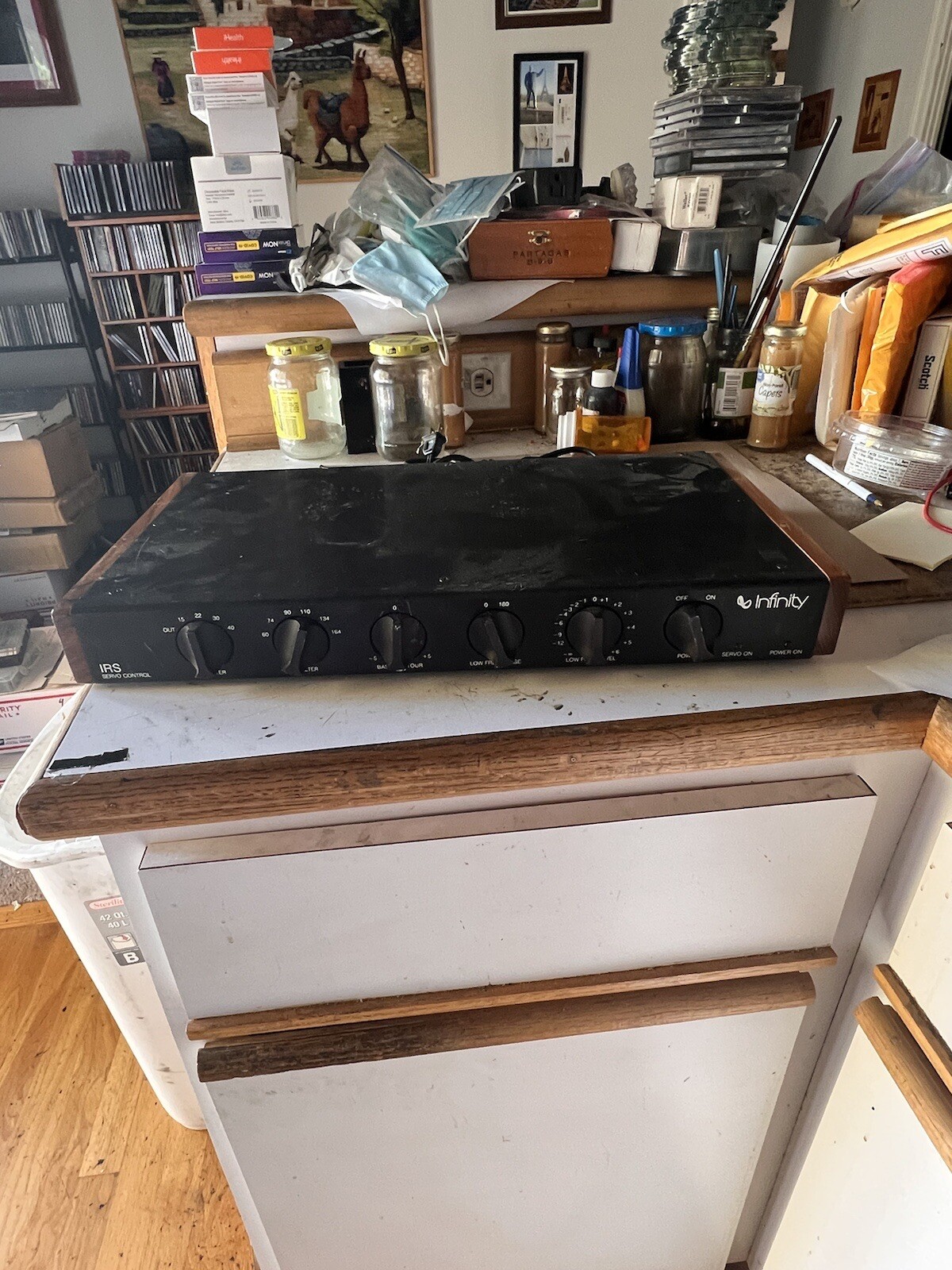
The RS-1B wasn’t passive. It relied on an outboard electronic crossover with servo feedback, connected via banana jacks to the amplifier and speakers. This active controller managed the four-way crossover at 150 Hz, 800 Hz, and 3.5 kHz, and included a feedback loop to correct woofer behavior in real time. But this sophistication came with strings attached: the system is “very fussy about polarity,” and incorrect wiring could send it into destructive oscillation. It also won’t play nice with all amplifiers—monoblocks without a common ground are a no-go.
Four-Way Configuration
With distinct drivers handling bass, mid-bass, midrange, and highs, the RS-1B was a true four-way system. The sealed enclosure design avoided port noise, but demanded serious amplifier control. The 6-ohm impedance and 86 dB sensitivity meant it wasn’t easy to drive, and while it could handle up to 400 watts, it needed quality power to shine.
Historical Context
Introduced in 1985, the RS-1B was Infinity’s answer to the high-end speaker wars of the era—a statement product designed to compete with the best in the world. As the top-of-the-line model in the Reference Standard series, it represented the pinnacle of the company’s engineering at the time. This wasn’t just about loudspeakers; it was about proving that servo control, planar magnetics, and active electronics could coexist in a single, high-performance system. At $5,000 a pair, it was never going to be mainstream, but it cemented Infinity’s reputation among audiophiles as a brand that pushed boundaries, even if the results were sometimes polarizing.
Collectibility & Value
Today, the RS-1B is a rare sight, but not forgotten. A pair sold for $4,500 on US AudioMart in 2023, suggesting strong collector interest. But buying one is not for the faint of heart. The active controller is a known weak point—capacitors fail, op-amps (like the LF353N) degrade, and those tiny 33-ohm and 62-ohm resistors in the feedback circuit can burn out, causing oscillation or hum. Grounding is also finicky: the chassis isn’t a true ground point, and there’s a 50- or 100-ohm resistance to ground depending on the version. Then there’s the planar drivers—EMIM and EMIT units fail as their mylar diaphragms age, though replacements exist. If you’re considering a pair, assume you’ll need to service both the electronics and the ribbons. But for those willing to do the work, the RS-1B remains a fascinating piece of audio history—a speaker that aimed for perfection and, in moments, almost reached it.
eBay Listings


As an eBay Partner, we earn from qualifying purchases. This helps support our independent vintage technology research.
Related Models
- Infinity SM-102 (1979)
- Infinity SM-125 (1975)
- Infinity RS-6 (1976)
- Infinity SM-112 (1975)
- Infinity 1500 (1972)
- Akai AM-2850 (1975)
- Akai AP-206 (1975)
- Nakamichi BX-1 (1985)
- Acoustic Research research-ar-17 (1978)
- Acoustic Research AR-19 (1994)