Infinity RS-1A: The Pioneering Servo-Controlled Loudspeaker System
In the late 1970s, when most loudspeakers relied on passive crossovers and conventional cone drivers, Infinity Systems introduced a radical departure from the norm: the RS-1A, a hybrid active loudspeaker system that pushed the boundaries of fidelity and control. Released in 1978, the RS-1A was not just another speaker—it was a bold experiment in servo-controlled bass technology, marking Infinity’s ambition to conquer the limitations of traditional speaker design. Though not as widely recognized as some of Infinity’s later models, the RS-1A holds a unique place in audio history as one of the first commercially available speakers to incorporate servo feedback in the bass driver, offering unprecedented accuracy and low distortion.
Historical Context and Design Philosophy
Infinity, founded in 1968 by Arnie Nudell and Cary Christie, quickly gained a reputation for innovation, particularly with its electromagnetic ribbon tweeters and servo-driven subwoofers. The RS-1A emerged from this era of experimentation, building on the success of earlier servo-woofers like those in the Servo Statik series. Unlike conventional speakers, which rely solely on the mechanical properties of the driver and enclosure to control cone movement, the RS-1A used a feedback loop to monitor and correct bass driver motion in real time—essentially applying principles from control theory to loudspeaker design.
The RS-1A was marketed as a “reference system,” targeting serious audiophiles and studio engineers seeking ultra-low distortion and tight, articulate bass. It was part of a broader trend in the late '70s and early '80s where high-end audio brands like Acoustic Research, KLH, and Advent explored active and servo-assisted designs. However, the RS-1A stood out for its hybrid approach: while the bass was actively servo-controlled, the midrange and high frequencies were handled by conventional passive drivers.
Technical Specifications
| Specification | Detail |
| Model | RS-1A |
| Manufacturer | Infinity Systems Corporation |
| Year Introduced | 1978 |
| Type | 3-way hybrid active/passive loudspeaker |
| Enclosure Type | Bass-reflex with servo-controlled woofer |
| Woofer | 12" servo-controlled cone driver |
| Midrange | 5.25" cone driver |
| Tweeter | 1" dome or soft-dome tweeter |
| Crossover | Hybrid active (bass) / passive (mids/tweeter) |
| Amplification | Internal servo amplifier for woofer |
| Frequency Response | 28 Hz – 20 kHz (±3 dB) |
| Impedance | Not applicable (active bass section) |
| Sensitivity | 89 dB (1W/1m) |
| Recommended Amp Power | 50–100W for passive section |
| Dimensions (H×W×D) | 38" × 12" × 16" (approx.) |
| Weight | 65 lbs per cabinet |
The RS-1A’s most groundbreaking feature was its servo-controlled 12-inch woofer. A sensor (typically a voice coil velocity sensor or optical pickup) monitored the actual movement of the cone and compared it to the input signal. Any deviation—caused by inertia, back-EMF, or enclosure resonance—was corrected by the internal servo amplifier, drastically reducing distortion and improving transient response. This allowed the woofer to achieve deep bass extension with remarkable control, even in moderately sized enclosures.
The midrange and tweeter were fed via a passive crossover, powered by the user’s external amplifier. This hybrid design reduced complexity and cost compared to fully active systems while still delivering the benefits of servo control where it mattered most: the bass.
Sound Characteristics and Performance
The RS-1A delivered a sound signature that was both precise and dynamic. The servo woofer produced bass that was exceptionally tight, articulate, and free from the "one-note" boom often associated with ported enclosures. Transient response was outstanding—percussive attacks like kick drums and plucked bass strings were rendered with startling realism.
In the midrange, the RS-1A offered a neutral, detailed presentation, though some listeners noted a slight forwardness—common in designs of that era aiming for clarity. The tweeter provided smooth high-frequency extension without harshness, contributing to a balanced overall tonal character.
Because the bass was actively driven and servo-corrected, the RS-1A was less dependent on room placement than many passive speakers. It could deliver consistent low-frequency performance even in less-than-ideal acoustic environments, a major advantage for both home and semi-professional use.
Notable Features and Innovations
- Servo-Controlled Bass: The defining feature, reducing distortion and improving bass accuracy.
- Hybrid Design: Combined the benefits of active control with the simplicity of passive midrange/tweeter operation.
- Built-In Servo Amplifier: Each RS-1A cabinet housed its own dedicated amplifier for the woofer, eliminating the need for an external sub amp.
- Modular Construction: Allowed for easier servicing and component replacement—a rarity in high-end speakers of the time.
- Professional-Grade Components: Used heavy-duty internal wiring, robust terminal cups, and high-quality crossover parts.
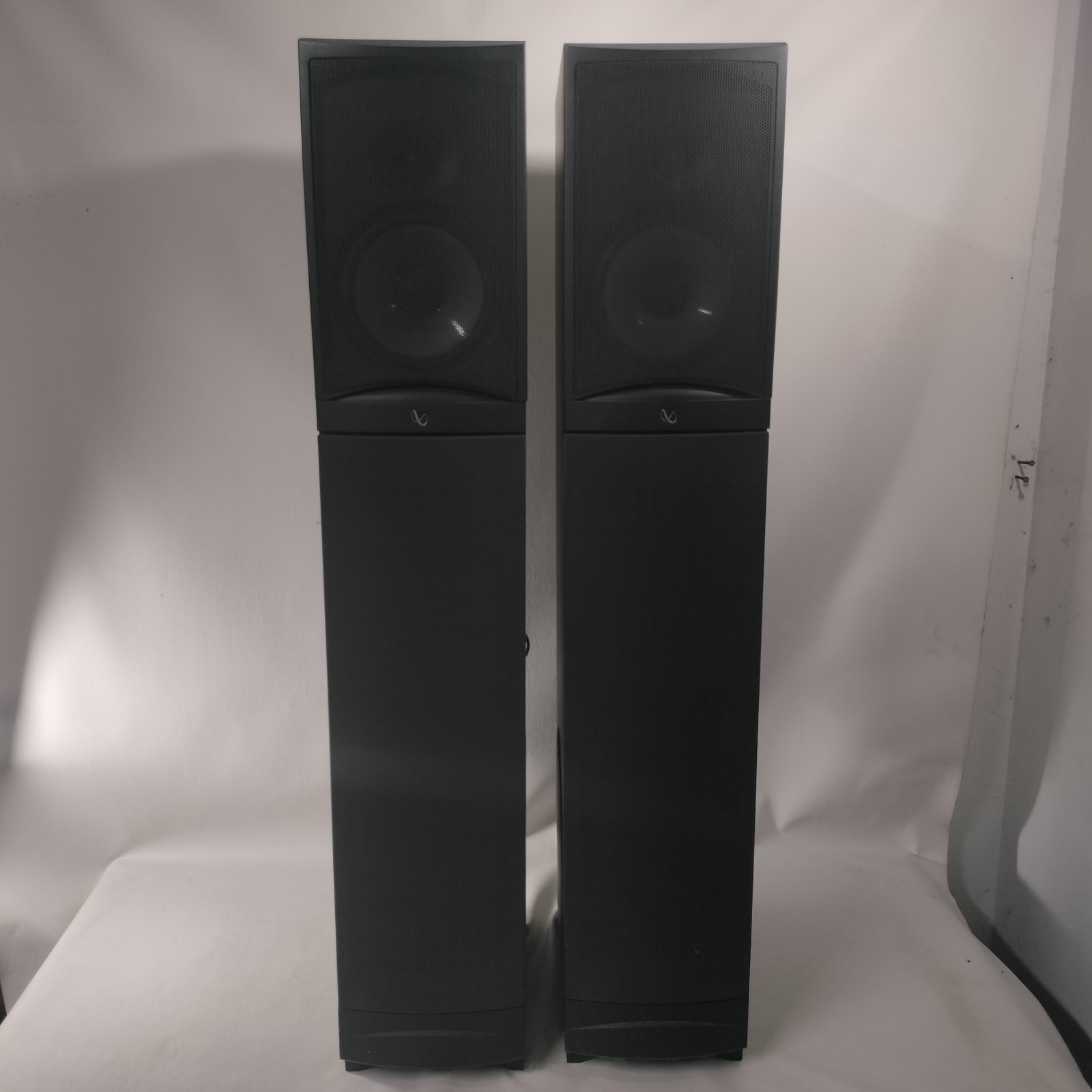
The RS-1A also featured a distinctive industrial design: a tall, narrow cabinet with a slightly angled front baffle, housing drivers in a vertical line. The aesthetic was utilitarian but purposeful, emphasizing function over form—a hallmark of Infinity’s engineering-first philosophy.
Common Issues and Maintenance
Due to their age and complexity, surviving RS-1A units often require attention. The most common issues include:
- Failed Servo Amplifiers: The internal amp boards, often based on discrete transistor designs, can suffer from capacitor leakage, resistor drift, or transistor failure. Electrolytic capacitors should be replaced as a matter of course.
- Degraded Wiring and Connectors: Internal wiring can become brittle, and solder joints may crack over time.
- Woofer Surround Disintegration: The foam or rubber surrounds on the 12" woofer may have perished. Re-foaming or reconing is typically necessary.
- Crossover Component Drift: Passive crossover components (capacitors, inductors) may have aged, affecting tonal balance.
Restoration is feasible but requires technical skill. Replacement parts are scarce, though some vintage audio specialists offer reconditioning services. Keeping the servo feedback loop properly calibrated is critical—misalignment can lead to instability or poor bass performance.
Current Market Value and Collectibility
The Infinity RS-1A is a rare find today. It never achieved the commercial success of models like the IRS V or the Beta series, and production numbers were limited. As a result, working examples command attention from collectors of vintage active and servo-driven speakers.
In good condition, a pair of RS-1As can fetch $800–$1,500, depending on functionality and cosmetic state. Fully restored units with upgraded capacitors and reconed woofers may sell for more, especially if accompanied by original documentation or accessories. While not as iconic as some of Infinity’s flagship models, the RS-1A is prized for its historical significance and innovative engineering.
Conclusion and Legacy
The Infinity RS-1A was ahead of its time—a bold fusion of control theory and high-fidelity audio. While it didn’t revolutionize the consumer market overnight, it laid the groundwork for future developments in active and powered speakers. Modern systems from brands like KEF (with LS50 Wireless), Genelec, and even high-end DIY communities owe a conceptual debt to early servo designs like the RS-1A.
Today, the RS-1A stands as a testament to Infinity’s fearless innovation. It’s not just a speaker—it’s a piece of audio history, a working prototype of ideas that would take decades to mature. For the vintage audio enthusiast, restoring and listening to a pair of RS-1As is not merely a technical challenge; it’s an opportunity to experience the sound of progress.
eBay Listings


As an eBay Partner, we earn from qualifying purchases. This helps support our independent vintage technology research.
Related Models
- Infinity RS-1B (1975)
- Infinity SM-102 (1979)
- Infinity SM-125 (1975)
- Infinity RS-6 (1976)
- Infinity SM-112 (1975)
- Akai AM-2850 (1975)
- Akai AP-206 (1975)
- Nakamichi BX-1 (1985)
- Acoustic Research research-ar-17 (1978)
- Acoustic Research AR-19 (1994)