Infinity IRS-1B: The Pinnacle of Electrostatic Hybrid Design
In the pantheon of high-end loudspeakers, few models command the reverence and awe of the Infinity IRS-1B. Introduced in 1980 by Infinity Systems—founded by audio visionaries Cary Christie and Arnie Nudell—the IRS-1B was not merely a speaker; it was a statement of intent, a technological tour de force that pushed the boundaries of what was possible in home audio reproduction. Standing over seven feet tall and spanning nearly four feet in width, the IRS-1B was as imposing in presence as it was in performance. More than four decades after its debut, it remains a benchmark for large-format, hybrid electrostatic loudspeakers and a coveted prize among vintage audio collectors.
Historical Context and Design Philosophy
The IRS-1B emerged during a golden era of speaker innovation, when companies like Acoustic Research, MartinLogan, and KLH were exploring the potential of electrostatic technology. Infinity, already known for its servo-controlled subwoofers and advanced crossover designs, took a bold step forward with the IRS (Idealized Realization Speaker) series. The IRS-1B was an evolution of the original IRS-1, refining its design for improved reliability, dispersion, and integration.
The goal was simple yet audacious: to create a speaker that could reproduce the full audio spectrum with the speed, transparency, and low distortion of electrostatic panels, while maintaining the deep, controlled bass response that only large dynamic drivers could deliver. The result was a hybrid system that combined electrostatic midrange and tweeter panels with a powerful, servo-controlled bass section—a marriage of technologies that few have matched since.
Technical Specifications
| Specification | Detail |
| Type | 4-way hybrid electrostatic/dynamic floorstanding loudspeaker |
| Frequency Response | 20 Hz – 20 kHz (±2 dB) |
| Sensitivity | 94 dB (1W/1m) |
| Nominal Impedance | 8 ohms (compatible with most amplifiers) |
| Crossover | Active/passive hybrid with external crossover unit |
| High Frequency Driver | Push-pull electrostatic panel (ultrasonic capable) |
| Midrange Driver | Electrostatic panel |
| Woofer | Dual 12-inch servo-controlled dynamic woofers |
| Bass Extension | Down-firing ports with boundary gain |
| Dimensions (H×W×D) | 90" × 44" × 24" (229 cm × 112 cm × 61 cm) |
| Weight | Approx. 250 lbs (113 kg) per speaker |
| Recommended Amplification | 50–200 watts (clean linear power) |
| Special Features | External active crossover, servo-bass control, bi-amp/bi-wire capable |
Sound Characteristics and Performance
The sonic signature of the IRS-1B is nothing short of transcendent. Listeners often describe the midrange and high frequencies as "effortless," "airy," and "holographic"—qualities inherent to well-designed electrostatic panels. The push-pull electrostatic tweeter delivers exceptional clarity and detail, with an extended high-frequency response that can reach beyond 20 kHz, capturing the subtlest nuances of reverb and instrument decay.
The midrange panel offers near-zero distortion and ultra-fast transient response, rendering vocals and acoustic instruments with startling realism. There's a transparency to the IRS-1B that makes the speakers seem to disappear, leaving only the music suspended in space.
But where many electrostatics falter—the bass—the IRS-1B excels. The dual 12-inch servo-controlled woofers, driven by a dedicated amplifier section (often integrated into the external crossover), deliver deep, articulate, and tightly controlled bass down to 20 Hz. Unlike conventional passive radiators, the servo system monitors cone movement and corrects for distortion in real time, resulting in bass that is both powerful and precise. This integration of dynamic bass with electrostatic mids and highs creates a seamless tonal balance across the spectrum.
In a properly treated room with sufficient space, the IRS-1B can produce a soundstage of cathedral-like proportions, with pinpoint imaging and exceptional depth. Whether reproducing a full orchestral recording or an intimate jazz trio, the IRS-1B conveys emotion and dynamics with rare authority.
Notable Features and Innovations
The IRS-1B was packed with groundbreaking technology:
- Push-Pull Electrostatic Panels: By using two stator layers (front and back), the IRS-1B achieved greater efficiency and lower distortion than single-stator designs. This also reduced cabinet interaction and improved off-axis response.
- Servo-Controlled Bass System: One of the first consumer applications of real-time feedback in bass drivers. A sensor on the woofer cone feeds back to the amplifier, correcting for non-linearities and ensuring tight, accurate bass even at high volumes.
- External Crossover/Control Unit: The IRS-1B required a separate electronic crossover that split the signal and powered the bass section. This unit often included level controls for bass and mid/treble balance, allowing fine-tuning to room acoustics.
- Scalable Design: The IRS-1B could be bi-amped or even tri-amped for ultimate performance, with separate amplifiers for bass, midrange, and treble. This modular approach was ahead of its time.
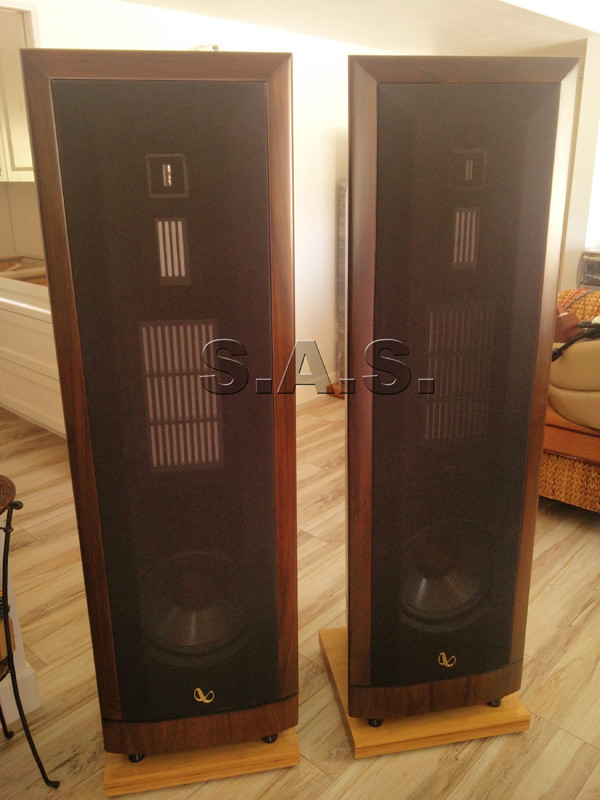
- Aesthetic Grandeur: The IRS-1B was not just a speaker—it was a piece of industrial art. Its tall, narrow profile with a sweeping curved baffle and exposed electrostatic panels made it a centerpiece in any listening room.
Common Issues and Maintenance
Owning an IRS-1B today is both a privilege and a responsibility. These speakers are complex and require careful maintenance:
- Electrostatic Panel Degradation: Over time, the thin Mylar diaphragms in the electrostatic panels can develop tears or lose tension, leading to distortion or arcing. Re-lacing or full panel replacement is possible but expensive and labor-intensive.
- High Voltage Power Supply Failure: The panels require high-voltage bias supplies (often 2–3 kV). These power supplies can fail or leak, especially in older units that have been stored improperly.
- Servo Amplifier Issues: The servo-bass control circuitry is analog and uses aging components. Capacitors dry out, transistors fail, and calibration can drift.
- Physical Size and Placement: The IRS-1B demands a large, reflective-free space with careful positioning. They perform best when "in-room" rather than against a wall, requiring significant real estate.
- Availability of Parts and Expertise: Few technicians today are qualified to service IRS-1Bs. However, a dedicated community of vintage audio enthusiasts and specialists (such as those at Audio Classics or IRS restoration shops) can refurbish and modernize these systems.
Current Market Value and Collectibility
The Infinity IRS-1B is a rare and highly collectible item. Complete, well-maintained pairs in good working condition can command $15,000 to $25,000 on the secondary market, with fully restored units sometimes exceeding $30,000. Factors influencing value include:
- Originality of components
- Condition of electrostatic panels
- Functionality of servo system and crossover
- Provenance (e.g., original owner, celebrity history)
While not as common as some vintage speakers, the IRS-1B has a loyal following. It’s often cited in "dream system" discussions and appears in high-end vintage audio shows. Its blend of engineering brilliance, sonic excellence, and visual drama ensures its place in audio history.
Conclusion and Legacy
The Infinity IRS-1B stands as a monument to ambition in loudspeaker design. It was one of the first systems to successfully merge the speed and clarity of electrostatics with the power and depth of dynamic bass, all within a cohesive, full-range package. Though complex and demanding, the IRS-1B delivers a listening experience that few speakers—modern or vintage—can match.
Its influence can be seen in today’s high-end hybrids from companies like MartinLogan and Wisdom Audio. But the IRS-1B remains unique: a product of its time, yet timeless in its pursuit of sonic perfection.
For the serious collector or audiophile with the space and dedication, the IRS-1B is more than a speaker—it’s a legacy. A towering achievement in sound, a piece of audio history, and a true icon of the golden age of high fidelity.
eBay Listings


As an eBay Partner, we earn from qualifying purchases. This helps support our independent vintage technology research.
Related Models
- Infinity RS-1B (1975)
- Infinity SM-102 (1979)
- Infinity SM-125 (1975)
- Infinity RS-6 (1976)
- Infinity SM-112 (1975)
- Akai AM-2850 (1975)
- Akai AP-206 (1975)
- Nakamichi BX-1 (1985)
- Acoustic Research research-ar-17 (1978)
- Acoustic Research AR-19 (1994)