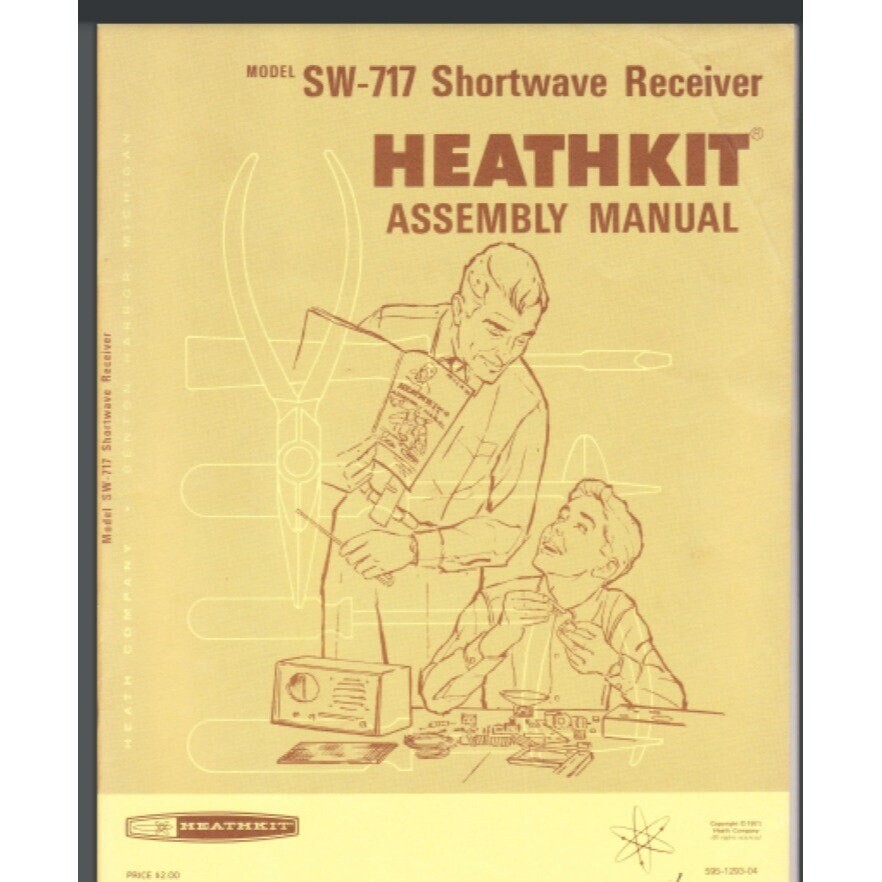
Heathkit SW-717 Shortwave Receiver
A four-band solid-state shortwave set that Heathkit sold as a build-it-yourself window on the world — and that the Japanese imports were already crowding off the shelf.
Overview
The SW-717 is a communications receiver that Heathkit also described as a portable shortwave receiver — a distinction worth noting, because the assembly manual makes clear this is a set built to be carried and used, not a bench instrument. It arrived as one of the seventeen GC receivers in Heathkit's lineup, a family the w6ze.org documentation lays out as a timeline. Collectors who track Heathkit's receiver chronology place the SW-717 within that run, and the model number itself carries the period's naming conventions.
The manual's introduction is unusually plain about what the set does: it tunes from 550 kHz to 30 MHz across four overlapping bands. Band A covers the standard broadcast range from 550 kHz to 1500 kHz. Band B picks up from 1.5 MHz to 4 MHz, Band C runs 4 MHz to 10 MHz, and Band D stretches from 10 MHz to 30 MHz. That spread covers the AM broadcast band, the amateur and shortwave broadcast territory in the middle, and the upper reaches where 27 MHz citizens band and 10-meter amateur activity live. For a kit-built portable, that's a serious tuning range — four bands with overlap means no gap in coverage, and the bandspread tuning on every band is the detail that separates a usable shortwave receiver from a toy.
The front panel controls tell you how Heathkit expected the set to be used. There is a volume control with the on-off switch built in, a mode selector with AM, standby, and CW positions, a BFO control, main tuning, bandspread tuning, and an ANL on-off switch. The mode switch is the giveaway: in the AM position the AVC voltage is on, in CW it's off, and in standby the receiver stays warmed up and ready but muted. That last position is a small convenience that owners of the period would have appreciated — leave the set on standby and it's instantly live when a signal comes through, no warm-up wait.
The BFO is what makes the SW-717 more than a broadcast radio. Beat frequency oscillation is required for receiving CW and single sideband signals, and the manual walks the builder through the procedure: turn the BFO about three-quarters clockwise, set the mode to CW, pick one of the shortwave bands, tune in a station with the main tuning control, then work the BFO back and forth until the clearest tone appears. For SSB, the instructions say to alternate between the bandspread and BFO controls until reception clears. That's the kind of tuning ritual that separates shortwave listening from simply turning a dial, and the SW-717 was built to support it.
The bandspread control deserves its own mention because the manual is candid about its quirks. It provides fine tuning for the main tuning capacitor, helping separate incoming signals that sit close together on the dial. But the manual warns that the bandspread capacitor is normally left in the "0" position because its position affects the main dial calibration. In other words, if you move the bandspread and then try to read a frequency off the main dial, you're not where the dial says you are. That's a real limitation, and it's the sort of thing a builder learns on the first evening of listening.
The receiver also carries a relative signal strength meter, a headphone jack that accepts low-impedance headphones or an external speaker, and a built-in loudspeaker. There's a built-in rod antenna for the broadcast band and provisions for connecting an external antenna for shortwave reception — which any shortwave listener will tell you is the difference between hearing a station and hearing nothing. The automatic noise limiter, switched on the rear panel, is there for impulse noise like automobile ignition radiation. It's a period-appropriate solution to a period-appropriate problem.
Inside, the SW-717 is solid-state throughout, with most components mounted on a printed circuit board for ease of assembly and reliability. The transistor complement listed in the manual includes a 40673 as mixer and RF amplifier, a 2N3393 as audio preamplifier, a 2N5232A as IF amplifier and AGC amplifier, a 2N5308 as IF amplifier, an MPF 105 as oscillator, and MPSU05 and MPSU55 as final audio amplifiers. That's a fairly conventional superheterodyne front end for the era, and the use of a dual-gate MOSFET (the 40673) in the mixer and RF stage was a sensible choice for a set that had to handle strong local signals without overloading. The built-in power supply is transformer operated from either 120 Vac or 240 Vac and uses four silicon diodes in a full-wave bridge circuit — a detail that matters to anyone restoring one today, because it means the set can be run on either mains voltage with the appropriate wiring.
The physical package is modest: 14-1/2 inches wide, 5-3/4 inches high, and 10 inches deep, weighing 7 lbs. Power consumption is listed at 8 watts. That's a small, light box for a four-band communications receiver, and it explains the "portable" description. It's not a pocket radio, but it's a set you can move from room to room or take to a campsite without thinking twice.
Historical Context
The SW-717 sits within a timeline of the seventeen Heathkit GC receivers, a family that the w6ze.org documentation treats as a lineage worth cataloguing. The market context the same source provides is blunt: by the late sixties, the Japanese radio invasion was making competition difficult for Heathkit. That single sentence explains a great deal about why a kit-built shortwave receiver occupied the niche it did. Heathkit's advantage was always the kit itself — the satisfaction of assembly, the lower price of a set you built yourself, and the company's reputation for instructions that actually worked. But when imported Japanese receivers arrived fully assembled, often at prices that undercut the kit, the calculus changed for buyers who wanted a radio rather than a project.
The SW-717's place in that story is as a solid-state four-band receiver built to Heathkit's usual standard, sold to hobbyists who valued the build as much as the listening. The manual's tone reflects that audience: it assumes the builder will read the operation section carefully, understand what the BFO does, and learn to use the bandspread without expecting the main dial to stay calibrated. That's a manual written for someone who wants to understand the set, not just operate it.
eBay Listings


As an eBay Partner, we earn from qualifying purchases. This helps support our independent vintage technology research.