Heathkit GR-180 (c. 1966–1968)
Heathkit's 180-square-inch color TV kit: a $379.95 solder-and-converge project that promised to beat any 19-inch set at any price.
Overview
First thing to get straight: the Heathkit GR-180 is filed in the wrong room. It is not an audio component. It is a 19-inch color television kit, sold as a box of parts, tubes, and a picture tube that the buyer assembled at the kitchen table. The archive lists it under audio, and that needs a correction note in the margin. What the record supports is a color TV kit advertised at a $379.95 kit price, with a rectangular picture tube advertised as 180 square inches of viewing area.
The date range is the softest part of the entry. The archive gives c. 1966-1968, and it flags that range as inferred from Heathkit's own advertising, not from confirmed production records. One catalog source lists 1969, which may be a catalog year rather than a production start. The two are not necessarily the same thing, and the archive does not try to reconcile them. Collectors chasing a hard production date will not find one here. The GR-180 was on sale in late 1966 and was still being called a veteran of the line by early 1968.
The price is the number that mattered. Heathkit put $379.95 on the kit - everything except the cabinet - and built an entire advertising campaign around the claim that no 19-inch color TV, regardless of price, could outperform it. That is a manufacturer claim, not a measured result. The archive is clear that no independent review or substantial service documentation has surfaced. The measurable record on this set is essentially Heathkit's own copy.
Key Features
180 Square Inches of Rectangular Picture Tube
The headline number is viewing area: 180 square inches on a rectangular tube, in a set Heathkit designated as 19-inch. The rectangular format was the selling point in the mid-Sixties. Heathkit's December 1966 campaign ran the same page in more than one magazine, describing the tube as a "Hi-Fi 180" rectangular picture tube with 180 square inches of viewing area (HiFi/Stereo Review, December 1966, p.43). The number is an advertising figure, and the archive has no independent measurement of the tube's usable area or its performance.
Built-In Dot Generator and Self-Servicing Design
This is the feature that separates the GR-180 from a generic kit television. Heathkit built a dot generator into the set and wrote the manual around full color photos and step-by-step instructions, so the owner could set up, converge, and maintain the picture without calling a technician. The pitch was blunt: no service calls for periodic convergence or minor repairs. By January 1968, Heathkit's ads for the newer GR-227 were still invoking the "famous" GR-295 and GR-180 and their built-in dot generator as the lineage the new set inherited (HiFi/Stereo Review, January 1968, p.48).
Sold as a Kit, Cabinet Not Included
The GR-180 was a kit in the literal sense - the buyer assembled it. The $379.95 price bought the kit, and the cabinet was a separate purchase or a custom build. At least one owner documented building a custom walnut cabinet for the set rather than buying a factory one, which is consistent with how these kits were often finished. Manufacturer documents list factory-assembled cabinet options including the GRA-180-1 (Contemporary Walnut), GRA-180-2 (Deluxe Early American), and GRA-180-3 (walnut-grained vinyl-clad wood). The archive has no dimensions or weight for the chassis.
Historical Context
Heathkit's December 1966 advertising was a full-page assertion that no 19-inch color TV, regardless of price, could perform as well as the new "Heathkit 180" at $379.95 (High Fidelity, December 1966, p.55). A near-identical campaign ran the same month in HiFi/Stereo Review (December 1966, p.43). Whether the claim held up is unrecorded, since there is no independent review in the file.
By early 1968 the 180 had become the elder statesman. Heathkit's ads introducing the newer GR-227 grouped the GR-180 with the GR-295 as the "famous" sets whose self-servicing features the new model carried forward (HiFi/Stereo Review, January 1968, p.48). That is the closest thing to a production timeline the record offers: on the market in late 1966, still being cited as a benchmark in early 1968. The archive's c. 1966-1968 range is an inference from those ads, and the competing 1969 catalog listing year is noted but unresolved.
Collectibility & Value
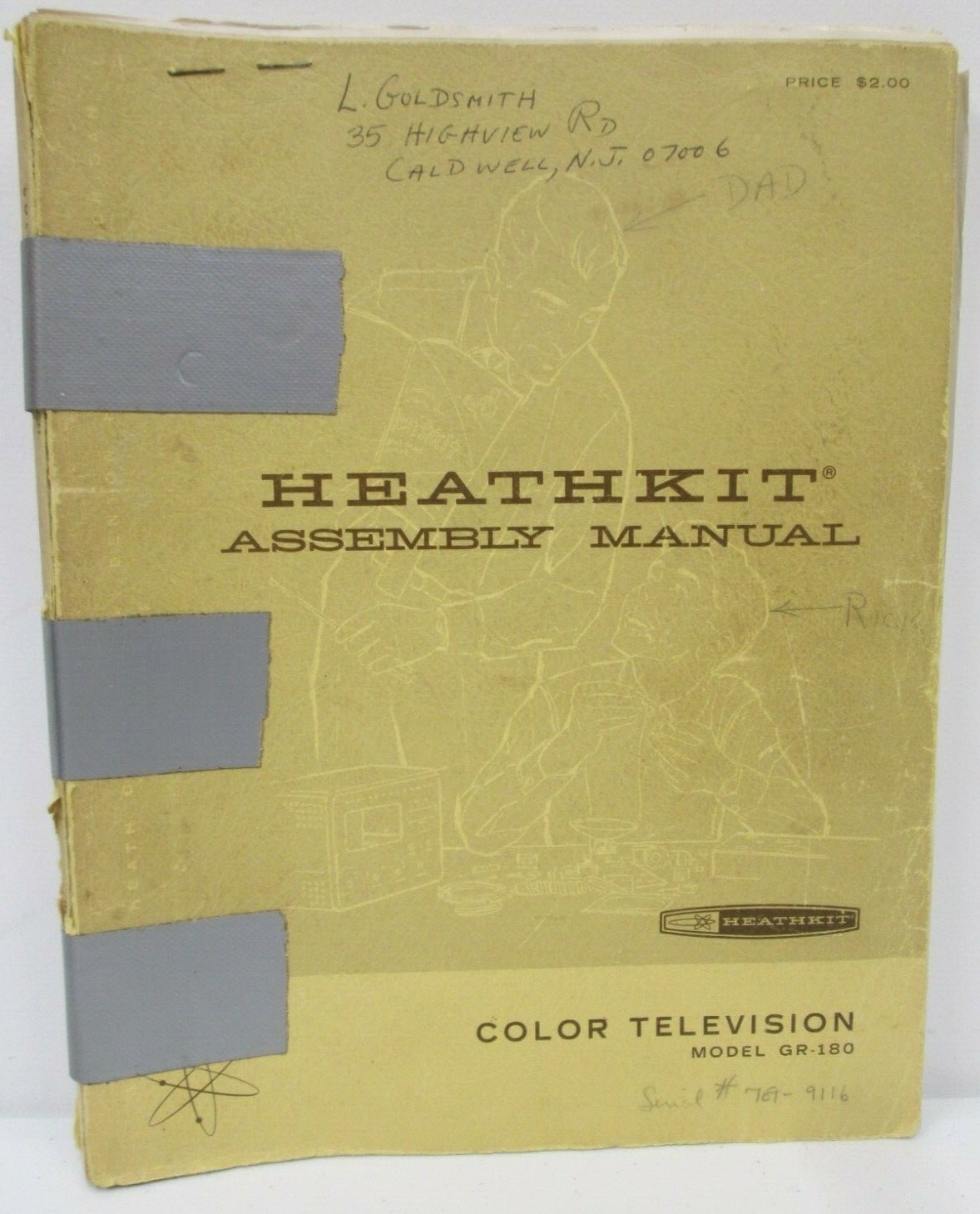
The market for a complete GR-180 is essentially undocumented. The only listing the archive has found is an assembly manual for the "Heathkit Assembly Manual Color Television Set Model GR-180" at $9.95 - the paperwork, not the television. No current prices for a complete, working unit have surfaced, and there is no spare-parts or service-documentation trail to speak of.
What owners do report is age. One account notes that as these TVs aged, some of the components began to fail, without naming specific parts. That is the ordinary fate of a Sixties tube color set, and it is the reason complete, working examples are scarce. Anyone considering one should assume a restoration project. The self-servicing design will not stand in for a CRT or a chassis full of tired components. The archive has no confirmed failure points, no maintenance guidance, and no parts availability information for this model.
eBay Listings

As an eBay Partner, we earn from qualifying purchases. This helps support our independent vintage technology research.
Related Models
- Heathkit AR-1500 (1975)
- Heathkit AR-1500A
- Heathkit GR-152-BK
- Heathkit AR-14 (1966–1968)
- Heathkit GR-53A (c. 1964–1965)
- Marantz 2226 (1974-1976)
- Marantz 2226B (1979-1980)
- Marantz 2235 (1974-1977)
- Marantz 2238B (1978-1980)
- Marantz 2250B (1978-1980)