Heathkit AS-104: The DIY Enthusiast’s Crossover Solution
In the golden era of do-it-yourself electronics, few names carried as much weight as Heathkit. From ham radios to hi-fi amplifiers, Heathkit empowered hobbyists to build professional-grade equipment at home. Among their diverse catalog of audio kits, the AS-104 stands out not as a complete speaker, amplifier, or receiver—but as a crucial, often overlooked component: a passive crossover network kit. Designed for integration into custom speaker systems, the AS-104 allowed audiophiles and tinkerers alike to fine-tune their speaker performance with precision and pride.
Released in 1972, the AS-104 arrived during a period of explosive growth in home audio. High-fidelity systems were becoming more accessible, and the DIY movement was in full swing. Speaker design, in particular, was an area where enthusiasts could experiment—choosing drivers, building enclosures, and tuning crossovers to their liking. The AS-104 catered directly to this niche, offering a well-engineered, cost-effective solution for those building two-way speaker systems.
Technical Specifications
The Heathkit AS-104 is a passive, second-order crossover network designed to split an audio signal between a woofer and a tweeter. It was intended for use with 8-ohm drivers and optimized for systems using 8" to 10" woofers paired with dome or cone tweeters. As a kit, it required assembly by the user—true to Heathkit’s hands-on philosophy.
| Specification | Detail |
| Type | Passive crossover network (2-way) |
| Crossover Frequency | Approximately 2.5 kHz |
| Slope | 12 dB/octave (second-order Butterworth) |
| Impedance Compatibility | 8 ohms |
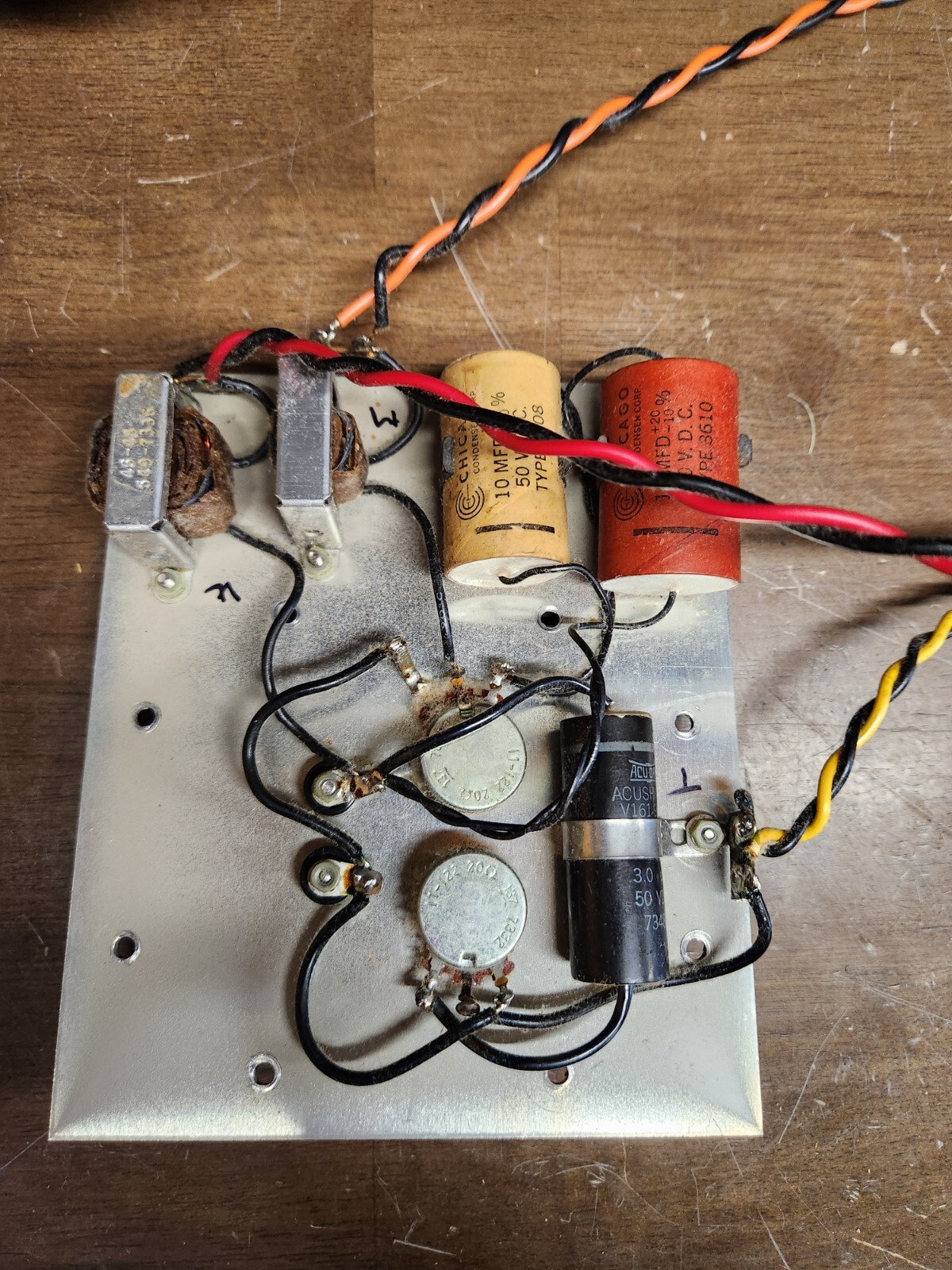
| Components Included | Inductors, capacitors, resistors, terminal strips, enclosure |
| Assembly Required | Yes (soldering and wiring) |
| Enclosure | Metal chassis for mounting |
| Recommended Drivers | 8"–10" woofers, 1"–2" tweeters |
| Power Handling | Up to 100 watts (depending on drivers) |
| Dimensions | Approx. 4" x 2.5" x 1.25" |
The AS-104 employed a Butterworth alignment, known for its flat frequency response and smooth phase characteristics, making it a popular choice for audiophiles seeking balanced sound. The crossover used air-core inductors for the tweeter leg to minimize distortion and polypropylene capacitors in critical signal paths—high-quality components for the time, especially in a kit format.
Sound Characteristics and Performance
While a crossover doesn’t "produce" sound, its impact on sonic quality is profound. The AS-104 was engineered to deliver a coherent transition between low and high frequencies, minimizing overlap and phase issues that can muddy the midrange. When paired with well-matched drivers and a properly designed enclosure, the AS-104 contributed to a clear, balanced sound with good imaging and detail.
The 2.5 kHz crossover point was carefully chosen to avoid the critical vocal range, reducing the chance of noticeable crossover artifacts. The second-order (12 dB/octave) slope provided sufficient driver protection while maintaining a natural tonal balance. Many users reported that the AS-104 helped tame harshness in bright tweeters and tightened bass response by properly filtering out high frequencies from the woofer.
Because the AS-104 was a kit, final performance depended heavily on user assembly quality, component placement, and integration with the chosen drivers. A well-built unit could rival commercial crossovers of the era, while poor soldering or incorrect wiring could degrade performance significantly.
Notable Features and Innovations
What made the AS-104 special wasn’t raw innovation, but accessibility and education. At a time when high-quality crossovers were expensive or proprietary, Heathkit offered a transparent, build-it-yourself alternative. The kit included:
- Detailed assembly manual with theory of operation, wiring diagrams, and alignment tips
- Pre-tested components matched for optimal performance
- Shielded metal enclosure to reduce interference
- Terminal strips for secure, clean connections
The manual was particularly valuable, walking users through not just assembly, but also the principles of crossover design—impedance curves, phase response, and driver protection. For many, building the AS-104 was as much a learning experience as it was a functional project.
Heathkit also emphasized modularity. The AS-104 could be adapted to different drivers with minor component substitutions, and its compact size made it easy to install in most speaker cabinets. Some advanced users even modified the design—adding Zobel networks or adjusting crossover points—for custom applications.
Common Issues and Maintenance
As with any vintage electronic kit, the Heathkit AS-104 is subject to aging components and wear. Common issues include:
- Capacitor degradation: Electrolytic capacitors (if used in modifications) or older film types may dry out or drift in value, affecting frequency response.
- Loose connections: Vibration from speaker cabinets can loosen solder joints or terminal screws over time.
- Corrosion: In humid environments, the metal chassis and terminals may develop oxidation.
- Inductor core saturation: Though air-core inductors are less prone to distortion, physical damage or poor mounting can affect performance.
Maintenance is relatively straightforward:
- Inspect and re-solder any suspect joints
- Clean terminals with contact cleaner
- Test component values with a multimeter or LCR meter
- Consider replacing aging capacitors with modern equivalents for improved reliability
Because the AS-104 used through-hole components and point-to-point wiring, repairs are accessible even for hobbyists with basic tools.
Current Market Value and Collectibility
The Heathkit AS-104 is not a high-profile collectible like a Marantz receiver or a McIntosh amplifier, but it holds niche appeal among vintage audio enthusiasts, DIYers, and Heathkit collectors. Complete, unused kits in original packaging can fetch $50–$100 on auction sites or forums, while built units typically sell for less unless part of a larger speaker project.
Its value lies more in historical and educational significance than in high-end performance by modern standards. However, for those restoring vintage Heathkit speaker systems—such as those designed around the T-15 or T-20 drivers—the AS-104 is a key component for authenticity.
Replacement parts are generally available, and the circuit design is simple enough that modern equivalents can be built from scratch. Still, owning an original AS-104 is a nod to the golden age of electronics hobbyism, when building your own gear was both practical and deeply rewarding.
Conclusion and Legacy
The Heathkit AS-104 may not be a star of the vintage audio world, but it embodies the spirit of the DIY movement that shaped high-fidelity audio in the 1970s. It wasn’t about flashy features or mass-market appeal—it was about empowerment, education, and craftsmanship.
For the modern audiophile, the AS-104 offers a window into how speaker systems were built and tuned before the era of digital crossovers and automated design tools. It reminds us that great sound often begins not with expensive gear, but with understanding, patience, and a soldering iron.
Whether you're restoring a classic Heathkit speaker project, building a retro-inspired system, or simply appreciating the history of audio engineering, the AS-104 stands as a quiet but essential piece of vintage audio heritage. In the world of Heathkit, where every kit told a story, the AS-104 was the unsung hero behind the speakers—the brain behind the brawn.
eBay Listings


As an eBay Partner, we earn from qualifying purchases. This helps support our independent vintage technology research.
Related Models
- Heathkit AA-32 (1972)
- Heathkit AA-100 (1957)
- Heathkit AA-121 (1972)
- Heathkit AA-40 (1970)
- Heathkit AD-17 (1976)
- Akai AM-2850 (1975)
- Akai AP-206 (1975)
- Nakamichi BX-1 (1985)
- Acoustic Research research-ar-17 (1978)
- Acoustic Research AR-19 (1994)