Heathkit AR-29 (1970–1976)
That hum when you turn it on? That’s the sound of 1970s solid-state warmth waking up—provided the sliders still work.
Overview
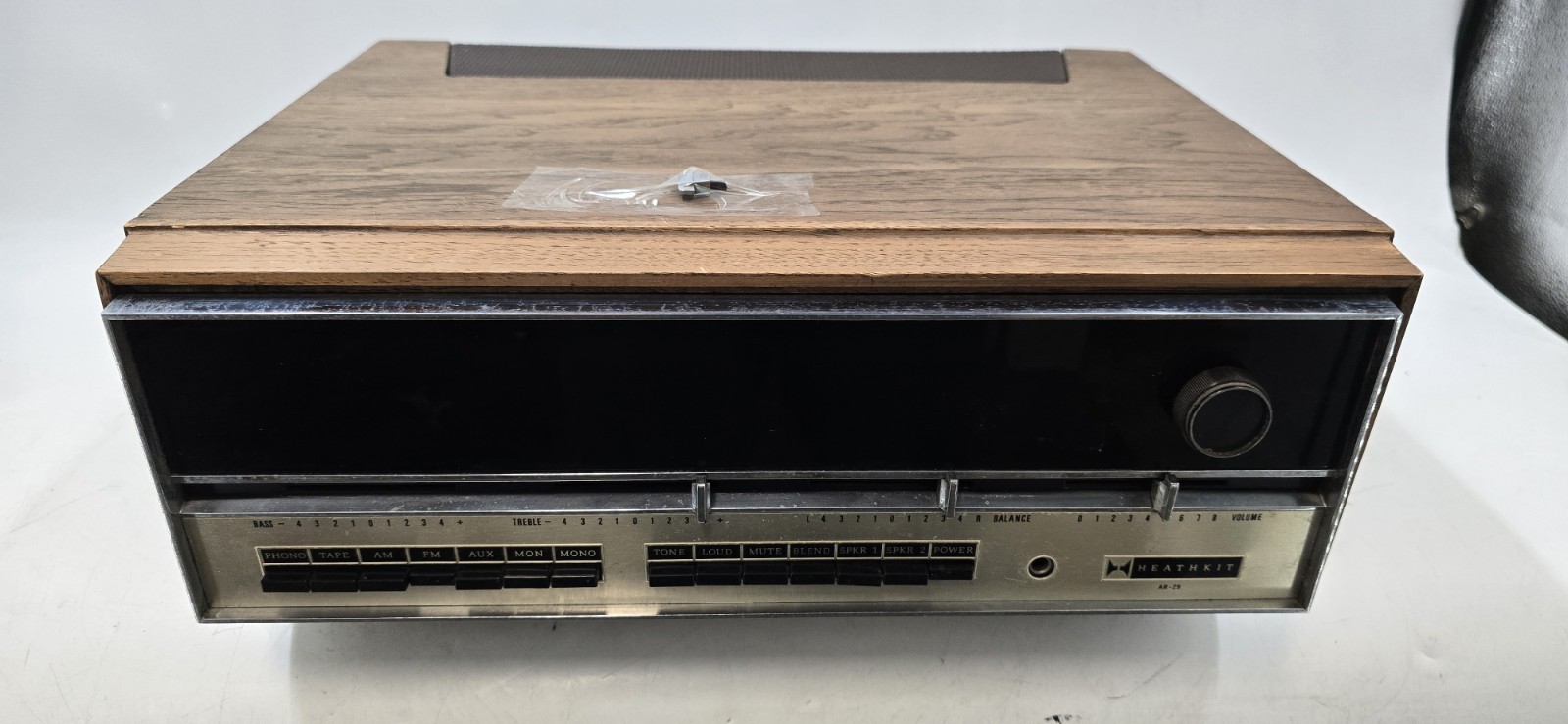
The Heathkit AR-29 AM-FM Stereo Receiver isn’t one of those mythical kits that every vintage audio geek raves about, but if you’ve ever dug through a basement full of dusty receivers or scrolled past a $29.99 “needs repair” listing, you’ve probably wondered: what even is this thing? Turns out, it’s a solid-state stereo receiver from the early '70s, built by Heathkit during a time when the line between kit and factory-built gear was starting to blur. Unlike earlier Heathkit staples that arrived in cardboard boxes with bags of resistors and hand-wound transformers, the AR-29 may have been available pre-assembled—or at least offered that option—reflecting a shift in the company’s approach as the DIY market evolved.
Manufactured between 1970 and 1976, the AR-29 sits quietly in the background of Heathkit’s catalog, mentioned in passing alongside more prominent models like the AR-4 and AR-15 in reference lists of classic offerings. It wasn’t a flagship, and it wasn’t a budget afterthought—it was just another receiver in a lineup that catered to hobbyists who wanted decent performance without the premium price tag. It’s the kind of unit that likely spent decades in a dorm room, a bedroom, or a second home, quietly playing FM radio and spinning vinyl until it was unplugged and forgotten.
What’s clear from surviving listings is that the AR-29 wasn’t immune to the wear and tear of time. Common issues include non-functional power, broken sliders, missing button covers, and absent AM antennas—hardly surprising for a 50-year-old piece of consumer electronics. One parts unit listed online won’t even power on, and another sells for $75 CAD with just the power supply and preamp boards. These aren’t rare failures; they’re the expected condition for most surviving units. If you’re hunting for a working AR-29, you’re not just buying a receiver—you’re buying a restoration project.
Specifications
| Manufacturer | Heathkit (Heath Company) |
| Model | AR-29 |
| Type | AM-FM Stereo Receiver |
| Years of manufacture | 1970 - 1976 |
Historical Context
Heathkit had been a cornerstone of the electronics hobbyist world since 1947, when it launched with a 5-inch oscilloscope kit that set the tone for decades of hands-on learning. By the time the AR-29 rolled around in the early 1970s, the company was no longer just about kits. While its reputation was built on do-it-yourself culture, the reality was shifting—many products, possibly including the AR-29, were offered either as kits or fully assembled, and some were only available pre-built. This reflected broader industry trends: consumers wanted convenience, and the complexity of solid-state circuitry made kit assembly less accessible to beginners.
The AR-29 appears in a “Classic Models Reference” list alongside other Heathkit audio gear like the AR-4 and AR-15, but there’s no documentation explaining where it fits in the hierarchy. Was it an upgrade? A budget alternative? We don’t know. What we do know is that Heathkit was still innovating in education and electronics, even as the market for home-built receivers began to shrink. The company would continue offering products into the early 1990s, though no new kits were developed after 1986. By 2012, Heathkit had filed for bankruptcy, closing a chapter that once made electronics tinkering a weekend pastime for thousands.
Collectibility & Value
Let’s be honest: the Heathkit AR-29 isn’t a collector’s darling. There’s no cult following, no boutique restoration scene, and no verified performance reviews to back up claims of sonic magic. What it has is presence in the used market—and even that’s spotty. Recent listings show a wide price range: a used unit with no manual or cables went for $75.00; another sold for $149.99; a third was listed at just $29.99 as a “vintage solid state” receiver in untested condition. These prices suggest that value is driven more by case condition and functionality than by demand.
Given the reported issues—non-working power supplies, broken sliders, missing parts—it’s safe to assume most AR-29s need work. The fact that individual boards (like the 85-459-1 power supply and 85-400-1 preamp) are being sold separately for $75 CAD hints at a niche repair ecosystem, but not a thriving one. If you’re looking for a complete, working AR-29, you’ll likely need to piece one together. And good luck finding the manual—multiple listings specifically note its absence, which is a real pain for troubleshooting or restoration.
Bottom line? The AR-29 isn’t valuable, but it’s not worthless either. For Heathkit completists or tinkerers with a soft spot for obscure solid-state receivers, it’s a curiosity worth $30 to $75—if it powers on. If not, it’s a parts donor with a few reusable boards. Either way, it’s a reminder that not every vintage receiver gets to be a legend.
eBay Listings



As an eBay Partner, we earn from qualifying purchases. This helps support our independent vintage technology research.
Service Manuals & Schematics
Related Models
- Heathkit AA-32 (1972)
- Heathkit AA-100 (1957)
- Heathkit AA-121 (1972)
- Heathkit AA-40 (1970)
- Heathkit AD-17 (1976)
- Akai AM-2850 (1975)
- Akai AP-206 (1975)
- Nakamichi BX-1 (1985)
- Acoustic Research research-ar-17 (1978)
- Acoustic Research AR-19 (1994)