Heathkit AR-15 (1968)
Nearly nineteen hundred parts, two FETs, and a crystal filter - Heathkit's most ambitious kit ever, and the receiver that started a dynasty.
Overview
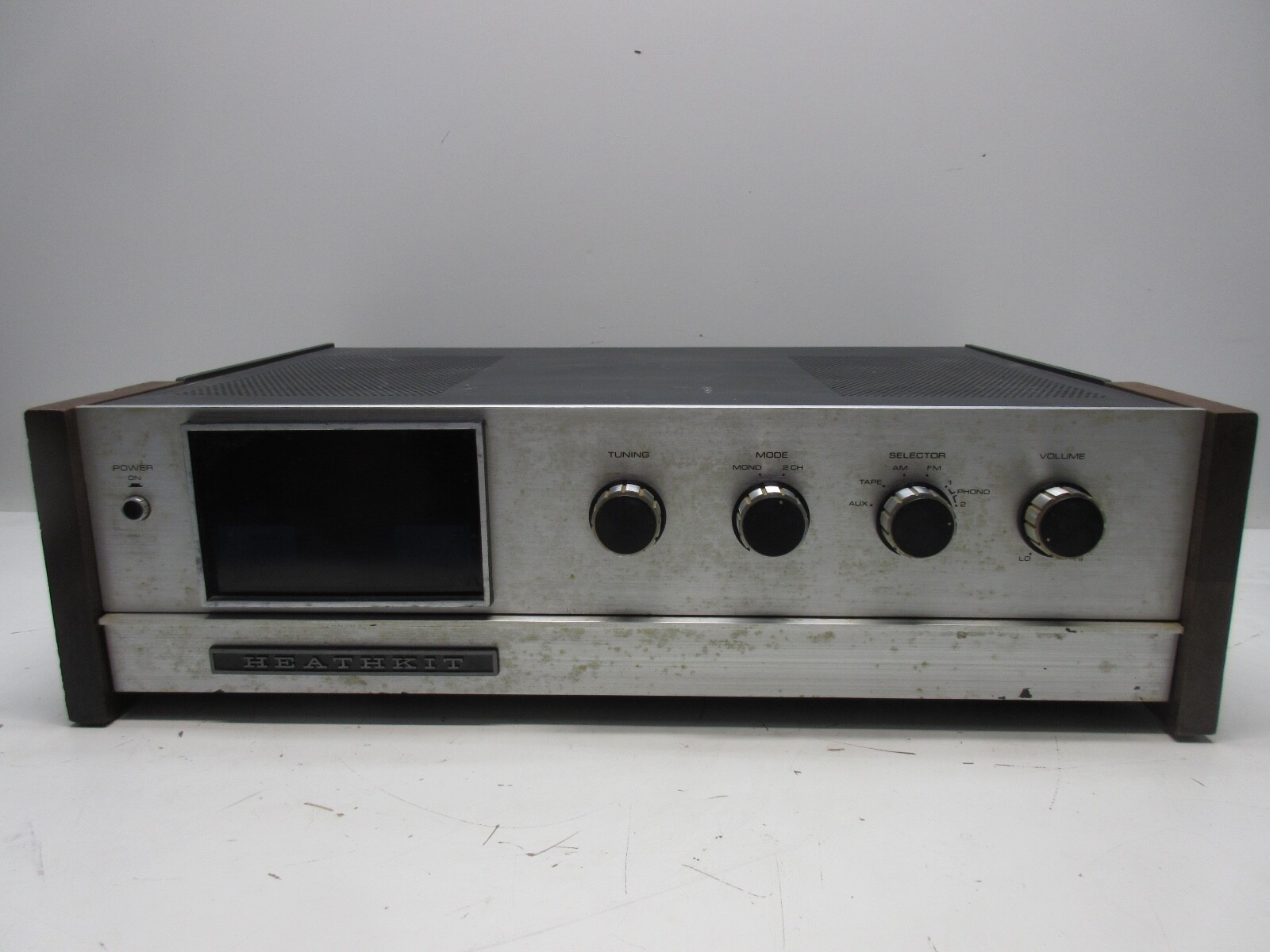
The AR-15 is the receiver that made Heathkit's reputation as a serious hi-fi house rather than a kit-parts supplier. It debuted in 1968 (some sources say 1967, and the year is contested). It was the company's top-of-the-line FM/FM stereo tuner amplifier, and one of the most ambitious pieces of kit electronics ever sold to the public. The build sheet ran to 1,890 parts. That's not a typo. Nearly two thousand components, each one soldered by the buyer, each one a potential cold joint.
The AR-15 wasn't a do-everything receiver. It was an AM/FM stereo receiver, with the AM band present alongside FM. For the era, that was a deliberate and somewhat radical choice. Heathkit put the money and the engineering into the FM front end, using two FETs paired with a 10.7 MHz crystal filter in the IF stages. According to period advertising, the tuner section could pull in weak stations and hold them, with six-stage IF limiting and selectivity above 80 dB. FM sensitivity was rated at 1.8 µV (IHF). That's a respectable figure for a kit-built unit, and it put the AR-15 in the same conversation as factory-built tuners costing considerably more.
The amplifier side was just as serious. Rated output was 75 watts per channel continuous (some sources say 50 watts per channel, and the figure is contested). Harmonic and IM distortion were both under 0.5% at rated output, and under 0.15% at 10 watts, which is where most listening actually happens. Frequency response was specified at 20 to 20,000 Hz ±1 dB, with power bandwidth extending from 5 to 40,000 Hz. Residual hum and noise sat 80 dB below rated output. Those are numbers you'd expect from a well-engineered factory receiver, not a kit.
The design is all solid-state, with 56 transistors and 43 diodes and no tubes anywhere. In 1968 that was still a statement. The AR-15 was Heathkit saying, publicly and at length, that solid-state was the future and that a kit builder with patience could own it for less than the cost of a comparable factory unit.
Key Features
Dual FET Front End with 10.7 MHz Crystal Filter IF
The FM tuner section is where the AR-15 earns its reputation. Two field-effect transistors in the front end, feeding a 10.7 MHz crystal filter in the IF strip, was a serious design for 1968. You'd find it in tuners from the big-name manufacturers, not in a mail-order kit. The crystal filter gives the IF section a fixed, stable passband that doesn't drift with temperature or age the way LC-tuned IF transformers can. Combined with six-stage IF limiting, it gave the AR-15 the capture ratio and quieting to make weak stereo stations listenable rather than merely receivable.
FM stereo separation was rated at greater than 40 dB. That's a solid figure for the era, and it means the stereo image held together across the band. Selectivity above 80 dB meant adjacent-channel rejection was good enough for crowded urban dials. The 1.8 µV IHF sensitivity figure was the headline number, and it's the one Heathkit's advertising led with.
75 Watts Per Channel, All Solid State
The amplifier section was rated at 75 watts per channel continuous, all solid-state, with 56 transistors and 43 diodes doing the work. Harmonic and IM distortion were both specified under 0.5% at rated output, dropping to under 0.15% at 10 watts. Frequency response was 20 to 20,000 Hz ±1 dB, with the power bandwidth reaching from 5 to 40,000 Hz. That's wide enough that the amplifier wasn't the limiting factor in the system.
Hum and noise sat 80 dB below rated output. A receiver with 75 watts and audible hum is worse than a receiver with 40 watts and a dead-quiet noise floor. The AR-15 was designed to be the quiet one.
1,890 Parts — The Most Ambitious Kit Heath Ever Sold
It was called "the most ambitious kit ever offered by Heath," and the 1,890-part count backs that up. This is not a weekend build. Heathkit itself positioned the finished receiver as the finest available, and period advertising quoted reviewers describing it as "an audio Rolls Royce" and "engineered on an all-out, no compromise basis."
The wooden cabinet was a separate accessory, part number AE-16. That's why so many surviving AR-15s turn up either in a generic case or in the optional walnut enclosure. The AE-16 is the case the receiver was designed around.
Historical Context
The AR-15 arrived in 1968 at a moment when Heathkit was already well established as a kit manufacturer but not yet as a hi-fi brand in its own right. According to one account of the company's lineup, "the tradition of Heathkit stereo receiver superiority began in 1967 with the Heathkit AR-15." The 1967-versus-1968 date is contested across sources, but the sentiment is consistent. Other Heathkit receivers were measured against the AR-15.
Heathkit's advertising leaned heavily on the reception the AR-15 received. Ads in High Fidelity (August 1968, p.29) quoted reviewers calling it "an audio Rolls Royce" and describing it as "engineered on an all-out, no compromise basis." The company repeated that praise across multiple publications through 1970. The archive has not surfaced any contemporary independent lab measurements beyond what Heathkit's own ads quoted. The praise is real and contemporaneous, but it comes largely through the manufacturer's own promotional filter.
What is not in dispute is the AR-15's place in the Heathkit lineage. The AR-1500, introduced around 1971 or 1972, is described as "Heath's flagship model following the renowned AR-15," an explicit acknowledgment that the AR-15 set the standard the AR-1500 was built to exceed. The AR-1500 was offered in both kit and pre-assembled form, priced at $379.95 with an additional $24.95 for the walnut cabinet. The AR-15's own original kit price is not documented in the sources.
Collectibility & Value
The AR-15 has a following, but it's a working-restoration following rather than a pure-collector one. Surviving units turn up on the used market in the $200 to $400 range depending on condition and whether the wooden cabinet is included. Listings describe units "offered in fair used condition," and at least some turn up sold as parts-only. The AR-1515 model name also appears in listings, which may be a variant or a different model. Verify before buying if the distinction matters.
The bigger issue is capacitors. Owners report that the AR-15 is prone to capacitor failure across the preamp, power amp, and power supply sections. One documented restoration involved "a serious case of bad caps in the preamp, power amp and power supply that were causing insane distortion (15%+!) in one channel and a loss of most of the audio in the other channel." Another owner symptom is one channel taking "a good fifteen seconds to come fully alive," moving from silence through distortion to full output. That's a classic sign of a dying capacitor in the power amp circuit.
The AR-15 is repairable. It's through-hole, discrete, and documented. Silver mica capacitors, per one restoration note, "don't typically fail" and are "as or more reliable than ceramic disc types," so a recap can focus on the electrolytics and the known-problem areas. There's no documented word on long-term reliability beyond these failure reports, and no published maintenance or spare-parts information in the archive. Anyone buying one should expect to do some work.
eBay Listings


As an eBay Partner, we earn from qualifying purchases. This helps support our independent vintage technology research.