Heathkit AJ-41 Tuner (1962)
A tube-powered AM/FM stereo tuner built like a tank, with a dial that glows like a spaceship control panel.
Overview
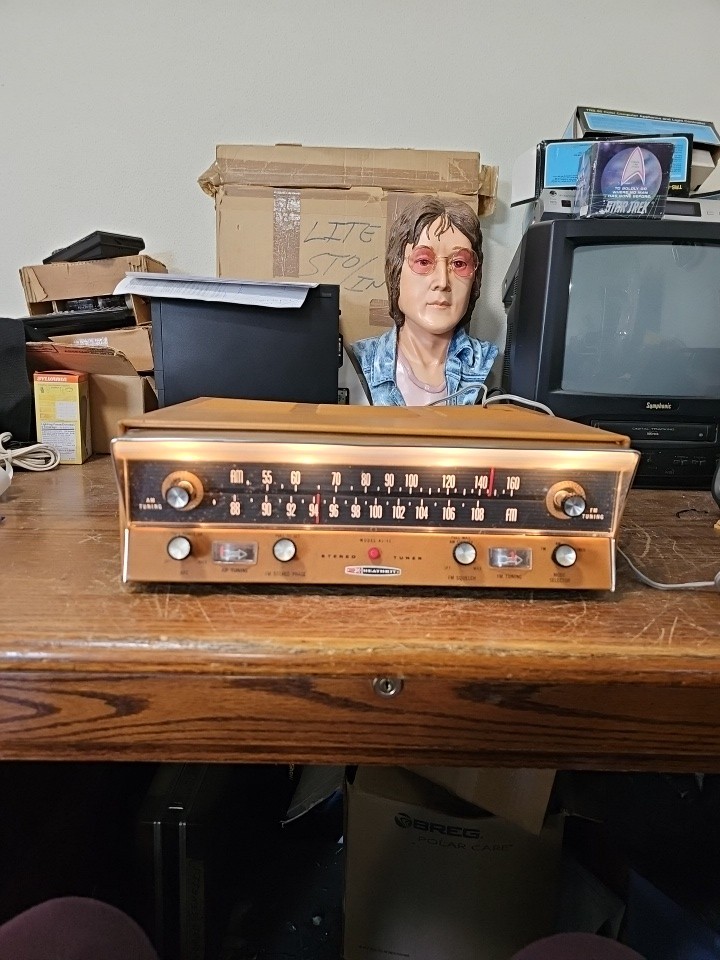
The Heathkit AJ-41 isn’t just a tuner—it’s a statement. Built in 1962, this AM/FM stereo tuner was designed for the serious hobbyist who wanted broadcast fidelity with the satisfaction of having built it themselves. With its luggage-tan vinyl-clad steel cabinet, polished anodized trim, and that iconic slide-rule dial lit from within, the AJ-41 looks like it rolled out of a mid-century sci-fi dream. But beneath the retro-chic exterior lies a serious piece of engineering: a tube-based receiver with completely separate circuits for AM and FM, a built-in FM multiplex adapter for stereo, and enough sensitivity and selectivity to pull in weak stations without breaking a sweat.
What sets the AJ-41 apart from many of its contemporaries is its dual nature—it’s both a precision instrument and a DIY project. Sold as a kit, it came with a preassembled tuning unit and prealigned coils, which meant builders could avoid the most finicky alignment steps while still getting their hands dirty on the rest. The “unitized” chassis design made assembly more manageable, and the heavy die-cast flywheels on the tuning controls gave it that luxurious, smooth feel that vintage gear collectors still crave. It was meant to match the Heathkit AA-100 amplifier, forming a high-fidelity tube stack that could hold its own against commercial receivers costing far more.
Owners report it as a "great, working" tuner with "deluxe features for deluxe performance," though many note it benefits from calibration and TLC after decades of shelf time. One listing calls it a "tube amplifier," which it isn’t—but that slip tells you something: people remember this thing not just for what it does, but for how it *feels*. With its sleek design and high-quality construction, it’s easy to see why it still turns heads.
Specifications
| Manufacturer | Heathkit |
| Product type | Tube-Type AM/FM and FM stereo Tuner |
| Tuning Range (FM) | 88 - 108 MHz |
| Tuning Range (AM) | 535 - 1620 kHz |
| Intermediate Frequency (IF) (FM) | 10.7 MHz |
| Intermediate Frequency (IF) (AM) | 455 kHz |
| Antenna (FM) | 300 Ω balanced |
| Antenna (AM) | Built-in rod, with provisions for external straight wire |
| Output Impedance (Cathode Follower) | variable to 4000 Ω |
| Output Voltage (FM) | Nominal, 0.5 volt with 3 µV, (30% modulation in) |
| Output Voltage (AM) | Nominal 3 volt |
| Quieting Sensitivity (FM) | 2 µV for 20 dB of quieting; 3 µV for 30 dB of quieting; 20 µV for full quieting, 40 dB |
| Sensitivity, Normal Position (AM) | at 1400 kHz : 3 µV; at 1000 kHz : 4 µV; at 600 kHz : 8 µV |
| Audio Frequency Response (FM) | 20 - 20,000 Hz, ±2 dB |
| Audio Frequency Response (FM Stereo Converter) | 50 - 15,000 Hz ±2 dB |
| Maximum Deviation Sensitivity | 5 µV, 400 Hz 100% modulation in, Deviation Sensitivity: 20 kHz (1100 µV in) |
| Harmonic Distortion (FM) | less than 1% (1100 µV, 400 Hz 100% modulation) |
| Harmonic Distortion (AM) | less than 1% |
| Intermodulation Distortion (FM) | less than 1% |
| Image Ratio (FM) | 40 dB |
| Image Ratio (AM) | 1400 kHz (50 dB); 600 kHz (75 dB) |
| Capture Ratio (FM) | 12 dB |
| AFC Correction Factor | 12 dB |
| Amplitude Modulation Suppression | 25 dB |
| Hum and Noise (FM) | 40 dB below 30% mod. (20 µV in) |
| Hum and Noise (Stereo) | -55 dB relative to 1 volt RMS output |
| Hum and Noise (AM) | 35 dB below 30% modulation (1000 kHz with 100 µV in) |
| Subcarrier Bandpass | 23,000 - 53,000 Hz ±3 dB |
| Channel Separation | 30 dB at 1 kHz; 25 dB at 10 kHz |
| Output Impedance (Stereo Cathode Follower) | variable to 4000 Ω , each channel |
| Outputs (Stereo) | Left - Right channel |
| Sensitivity Change, Normal to Maximum (AM) | -5 dB |
| IF Band Width (AM) | Normal : 14 kHz (6 dB down); Maximum : 20 kHz (6 dB down) |
| IF Rejection Ratio (AM) | 1400 kHz (42 dB); 600 kHz (38 dB) |
| 10 kHz Rejection (AM) | 40 dB |
| Tube Complement | 5 x 6AU6; 2 x 6BA6; 1 x 6BS8 or 6BZ7; 1 x 6AB4; 2 x 12AT7; 1 x 6AL5; 1 x 6BE6; 2 x 12AU7; 1 x 12BH7 |
| Power Supply | Transformer-operated, silicon rectifiers. |
| Power Requirements | 117 V, 50/60 Hz |
| Power Consumption | 100 watts |
| Dimensions (H x W x D) | Overall : 5-1/4" x 15-1/2" x 14-1/4"; Panel Mounting : 4-1/4" x 14-1/2" (Cutout); 12-7/8" (Depth) |
| Weight [net/shipping] | 18.5 lbs / 22 lbs |
Key Features
Separate AM and FM sections for clean signal paths
One of the AJ-41’s standout engineering choices is its completely separate circuits for AM and FM. This isn’t just a cost-no-object luxury—it’s a performance decision. By isolating the two bands, Heathkit avoided crosstalk, interference, and the kind of grounding issues that plague integrated designs. The result? A remarkably clean signal, especially on FM, where the full MPX stereo decoding happens without compromise. The AM side gets its own attention, with a fidelity switch that toggles between normal and maximum bandwidth (20 kHz at 6 dB down in max mode), letting you hear more detail on strong stations.
Built-in FM multiplex adapter and stereo indicators
For 1962, having a built-in FM multiplex adapter was a big deal. Most tuners required an external decoder to get stereo, but the AJ-41 had it baked in. That meant you could plug in your amplifier and get stereo right away—no extra boxes. And to let you know when stereo was active, a neon lamp lights up on the front panel. It’s a small touch, but it feels like a spaceship alert: *stereo engaged*. The stereo phase control lets you tweak channel separation for maximum clarity and minimum distortion, which matters because the spec sheet shows 30 dB at 1 kHz—respectable for the era, but adjustable fine-tuning helps get the most out of it.
Precision tuning with flywheel controls and illuminated dial
Tuning is a tactile experience here. The heavy die-cast flywheels on the tuning knobs aren’t just for show—they provide smooth, precise control, letting you zero in on stations without overshooting. The big slide-rule dial is refracted and internally lit, giving it that glowing, almost three-dimensional look that vintage gear collectors love. Individual meters monitor both AM and FM tuning, so you don’t have to rely solely on the needle—there’s a visual peak indicator to help with alignment.
Low-noise design with cathode followers and choke filtering
The AJ-41 takes noise seriously. Cathode follower output stages ensure low line impedance, which means it can drive long cables without high-frequency loss. The power supply uses silicon diode rectifiers—modern for the time—plus a choke to smooth out ripple and minimize hum. That heavy-duty, electrostatically-shielded power transformer isn’t just overkill; it’s there to keep the sensitive tube circuits isolated from power line noise. The result? Hum and noise on FM is 40 dB below 30% modulation, and stereo hum is down at -55 dB relative to 1 volt RMS—impressive numbers even by today’s standards.
Adjustable AFC and FM squelch for stable, quiet reception
The adjustable Automatic Frequency Control (AFC) helps lock onto stations and fight drift, a common issue with tube gear as it warms up. The AFC correction factor is 12 dB, which gives it enough pull to keep things stable without overcorrecting. And the adjustable FM squelch circuit? That’s a quiet superpower. It kills the hiss between stations, so when you’re scanning, you only hear audio when there’s a real signal. It’s a small feature, but once you’ve used it, you miss it on tuners that don’t have it.
Collectibility & Value
The Heathkit AJ-41 originally sold for $175—a serious investment in 1962. Today, working units in good condition are priced between $179 ("Used – Excellent") and $249.99 ("Used – Very Good"), with some listings as low as $99 for untested or repair-grade units. One Reverb listing describes it as "great, working" but notes it "could use some calibration and TLC"—a common refrain for vintage tube gear that’s been sitting for decades. Others are listed for "Parts/Repair," which suggests that while the AJ-41 is collectible, it’s not immune to age-related issues like dried capacitors or oxidized switches. Still, with its robust construction, preassembled tuning unit, and detailed service manual support, it’s a rewarding project for the right builder. It’s not just a tuner—it’s a time capsule of 1960s high-fidelity ambition.
eBay Listings



As an eBay Partner, we earn from qualifying purchases. This helps support our independent vintage technology research.
Service Manuals & Schematics
- Manual — archive.org
Related Models
- Heathkit AA-32 (1972)
- Heathkit AA-100 (1957)
- Heathkit AA-121 (1972)
- Heathkit AA-40 (1970)
- Heathkit AD-17 (1976)
- Akai AM-2850 (1975)
- Akai AP-206 (1975)
- Nakamichi BX-1 (1985)
- Acoustic Research research-ar-17 (1978)
- Acoustic Research AR-19 (1994)