Heathkit AJ-31 FM Tuner (1962)
That warm, tube-powered glow when you fire it up—like tuning into the future from your basement workshop in 1962.
Overview
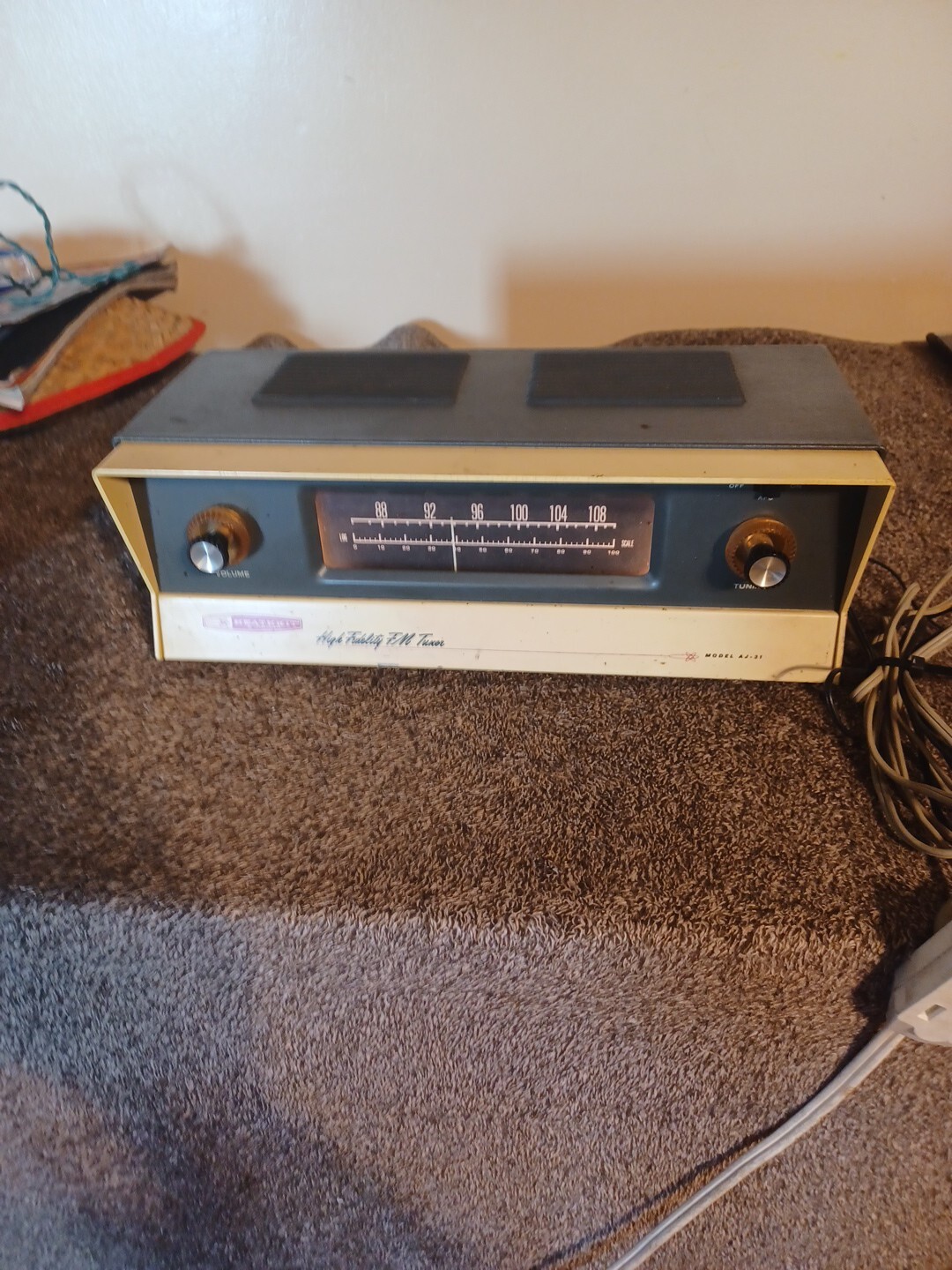
You didn’t just buy the Heathkit AJ-31 FM Tuner—you built it. That’s the whole point. Released in 1962, this wasn’t some off-the-shelf box from a department store; it was a hands-on invitation to dive into the guts of high-fidelity FM reception, screwdriver in hand, following Heathkit’s famously clear instructions. Marketed as a “High Fidelity” mono FM tuner kit, the AJ-31 carried forward the legacy of its predecessor, the “world-famous” FM-4, packing all its superior performance into a sleek new chassis with modern styling. For the DIY audiophile of the early 1960s, this was a serious step up—offering broadcast band clarity that could stand toe-to-toe with commercial units, but at a fraction of the cost and with the pride of ownership that only comes from assembling it yourself.
And let’s be honest—there’s something deeply satisfying about that charcoal grey steel case. It doesn’t scream “hi-fi,” but it doesn’t need to. It’s understated, industrial, built to last. When you slide that flywheel tuning knob, feeling the smooth resistance as the slide-rule dial glides past 98.5 or 101.1, you’re not just changing stations—you’re engaging with a machine. This was Heathkit at its peak, when the company was on its way to becoming the largest kit manufacturer in history, and the AJ-31 was a perfect example of their formula: smart engineering, accessible design, and tube-based warmth that still sings today.
Specifications
| Manufacturer | Heathkit |
| Model | AJ-31 |
| Type | FM Tuner kit |
| Year Introduced | 1962 |
| Tuning Range | 88 to 108 mc |
| IF Frequency | 10.7 mc |
| Quieting Sensitivity | 2.5 uv for 20 db of quieting; 3.5 uv for 30 db of quieting; 25 uv for maximum quieting (45 db) |
| Image Ratio | 45 db |
| AFC Correction Factor | 75 kc per volt |
| AM Suppression | 25 db |
| Frequency Response | ± 2 db 20-20,000 cps |
| Harmonic Distortion | less than 1.5%, 1100 uv, 400 cycles 100% modulation |
| Antenna | 300 ohms unbalanced |
| Output Impedance | 600 ohms (cathode follower) |
| Output Voltage | nominal .5 volt (with 30% modulation, 20 uv signal) |
| Power Requirements | 105-125 volts, 50/60 cycle AC at 25 watts |
| Dimensions | Overall--including cabinet and feet, 4-½" H x 13½" W x 6" D |
| Weight | 8 lbs |
Key Features
Tubes, Tuning, and That Flywheel Feel
The AJ-31 runs on a 5-tube circuit that handles nine tube functions—Heathkit’s clever way of doing more with less. Being tube-based, it delivers that classic mid-century warmth that solid-state tuners of the era often lacked. But what really sets it apart is the tuning experience. The flywheel mechanism gives you precise, drift-free control, letting you creep up on a station with satisfying mechanical feedback. Paired with the slide-rule dial, which lays out the FM band in crisp, linear fashion, it’s a joy to use—especially if you’re the type who likes to hunt for distant signals on a quiet Sunday night.
Pre-Assembled Front End: A Game Changer
One of the AJ-31’s smartest design choices was the preassembled, prealigned front end and tuning unit. For a kit, this was a big deal. It meant you didn’t have to wrestle with aligning the most sensitive RF stages—a task that could frustrate even experienced builders. Instead, you got reliable, factory-calibrated performance right out of the box, while still enjoying the hands-on assembly of the rest of the circuitry. It struck the perfect balance between accessibility and authenticity.
Built for the Future (and Stereo)
Even though the AJ-31 is a mono tuner, it was engineered with stereo in mind. How? Through its multiplex output jack, designed specifically for use with the Heathkit AC-11 Multiplex Converter. Plug in the AC-11, and suddenly you’ve got full FM stereo reception—making the AJ-31 a forward-thinking choice in 1962, when stereo broadcasting was just beginning to take off. That foresight is part of what makes it more than just a relic; it’s a modular component in a larger, expandable system.
Historical Context
The AJ-31 arrived in 1962, squarely in the 1960s era of rapid FM adoption and the golden age of DIY electronics. It wasn’t built in a vacuum—it was the direct successor to the legendary FM-4, and Heathkit made sure owners knew it. Every bit of the FM-4’s performance was carried over, now wrapped in a more modern chassis with improved ergonomics. At a time when high-fidelity gear was expensive and often out of reach for average hobbyists, Heathkit offered a way in. The AJ-31 wasn’t just a tuner; it was a statement that quality audio didn’t have to come from a big-name brand behind glass at a hi-fi store. You could build it yourself, learn from it, and own it completely.
Collectibility & Value
Original Heathkit kits like the AJ-31 are now considered vintage collectibles, prized for their build quality, historical significance, and that unmistakable tube-era charm. While comprehensive market data is sparse, one eBay listing offered a “Vintage Heathkit AJ-31 High Fidelity FM Tuner” at $68.00, labeled as sold. Descriptions from actual units highlight their condition: “immaculate” cases with no dents or scratches, and reports that they’ve been “gone through and are ready for action.” One seller noted a unit was “in overall great condition for the age” with “all tubes intact and it powers right up”—a reassuring sign for potential buyers.
Collectors pay attention to originality. One forum user stressed that the charcoal grey paint is the correct factory color and advised against repainting, warning it could “ruin the collector value.” That tells you something: this isn’t just about function. It’s about preserving a piece of audio history exactly as it left the kit box in 1962. If you find one that’s complete, tested, and cosmetically honest, you’re holding onto a well-built slice of the DIY revolution.
eBay Listings



As an eBay Partner, we earn from qualifying purchases. This helps support our independent vintage technology research.
Related Models
- Heathkit AA-32 (1972)
- Heathkit AA-100 (1957)
- Heathkit AA-121 (1972)
- Heathkit AA-40 (1970)
- Heathkit AD-17 (1976)
- Akai AM-2850 (1975)
- Akai AP-206 (1975)
- Nakamichi BX-1 (1985)
- Acoustic Research research-ar-17 (1978)
- Acoustic Research AR-19 (1994)