Heathkit AJ-1510/AJ-1510A (1972)
The blinking, card-swiping FM tuner that looked like it came from 2072—but actually helped invent the future of digital radio
Overview
Picture this: it's 1972, and your hi-fi rig still has knobs, dials, and maybe a VU meter or two. Then you lay eyes on the Heathkit AJ-1510. No tuning knob. No analog scale. Just a row of glowing orange numerals, a keyboard like a bank vault, and punch cards that click into place like something from NASA mission control. This wasn’t just a tuner—it was a statement. One of the very first all-digital synthesis PLL FM tuners ever produced, the AJ-1510 landed like a time traveler in the middle of the analog era, flashing its 88.1 to 107.9 MHz range with cold, digital precision.
Sold as a kit, of course—because this was Heathkit, and you didn’t just buy gear, you built it, learned from it, wrestled with it. The AJ-1510 wasn’t for the faint of heart or the casually curious. It was aimed at the advanced audiophile, the FM enthusiast, the tinkerer who wanted to stand at the bleeding edge of consumer electronics. And make no mistake: this thing was bleeding. Circuits ran on the edge of what was possible with early 1970s digital logic, using over 30 SSI/MSI ICs wired together without a microprocessor in sight. It was hard-wired logic, pure and unrelenting, a digital fortress built from TTL chips and FET amplifiers.
Despite its ambition, the AJ-1510 wasn’t flawless. Some owners report average sound quality—surprising for a $600 flagship (a fortune back then). The MC1310-based multiplex decoder and switching diodes in the audio path don’t exactly sing, and reliability? Let’s just say it’s not the most stable unit in the Heathkit catalog. But none of that diminishes its significance. This was the first digital frequency-synthesized tuner you could build at home, a machine that replaced the wobbly needle with rock-solid digital locking. And yes, it only tunes odd 200 kHz channels—92.3, 98.7, 106.9—but not 92.4 or 106.8. That’s not a typo. That’s how it works. Every. Single. Time.
Specifications
| Manufacturer | Heathkit (Heath Company) |
| Model | AJ-1510/AJ-1510A |
| Year Introduced | 1972 |
| Type | FM Stereo Tuner / Digital FM Tuner |
| Tuning Bands | FM |
| Tuning Scale | Digital |
| FM Tuning Range | 88.1 to 107.9 MHz |
| Sensitivity | 1.8uV (FM) |
| Signal to Noise Ratio | 65dB (FM) |
| Distortion | 0.3% (FM) |
| Selectivity | 95dB (FM) |
| Frequency response | 20Hz to 15kHz (FM) |
| Output | 1000mV |
| Dimensions | 16-3/8 x 6 x 14-3/4 inches |
| Weight | 15lbs |
| Tuning system | Digital phase-locked-loop (PLL) synthesis |
| Preset stations | 3 card-programmed preset station selectors |
| Tuning feature | Auto-scan tuning |
| Demodulator type | Digital/pulse-width FM demodulator |
| RF amplifier | FET RF amplifier |
| Display type | RCA Numitron display tubes |
| Multiplex decoder IC | MC1310 PLL decoder IC |
| Tuning increment steps | 200 kHz |
| Channel reception | Can only receive odd 200 kHz channels (e.g., 92.3, 106.9 MHz); cannot receive even channels (e.g., 92.4, 106.8 MHz) |
Key Features
Digital Synthesis Before Microprocessors
The AJ-1510 didn’t just use digital tuning—it helped define it. With no microprocessor, it relied on a hard-wired phase-locked-loop (PLL) system built from SSI and MSI logic ICs. This wasn’t an analog tuner with a digital counter slapped on top; it was a true synthesizer, locking onto stations with precision that analog dials could only dream of. The tuning voltage? A clean +30V applied to varicap diodes, regulated by discrete +5V, +15V, and +30V supplies. It was digital engineering in its rawest form—brilliant, brittle, and utterly fascinating.
Punch Card Presets: Analog Memory for a Digital World
Want to save your favorite stations? You didn’t program them—you punched them. Literally. The AJ-1510 used three BCD-encoded punch cards, each notched by hand to store a frequency. Slide one in, press the matching button, and the tuner jumps to your station. It’s a bizarre hybrid: ultra-modern digital logic paired with a mechanical memory system straight out of early computing. And yes, it’s as finicky as it sounds. Misaligned cards? Bad contact? You’re back to manual entry via the 1970s-style keyboard with its high-quality tactile buttons. But when it works, it feels like magic.
Numitron Displays: The Glowing Heart of the Machine
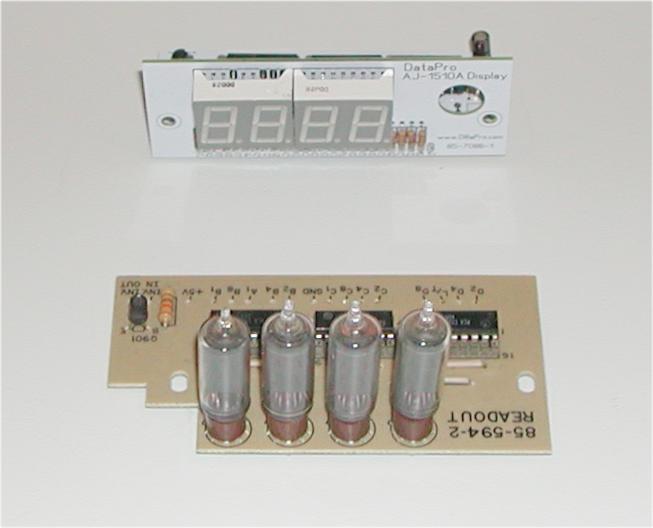
Those warm, filament-lit numerals? Those are RCA Numitron tubes—rare, fragile, and absolutely iconic. Each digit glows with a soft orange incandescence, housed in shrouded wells to cut down on reflections. They’re beautiful, yes, but they’re also a known failure point. Segments burn out, filaments break, and replacements are scarce—especially the smaller size used here. Owners report using the built-in lamp-test button just to check if all the digits still light up. But fear not: modern LED upgrade kits exist, reversible and designed to preserve originality while restoring function.
Modular, Serviceable, and Built Like a Tank
Inside, the AJ-1510 is pure Heathkit: seven plug-in circuit boards, a massive wiring harness connecting the front panel, and a chassis built for service. The face and trim are thick anodized aluminum, the inner cabinet thick-gauge aluminum for shielding. It was originally sold with a heavy wood cabinet—this wasn’t just a tuner, it was furniture. And under the drop-down front panel? A control suite that reads like a jet cockpit: auto-sweep speed, noise squelch, AGC squelch, signal/multipath switch, stereo/mono toggle. This was not a set-it-and-forget-it box. It demanded engagement.
Historical Context
The AJ-1510 arrived in 1972, a moment when digital technology was creeping into consumer audio but hadn’t yet taken over. No microprocessors, no memory chips—just logic gates and discrete regulation. It was futuristic not because it was easy, but because it was bold. The lack of knobs, the keyboard input, the blinking Numitrons—it all screamed “future” at a time when most tuners still had analog dials and mechanical presets.
Heathkit built it to capitalize on the growing fascination with digital precision and high-fidelity performance. It competed for top-tier status with elite tuners like the Sequerra FM1, Marantz 10B, and REL Precedent. And while Heath was beginning its pivot toward early computers, the AJ-1510 stood as one of its most expensive and advanced tuners—a final, glorious statement in the analog-to-digital transition. Some units even found their way into radio stations and studios, where the punch card system offered repeatable, reliable tuning for broadcast monitoring.
Collectibility & Value
The AJ-1510 is rare. Seldom seen. An amazing collector’s piece—not because it’s flawless, but because it’s fearless. It’s a machine that tried to do something radical with the tools available, and it shows. Reliability is a known issue; owners note that circuits run “on the edge” of then-available technology, and several design flaws have been documented. Detailed repair and modification guides exist, and many units have been upgraded for stability.
The biggest headache? The RCA Numitron displays. They fail. Segments go dark. Replacements are hard to find. But the community has responded: LED retrofit kits are available, and the lamp-test button remains a crucial diagnostic tool. Performance-wise, opinions vary—some call it “great,” others note the sound is limited by the MC1310 decoder and switching diodes in the signal path. But let’s be honest: people aren’t buying this for sonic perfection. They’re buying it for the experience, the history, the blinking, card-swiping, auto-scanning spectacle of it all.
As for price? No current market data was confirmed, but given its rarity, complexity, and cult status, a working, well-maintained unit would command a serious premium among vintage audio collectors—especially those who appreciate the DIY ethos and the dawn of digital tuning.
eBay Listings


As an eBay Partner, we earn from qualifying purchases. This helps support our independent vintage technology research.
Related Models
- Heathkit AR-19 (1964)
- Heathkit AA-111 (1976)
- Heathkit AA-13 (1957)
- Heathkit AA-14 (1957)
- Heathkit AA-141 (1977)
- Luxman L-530 (1975)
- Luxman R-404 (1975)
- Luxman RV-371 (1975)
- Luxman SQ-38U (1975)
- Luxman T-14 (1972)