Heathkit AA-40 (1960–1961)
Forty watts per channel of raw, unapologetic tube muscle—built by hand, tested to the limit, and still revered by those who’ve cranked it past eleven.
Overview
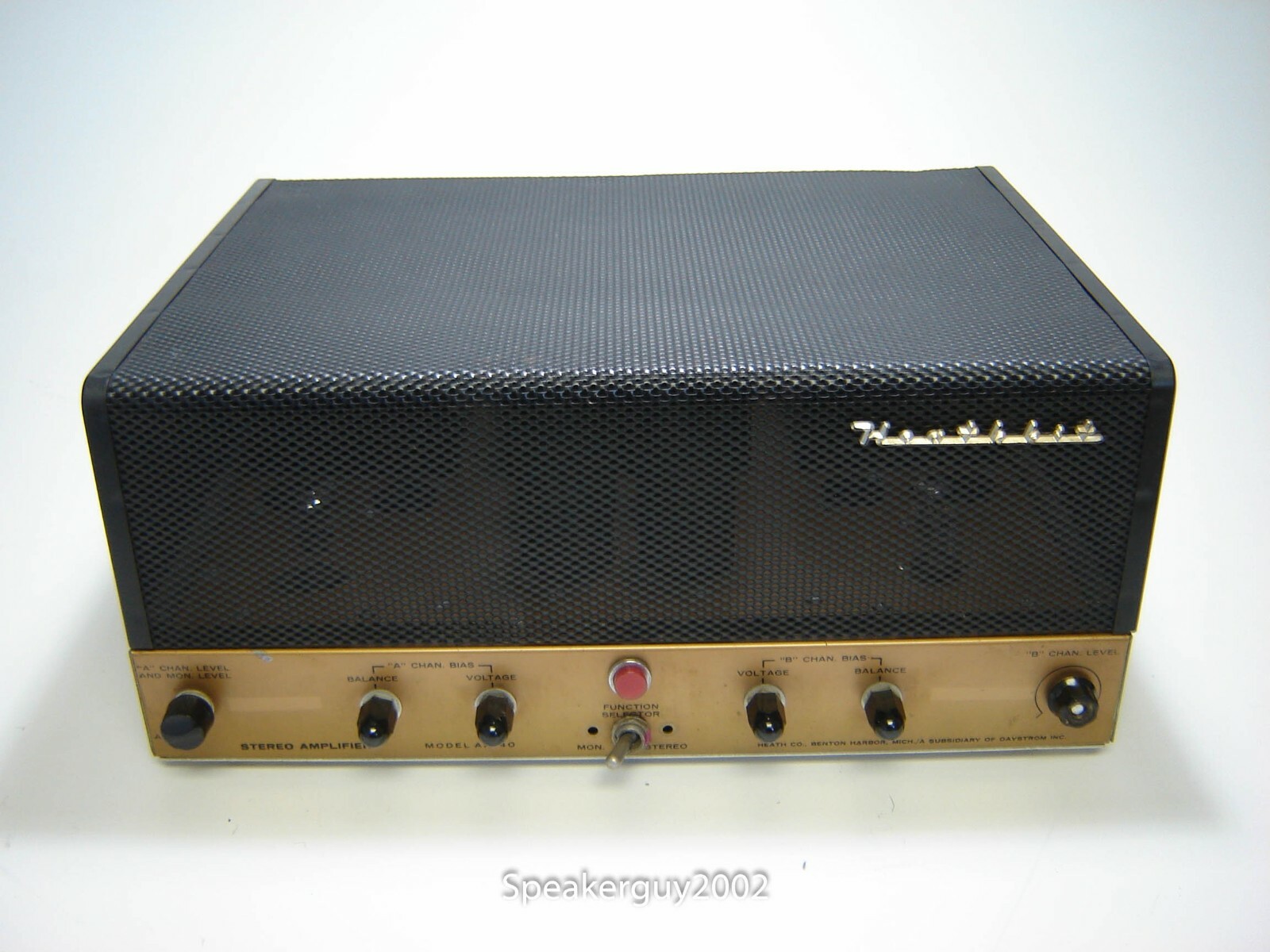
The Heathkit AA-40 isn’t just another vintage tube amp—it’s a statement. Built during the brief but brilliant window of 1960–1961, this stereo power amplifier was Heathkit’s 40-watt-per-channel flagship, a no-compromise design aimed squarely at the serious audiophile and the hands-on builder. At a time when many kits leaned toward modest performance and beginner-friendly assembly, the AA-40 stood apart: complex, powerful, and demanding. It wasn’t for someone looking to dip a toe into DIY audio. This was for the builder who wanted to wrestle with high-voltage circuits, bias adjustments, and a parts count pushing 470, all for the reward of an amplifier that could drive speakers with authority and grace.
And it delivered. Reviewers at the time didn’t just say it sounded good—they said it sounded like the best. “It proved to be rock-stable under a variety of load conditions, with a clean, solid sound that places it in a select but widening group of outstanding power amplifiers.” That’s not marketing fluff; that’s from a measured review in its era, and owners today still echo it. “Sounds awesome,” one reports. “Good sound tone, beautiful sound color.” Another puts it more bluntly: “If you own an AA-40, in my opinion you own gold.”
But let’s be clear—this is not a plug-and-play relic. It’s a 60-year-old tube amp with selenium rectifiers, bias adjustments that require a voltmeter, and a chassis prone to sagging under the weight of its own transformers. It demands respect, maintenance, and a willingness to get your hands dirty. But for those willing to meet it on its terms, the AA-40 offers something few vintage kits can match: the sound of a high-end amplifier from the golden age of hi-fi, built with your own hands.
Specifications
| Manufacturer | Heathkit |
| Model | AA-40 |
| Year Introduced | 1960 |
| Year Discontinued | 1961 |
| Type | Stereo power amplifier |
| Power Output | 40 watts per channel |
| Power Output (Measured) | 48 watts per channel at 1% harmonic distortion at mid-frequencies |
| Power Output (Mono) | 80 watts monophonically (paralleled operation) |
| Power Bandwidth | Below 20 cps to over 20 kc at half power (24 watts) with 1% distortion |
| Intermodulation Distortion | A few tenths of a percent at listening levels under 10 watts, reaches 1% at 40 watts |
| Frequency Response | Within a few tenths of a dB from 20 cps to 10 kc, -2.5 dB at 20 kc |
| Hum Level | 75 to 80 dB below 10 watts |
| Output Impedances (Stereo) | 4, 8, 16, and 32 ohms |
| Output Impedances (Mono) | 2, 4, 8, and 16 ohms |
| Tube Complement | 4 x EL34/6CA7, 2 x 6AN8 |
| Construction Time | About twelve hours |
| Parts Count | Approximately 470 parts |
| Dimensions | 11 in. deep by 15 in. wide by 7¼ in. high |
| Fuse Rating | 4 amp slo-blo |
Key Features
Push-Pull Power with Precision Tubes
The AA-40’s circuit topology is classic push-pull: each channel uses a pair of EL34 or 6CA7 output tubes, driven by a 6AN8 tube that combines a pentode and triode in one envelope. This configuration delivers both high power and tight control over the output stage. The result? An amplifier that stays stable even with difficult speaker loads and refuses to “break up or sound mushy at the highest levels our ears could stand,” as one contemporary review put it. It’s not just loud—it’s clean, even at volume.
Robust Power Supply with Surge Protection
Powering this beast is a sophisticated supply that uses four silicon diodes in a voltage-doubling rectifier circuit—unusual for the time, and a sign of Heathkit’s engineering ambition. A selenium rectifier handles bias voltage for the output tubes, a design choice that’s now a known failure point but was standard practice in 1960. More clever is the “surgistor,” a current-limiting resistor in the primary power lead that acts like a time-delay relay, reducing surge voltage during warm-up. It’s a subtle touch, but one that protects both the tubes and the power transformer.
Hands-On Control and Flexibility
The AA-40 doesn’t hide its complexity—it embraces it. Each channel has its own level control, allowing for fine-tuning of balance. A slide switch marked STEREO-MON connects both channel inputs for mono operation, useful for older recordings or critical listening. Channel A includes a phase-reversing switch, handy for checking speaker polarity. And for those experimenting with multi-channel setups, there’s a center channel output that sums the two signals—a rare feature in a stereo amp of this era.
But the real hands-on experience comes from the bias voltage and balancing adjustments, which require an external voltmeter. This isn’t a set-it-and-forget-it amp. You’ll need to measure and tweak the bias regularly, especially after tube changes. It’s a ritual, really—one that connects the owner to the machine in a way modern gear rarely allows.
Collectibility & Value
The Heathkit AA-40 is not a common sight, and a properly restored unit can command serious money. One eBay listing sold for US $1,049.00, described as used but restored. Even a bent-chassis AA-121—a model identical to the AA-40 except for cosmetics—sold for over $400 in a 2004 auction, suggesting strong and lasting demand.
But ownership comes with responsibilities. A proper restoration isn’t just about new tubes. It requires replacing all electrolytic, paper, film, and oil capacitors—a full recap of all PCBs. One seller offers a restoration kit for US $145.00, but even that won’t cover everything. And while the sound may be golden, the chassis isn’t always up to the task: the top can bend from the weight of the transformers, a known structural weakness.
Crosstalk is another potential issue, possibly caused by dirty switches or pots, though it’s not universally reported. And while some units show “very light hum” at startup, others report “no hum” at all—suggesting that a well-maintained AA-40 can be as quiet as it is powerful.
If you find one, expect to invest in its upkeep. But for those who do, the payoff is an amplifier that doesn’t just play music—it commands it.
eBay Listings


As an eBay Partner, we earn from qualifying purchases. This helps support our independent vintage technology research.
Related Models
- Heathkit AA-32 (1972)
- Heathkit AA-100 (1957)
- Heathkit AA-121 (1972)
- Heathkit AD-17 (1976)
- Heathkit AD-22 (1974)
- Akai AM-2850 (1975)
- Akai AP-206 (1975)
- Nakamichi BX-1 (1985)
- Acoustic Research research-ar-17 (1978)
- Acoustic Research AR-19 (1994)