Heathkit AA-32
A humble kit that punches way above its weight, this little tube amp delivers a surprisingly rich, three-dimensional sound that still surprises people who hear it today.
Overview
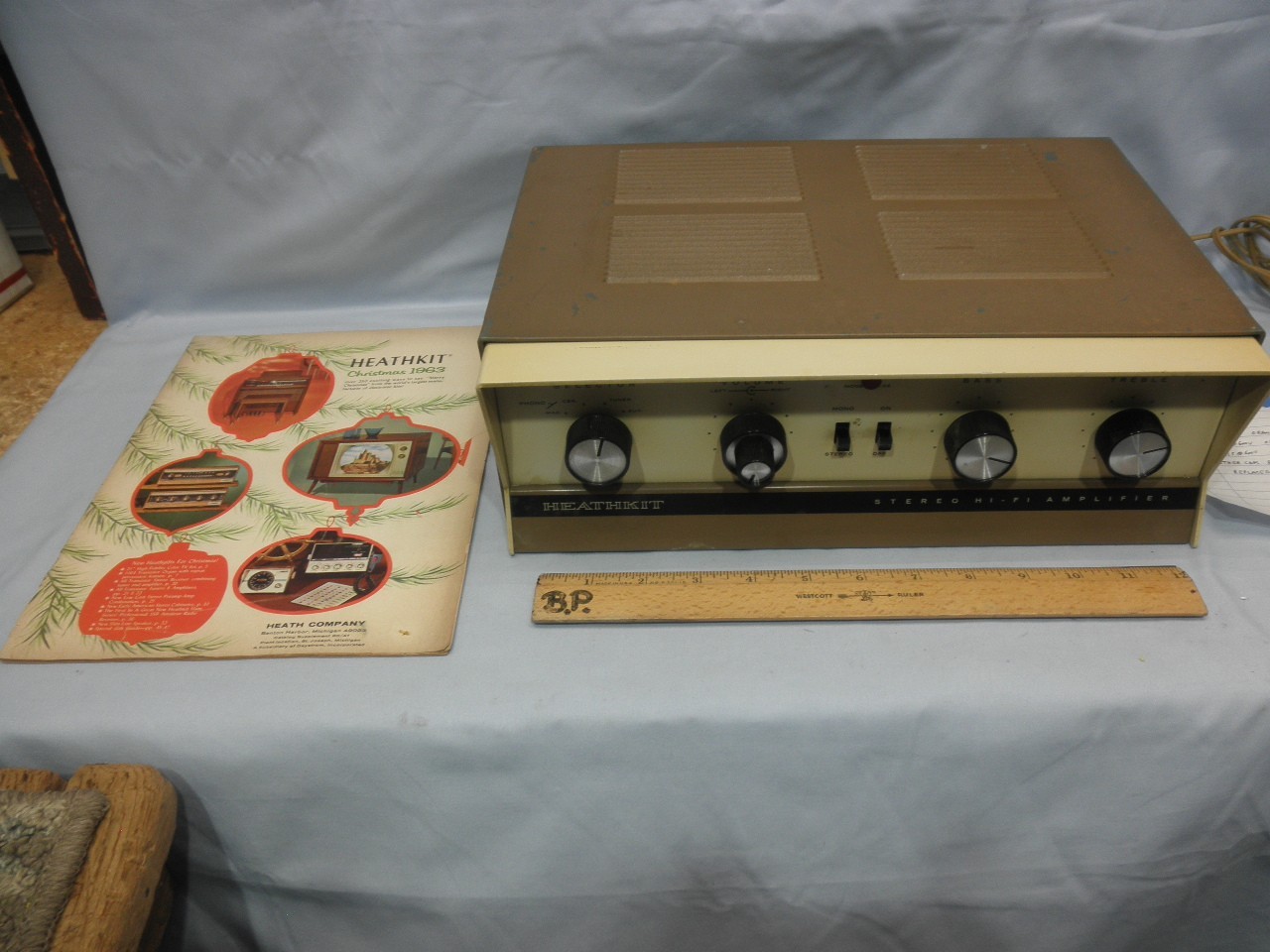
You don’t buy a Heathkit AA-32 because it’s flashy or powerful—you buy it because somewhere along the line, someone told you about this unassuming little integrated tube amplifier that, despite its modest specs and bargain-bin origins, just sounds right. Built from a kit for $39.95, the AA-32 wasn’t meant to be a high-end statement piece. It was supposed to be an affordable, build-it-yourself gateway into decent hi-fi. But what Heathkit accidentally created was something of a cult classic—an “excellent sleeper,” as one owner put it, and “one of the best kept secrets in vintage tube audio.”
Owners still talk about it with a kind of quiet reverence. “I am sorta amazed at how good this little thing sounds,” wrote one in 2008, and that sentiment echoes across decades of forum posts. It’s not the power—it’s only 8 watts per channel—but the character. People describe a “wonderful 3D quality,” especially in depth, with a punch and clarity that belie its price and era. One user runs it with JBL L20T speakers (around 87dB sensitivity) and says it “sounds great!” Another calls it “punchy” and full of life. It’s the kind of amp that makes you forget you’re listening to a 50-year-old kit built with hand-soldered wires and off-the-shelf tubes.
And that’s the point: the AA-32 was as much fun to build as it was to use. Heathkit’s whole philosophy was about engagement, about letting the hobbyist understand the machine they were feeding music into. This wasn’t a black box. It was a lesson in tube circuitry, hardwired point-to-point, with a heavy-duty power supply and large filter capacitors that gave it surprising headroom. It came with everything you needed—tubes, sockets, transformers, even the chassis—and a manual that walked you through every connection. For many, the pride of ownership started long before the first note played.
Specifications
| Manufacturer | Heathkit / Heath Company |
| Type | Stereo Amplifier / Integrated tube amplifier / Stereo Hi-Fi Tube Amplifier |
| Power output | 8 watts per channel |
| Total Harmonic Distortion | > 2% at 15,000 cps |
| Frequency response | 15-30,000 Hz |
| Inputs | Magnetic phono, tuner, auxiliary |
| Controls | Bass, treble, balance, loudness, mode |
| Speaker outputs | 4, 8, and 16 ohm |
| Output tubes | 6GW8/ECL86 (4 used) |
| Other tubes | 3 × 6EU7 |
| Dimensions | 15" wide, 4-1/2" high, 10" deep |
| Weight | 22 lbs |
| Feedback | 18 dB |
| Damping Factor | 9 |
Key Features
Tube-Based Design with Thoughtful Circuitry
The AA-32 is all tube, all the time—no solid-state trickery here, despite one erroneous claim floating around. It uses a cathode-biased push-pull output stage, which gives it that classic tube warmth with a bit more control than single-ended designs. The output tubes are four 6GW8/ECL86s—two per channel in push-pull—which were a compact, integrated pentode-triode design meant to simplify construction. Up front, three 6EU7 tubes handle the preamp duties, and interestingly, the triode sections in those 6EU7s are electrically identical to those in the legendary 12AX7, which might explain part of the amp’s lively, detailed character.
One of the more intriguing aspects is that the original output transformers aren’t Ultralinear capable, which limits certain mods—but that hasn’t stopped tinkerers. Owners report success “triode strapping” the 6GW8s, which reduces power slightly but often results in a smoother, more refined sound. One user noted it “sounds really better” with no noticeable drop in punch. That kind of mod-friendly nature is part of the AA-32’s appeal: it’s a solid foundation that invites experimentation.
Hardwired for Reliability and Tone
Unlike some kits that cut corners with terminal strips or printed circuit boards, the AA-32 is all hardwired. That means point-to-point wiring, hand-soldered connections, and a layout that’s both robust and sonically transparent. Some builders argue this construction is “probably structurally better than any Dynaco PAS3,” and while that’s debatable, there’s no denying that a well-built AA-32 has a certain solidity to it. The heavy-duty power supply, with its large filter capacitors, helps deliver stable voltage even during dynamic peaks—something that likely contributes to its surprising authority despite the low wattage.
One quirk: the phono section uses a 12.6V heater supply, which can limit tube substitution options. Some suggest building an external 12VDC supply to avoid noise or compatibility issues. But for those willing to work within the design, it’s a reminder that this amp was built with specific components in mind—not as a universal platform, but as a complete, self-contained system.
Collectibility & Value
Today, the AA-32 trades in a quiet but dedicated market. Complete units in working condition have been listed at $299 on Reverb and €350 on willhaben.at—prices that reflect both its cult status and the cost of bringing one up to spec. A restoration kit for the filter capacitors alone once sold for $147, underscoring how much effort (and money) owners are willing to invest.
The biggest hurdles for ownership aren’t mechanical—they’re existential. The 6GW8/ECL86 output tubes are becoming scarce. Sourcing a single tube is “tough enough,” let alone a matched quartet, and replacements can be costly. That alone makes the AA-32 a riskier proposition than more common tube amps. Then there’s the inevitable capacitor issue: like any vintage gear, the electrolytics dry out. One owner reported an intermittent “sizzling and crackling” in the right channel, suspecting leaky caps. Advice across forums is unanimous: recapping is essential. Specific replacements are known—a 40/40/40/40 μF @ 350/350/250/250V Mallory cap for the main filter, 30μF @ 200V (or 350V) for the voltage-doubler duty caps—and the power supply resistors are 3300Ω, 3300Ω, and 15KΩ, all ½ watt.
If you’re not comfortable doing the work, repair costs add up. One shop quoted $60 just for diagnostics, with full restoration likely exceeding $200. Manuals are still available from old Heathkit stock, though they’ll set you back around $25 if you can find them. All of this means the AA-32 isn’t a plug-and-play vintage gem—it’s a project. But for those who love the process as much as the result, that’s part of the charm.
eBay Listings



As an eBay Partner, we earn from qualifying purchases. This helps support our independent vintage technology research.
Service Manuals & Schematics
- Manual — archive.org
Related Models
- Heathkit AA-100 (1957)
- Heathkit AA-121 (1972)
- Heathkit AA-40 (1970)
- Heathkit AD-17 (1976)
- Heathkit AD-22 (1974)
- Akai AM-2850 (1975)
- Akai AP-206 (1975)
- Nakamichi BX-1 (1985)
- Acoustic Research research-ar-17 (1978)
- Acoustic Research AR-19 (1994)