Heathkit AA-1640 (1975)
Two hundred honest watts per channel, twelve pounds of diecast heat sink, and a soldering iron you supplied yourself.
Overview
Fifty-eight pounds of amplifier is the first thing that registers. That's the net weight Heathkit's own literature gives for the AA-1640, and it explains everything about the machine: the 25-pound power supply transformer alone accounts for nearly half of it, and the 12 pounds of diecast heat sinking make up most of the rest. This was a stereo power amplifier kit sold in 1975 and billed as the "Super-Amp," and the numbers Heathkit printed for it were not modest — 200 watts minimum RMS per channel into 8 ohms at less than 0.1% total harmonic distortion from 20 Hz to 20,000 Hz. The company's own advertising framed the case for that much power in plain terms: an acoustic-suspension speaker might need 20 watts for a normal listening level, but a momentary musical peak 10 dB louder demands 200, and an amp that can't deliver clips the peak off and takes the dynamic range with it.
The engineering under the rating sets the AA-1640 apart from the mid-'70s receiver kits. The output stage is quasi-complementary, built around 16 output transistors, eight per channel, run in parallel. The input amplifier is direct-coupled and differential. There's dissipation limiting, automatic thermal shutdown, and output compensation that Heathkit claimed made the amplifier unconditionally stable into any load. None of that is glamorous, and most of it is invisible once the cover is on. It's also the kind of conservative design that keeps a 50-year-old amplifier alive.
The full specification set, as Heathkit documented it, goes beyond the headline power figure. Frequency response is quoted at −1 dB from 7 Hz to 50 kHz and −3 dB from 5 Hz to 100 kHz. Intermodulation distortion stays under 0.1% from 0.25 watts all the way to 200 watts. Damping factor is greater than 50. Hum and noise is specified at less than 400 µV, or 100 dB below full output. Input impedance is 50k ohms, and input sensitivity is 1.5 V. That's high enough that the amp expects a line-level preamp rather than a phono stage, which is why Heathkit recommended pairing it with its own AP-1615 or AN-2016. Channel separation is quoted at a 50 dB minimum.
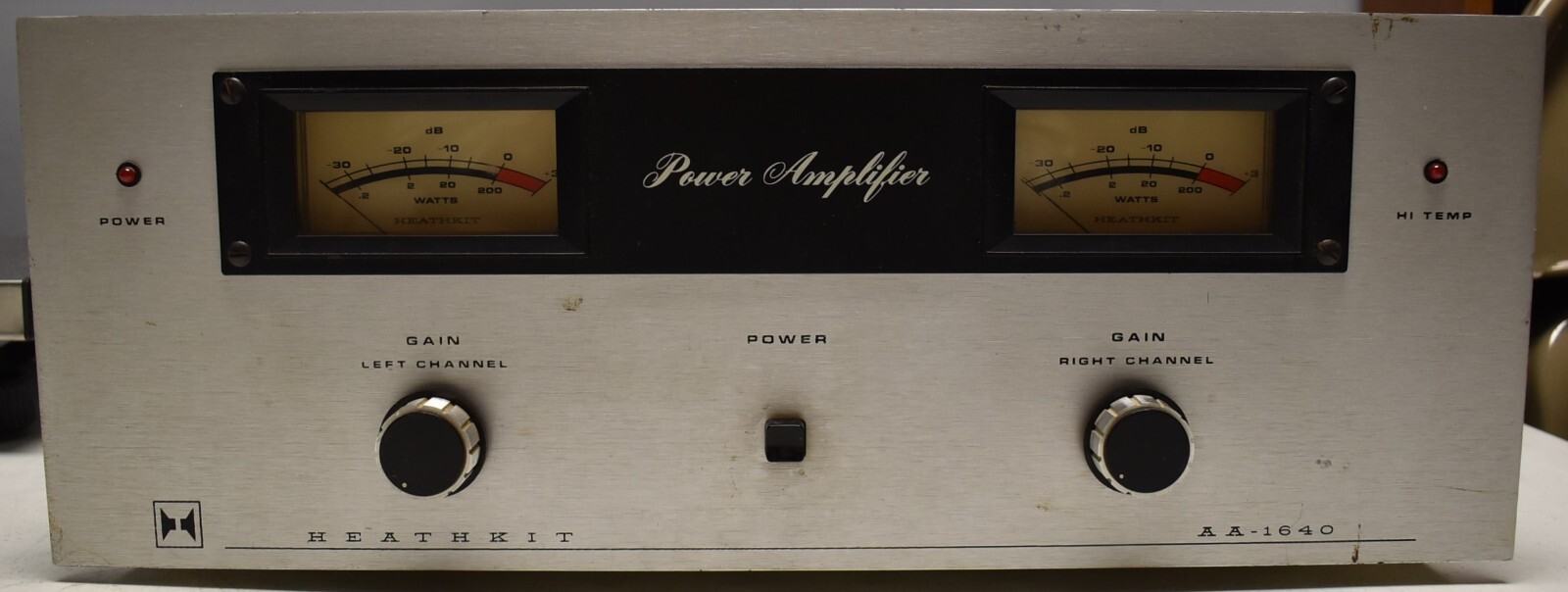
The chassis is a 19-inch-wide rack-style box, 7 inches tall and 18 inches deep, and it runs on a 120 VAC, 60 Hz supply only. Owners report the front panel carries pushbutton power, separate left and right gain controls, and LED indicators for power and high temperature. A pair of backlit meters was offered as an add-on rather than standard equipment. At least one owner notes his example was built with banana jacks on the outputs instead of the stock connectors, so no two kit-built units are quite identical.
Key Features
Sixteen Output Transistors in Quasi-Complementary Parallel
The output stage is eight transistors per channel, wired in parallel in a quasi-complementary arrangement. Spreading the current across that many devices helps reliability as much as power. Each transistor carries a fraction of the load, and the whole stage runs cooler than a two- or four-device design at the same output.
Twelve Pounds of Diecast Heat Sinking, No Fan
Heathkit dealt with the heat the plain way. Twelve pounds of diecast heat sinking handles dissipation without a fan, and the company made a point of it - even used as a PA amplifier, the AA-1640 needed only normal ventilation. No fan means no fan noise, no fan bearing to fail, and no dust pulled through the chassis. Fan-cooled high-power amps of the period weren't silent. Heathkit's own literature leaned on the 100 dB signal-to-noise figure and the absence of fan noise together.
Speaker Protection Relay and Thermal Shutdown
A relay circuit guards the speakers in two directions. It mutes the output on power-up and power-down to prevent thumps, and it disconnects the speakers if it detects DC or extremely low-frequency AC at the outputs. Those are the failures that turn a woofer into an expensive paperweight. Automatic thermal shutdown backs that up on the amplifier side, cutting the unit off before overheating can do damage.
Speaker Fuses in the Primary Feedback Loop
Heathkit's own design notes call this an exclusive arrangement. The speaker fuses sit inside the primary feedback loop, so the fuse doesn't sit between the amplifier and the speaker degrading the damping factor. The amp still sees better than 50 damping. Most designs that protect speakers with fuses pay for it in bass definition. This one, at least on paper, doesn't.
Optional Peak-Responding Output Meters
The backlit meters were an extra-cost accessory, calibrated from 0.2 to 200 watts into 8 ohms and from −30 to +3 dB. Their ballistics were fast enough to catch peaks as short as a record click, which made them useful as overload indicators rather than slow-swinging decoration. Buyers who ordered the amplifier and meters together saved $19.95 over buying them separately.
Historical Context
The AA-1640's launch advertising ran in HiFI-Stereo (May 1975, p.57) and High Fidelity (July 1975, p.31), both carrying the same "Super-Amp" copy and the same 200-watt claim. Heathkit's own catalog listed the kit at $479.95, or $539.95 with the meters included. A 1975 Christmas catalog page advertised the amplifier as "COMING JANUARY (1976)", so the model's commercial life straddled the two years. RadioMuseum records an original price of $489.95 for the "AA-1640 & AAA-1640-1" pairing, the AAA-1640-1 being the meter accessory designation. The Archive's own assessment is that the 200-watt rating put the AA-1640 near the top of the kit market at the time.
Independent bench testing is the gap in the record. No lab report from the period has surfaced, so the 200-watt figure, the distortion numbers, and the damping factor all trace back to Heathkit's own documentation rather than a third-party measurement. One owner's account describes the amp as built from kit by a former audio engineer for a local TV station.
Collectibility & Value
Prices for complete AA-1640s sit in a wide band. Reverb has listed a professionally tested and serviced example at $1,099, an Audio Asylum Trader unit sold at $450, and eBay listings in the Archive's own records sit at $430 and $640. The spread tracks condition and whether the amplifier has been gone through. A serviced unit with fresh capacitors commands roughly double an as-found example. Original speaker adapter plugs sell separately for $27.89 to $49.95, so the small parts evidently go missing a lot.
Support is better than for most kit amplifiers of the era. A restoration recap kit is sold for the model, service manuals and schematics are available through several sources, and at least one specialist shop advertises repair service for the AA-1640 by phone. One owner's YouTube account of blowing his up and bringing it back to life is the closest thing to a documented failure mode in the record. A 50-year-old amplifier with original electrolytics should be recapped before it's trusted with a good pair of speakers. The 58-pound weight means shipping is a real cost, and the 19-inch rack chassis means it wants a proper shelf.
eBay Listings
As an eBay Partner, we earn from qualifying purchases. This helps support our independent vintage technology research.
Related Models
- Heathkit AA-32 (1960s)
- Heathkit A5
- Heathkit AA-111 14W/Ch
- Heathkit AA-151 (1962–1967)
- Heathkit AA-1800 Stereo
- Eico 3150 (1967)
- Fisher CUSTOM-ELECTRA-I (K-14/K-15) (1957)
- Fisher CUSTOM-ELECTRA IV (E33/E44) (1960)
- Akai AM-2400 (1978)
- Akai AM-2600 (1977)