Heathkit AA-161 (1960s)
A warm, hand-built monophonic powerhouse from the golden age of tube kits—where hum, harmony, and a little homebrew craftsmanship met.
Overview
You didn’t just buy the Heathkit AA-161—you built it. That’s the whole point. Introduced in the early 1960s (circa 1963, based on a dated capacitor found in an unbuilt kit), this wasn’t some mass-market console with fake woodgrain and tinny speakers. It was a serious monophonic combination amplifier designed for the hobbyist who wanted real high-fidelity sound without the boutique price tag. And it delivered.
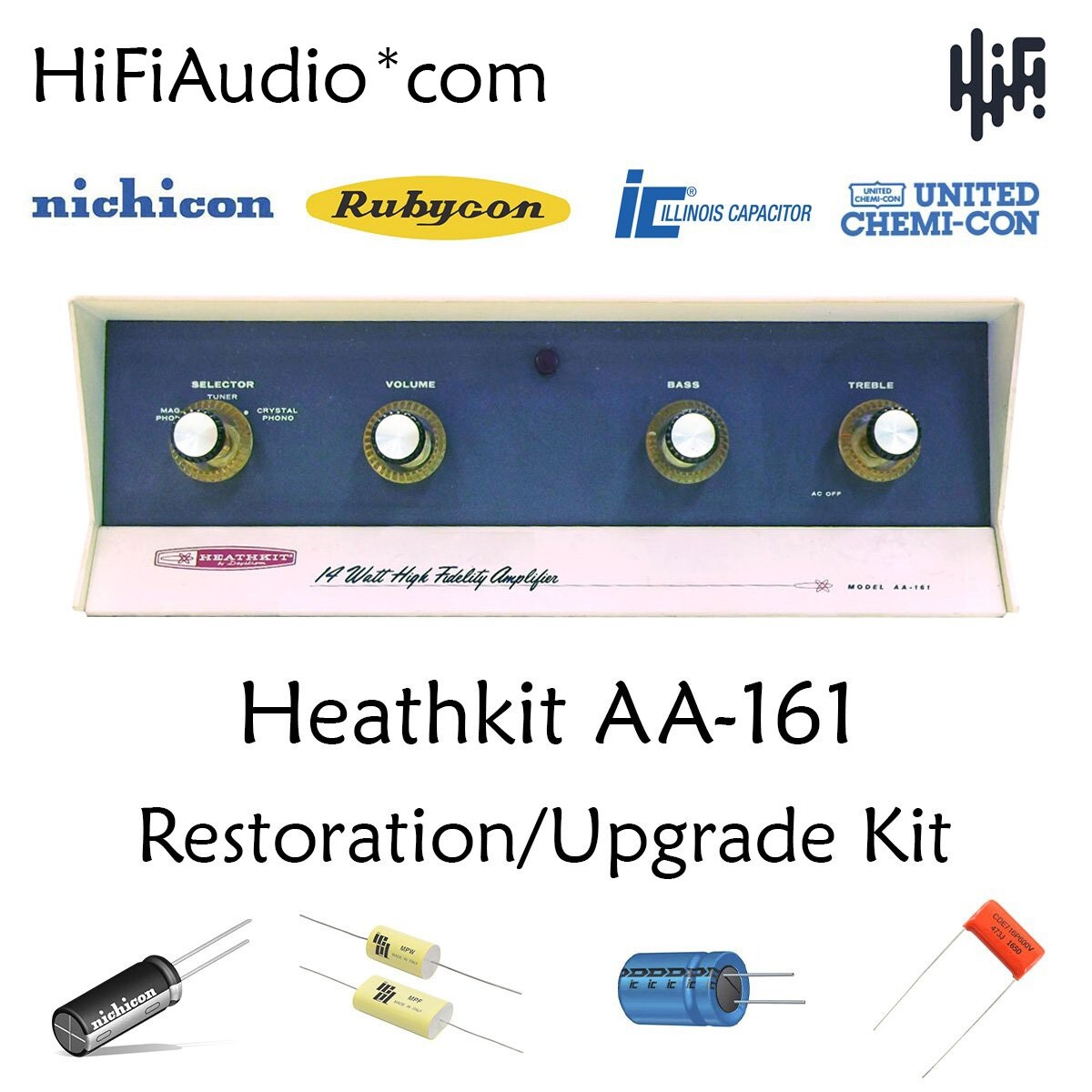
The AA-161 packed both preamplifier and power amplifier stages into one compact, charcoal grey steel chassis, finished with an elegant ivory bezel and lower front panel that gave it a clean, mid-century modern look. It was engineered to pair seamlessly with Heathkit’s AJ-21 AM or AJ-31 FM tuners, forming the core of a complete, matched hi-fi system built by hand—soldering iron in one hand, tube in the other.
Rated at 14 watts (Heath Hi-Fi Rating), with a slightly more optimistic 16 watts IHFM music power output, the AA-161 wasn’t about brute force. It was about clarity, control, and that rich, forgiving tube warmth that makes even worn vinyl sound inviting. With inputs for both magnetic and crystal phono cartridges, plus a tuner or tape source, it was built for the real-world setups of the era—no adapters, no compromises.
And yes, it hums. A little. But as one owner put it: “It works great but has a light hum, but can not be hear when music is playing, its the same with most tube amps 40 + years old.” That’s not a flaw—it’s a fingerprint. A whisper from the past, reminding you this thing was alive when JFK was in office.
Specifications
| Manufacturer | Heathkit |
| Model | AA-161 |
| Year Introduced | 1960s (circa 1963) |
| Type | Monophonic Combination Amplifier (Tube) |
| Power Output | 14 watts (Heath Hi-Fi Rating); 16 watts IHFM Music Power Output (2% THD, 1 KC) |
| Frequency Response | 30–15,000 cps ±1 dB at 14 watts output |
| Harmonic Distortion | Less than 2% at 30 cps to 15 kc at 14 watts output |
| Intermodulation Distortion | 2% or less at 14 watts output using 60 and 6,000 cps signals, 4:1 |
| Hum and Noise | 55 dB below 14 watts (mag. phono input); 65 dB below 14 watts (tuner and crystal phono) |
| Input Sensitivity | Mag phono: 0.004 V at 1 kc; crystal phono: 0.2 V; tuner: 0.25 V (tone controls flat) |
| Outputs | 4, 8, and 16 ohms |
| Damping Factor | 10:1 |
| Controls | 3-position function selector, bass and treble tone controls, volume control |
| Tube Complement | 1-6EU7, 1-6AU6, 1-6AN8, 2-EL84/6BQ5, 1-EZ81/6CA4 |
| Inputs | Tuner, magnetic phono, crystal phono |
| Output Transformer Model | 51-29 |
| Power Transformer Model | 54-63 |
| B+ Voltage (stock) | 390 VDC at designed line voltage |
| B+ Voltage (120VAC line) | 430 VDC |
| Power Requirements | 117 V, 50–60 Hz, 55 watts |
| Color and Finish | Charcoal grey steel cabinet with ivory bezel and lower front panel |
| Shipping Weight | 15 lbs |
Key Features
Kit-Built from the Ground Up
Like all Heathkits, the AA-161 arrived in a box—components, chassis, tubes, and a thick instruction manual that walked you through every solder joint and alignment step. This wasn’t just assembly; it was education. You learned how tubes bias, how transformers couple, and why grounding matters. And when it powered up for the first time, that glow from the EL84s wasn’t just light—it was pride.
Ultra-Linear Push-Pull with EL84s
At its heart, the AA-161 used two EL84/6BQ5 tubes in an ultra-linear push-pull configuration, driven by a 6AN8 tube. This topology offered a sweet spot between efficiency and linearity, delivering punchy midrange and smooth highs without the harshness that sometimes plagued lower-cost designs. The specially-designed output transformer (model 51-29) helped optimize power transfer across 4, 8, and 16 ohm loads, making it flexible with a wide range of speakers.
Filament-Balance Control for Hum Suppression
One standout feature was the filament-balance control—a clever circuit tweak that virtually eliminated AC hum by balancing the heater supply. It wasn’t magic, but it was smart engineering. In an era when hum was the bane of every tube amp owner, this was a real quality-of-life upgrade. Of course, after 60 years, that balance may need recalibrating—especially if you’re running it on modern 120VAC lines.
Input Versatility for Its Time
Having both magnetic and crystal phono inputs meant you could plug in nearly any turntable of the era without external preamps. The tuner input handled FM or AM sources, and while there was no dedicated tape loop, the labeling suggests it could accommodate a tape recorder or other line-level device. Three inputs, one clean switch—simple, effective.
Conservative Tube Layout with Miniature Tubes
The entire chassis used miniature tubes—no octal bases taking up space. That allowed for a compact layout inside the steel cabinet, and the use of the 6EU7 for phono, 6AU6 for line stage, and 6AN8 as driver was a proven, reliable chain. The EZ81 rectifier handled B+ duties, though owners today often note that replacing the electrolytic capacitors is a must for safe, long-term operation.
Historical Context
The AA-161 wasn’t invented in a vacuum—it was the successor to the well-regarded EA-3 monophonic combination amplifier, carrying forward proven design elements like the 51-29 output transformer and 54-63 power transformer, shared with earlier models UA-1, UA-2, EA-2, and EA-3. This continuity meant Heathkit could offer a high-performance amp at a lower cost, leveraging existing tooling and designs.
It arrived at a time when hi-fi was moving from luxury curiosity to middle-class aspiration. More people wanted better sound, but few could afford McIntosh or Marantz. Heathkit filled that gap—offering a “top-notch amplifier and preamplifier in a single low-cost package” that let enthusiasts build pro-level gear at home. The AA-161 wasn’t just an amp; it was a gateway.
Collectibility & Value
The AA-161 isn’t a headline-grabber at auctions, but it has steady appeal among Heathkit collectors and tube DIYers. One unit was listed for $400, though final sale prices aren’t widely documented. Condition, originality, and whether it’s been serviced play a big role.
The biggest red flag? Electrolytic capacitors. Like all tube amps of this era, the AA-161’s filter caps are likely dried out or failing. Owners consistently advise replacing all electrolytics before powering it up—especially given that modern line voltage (120VAC) pushes the B+ voltage up to 430VDC, beyond the 390VDC it was designed for. That extra stress can shorten tube life and increase the risk of failure.
Other common issues include intermittent fuses (one listing noted an intermittent fault causing blowouts), hum imbalance, and cosmetic wear—missing feet, scuffed cabinets, or oxidized controls. But with a full recap, tube check, and cleaned controls, the AA-161 can still deliver that “great little amp for your home audio enjoyment” experience, as one seller put it.
And yes—some people love the tone controls. One owner admitted: “I like the tone controls so I would like to keep them if quiet enough as they can add some flavor to the sound.” So much for neutrality. Sometimes, coloration is the point.
eBay Listings



As an eBay Partner, we earn from qualifying purchases. This helps support our independent vintage technology research.
Service Manuals & Schematics
- Schematic — archive.org
Related Models
- Heathkit AR-19 (1964)
- Heathkit AA-111 (1976)
- Heathkit AA-13 (1957)
- Heathkit AA-14 (1957)
- Heathkit AA-141 (1977)
- Luxman L-530 (1975)
- Luxman R-404 (1975)
- Luxman RV-371 (1975)
- Luxman SQ-38U (1975)
- Luxman T-14 (1972)