Heathkit AA-100 (1960–1964)
It wasn’t just a kit—it was a statement that DIY could outperform the competition, and for $84.95, it rewrote the rules of tube hi-fi.
Overview
The Heathkit AA-100 wasn’t just another amplifier dropped into the crowded 1960s hi-fi market—it was a declaration of independence. Introduced in 1960 as a kit-built, ultra-linear stereo integrated amplifier, it gave hobbyists the chance to assemble a 25-watt-per-channel powerhouse that reviewers claimed outperformed commercial units selling for twice the price. Priced at $84.95 in kit form, the AA-100 quickly earned its reputation as the "best buy on the market today" in the kit industry, and for good reason: it delivered serious performance with serious versatility, all wrapped in that unmistakable 1960s Heathkit aesthetic. Sold through 1964, this was the flagship of the Heathkit line during its prime, a machine built not just to amplify music, but to prove that a carefully engineered kit could stand toe-to-toe with anything off the shelf.
More than just a pair of glowing tubes in a steel chassis, the AA-100 was a full-featured control center. With five stereo inputs—including magnetic phono, tape head, tuner, and two auxes—it served as both preamp and power amp, making it one of the earliest true integrated designs in the kit world. Its feature set was ambitious: ganged level controls, balance and separation adjustments, dual-concentric tone controls, and even a mixed-channel center speaker output for early surround-like setups. This wasn’t a stripped-down amp for purists—it was for the tinkerer who wanted it all, and who took pride in building it themselves.
Specifications
| Manufacturer | Heath Company (Heathkit) |
| Model | AA-100 |
| Year Introduced | 1960 |
| Production Period | 1960–1964 |
| Type | Stereo Integrated Amplifier, kit |
| Power Output (Stereophonic) | 25 watts per channel |
| Frequency Response | 30 Hz to 15 kHz ±1 dB |
| Harmonic Distortion | Less than 0.5% at 25 watts, 1 kHz |
| Damping Factor | 15 |
| Input Sensitivity (Mag Phono) | 1.5 mV |
| Input Sensitivity (Tuner) | 0.2 V |
| Signal to Noise Ratio (MM) | 55 dB |
| Signal to Noise Ratio (Line) | 70 dB |
| Tube Complement | 2 x EF86, 4 x 12AX7, 2 x 7199, 4 x 7591, 1 x GZ34 |
| Power Consumption | 150 watts |
| Dimensions (H x W x D) | 5" x 15 3/4" x 13 1/2" |
| Shipping Weight | 34-1/2 lbs |
Key Features
Ultra-Linear Design with Precision PCBs
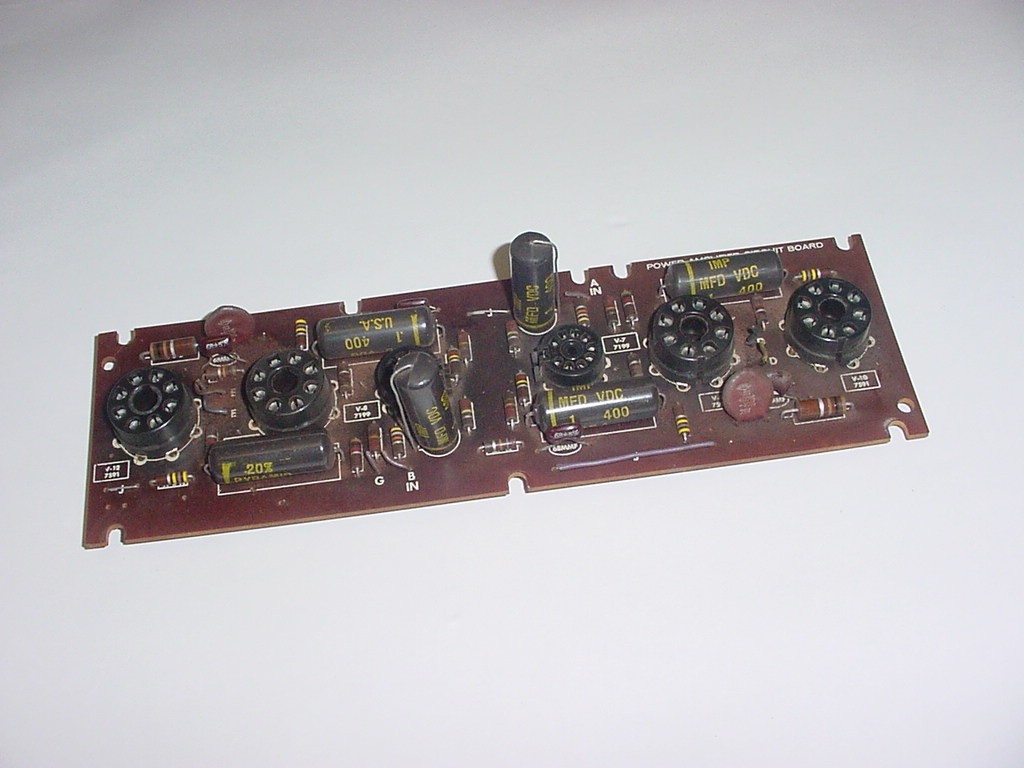
Under the hood, the AA-100 was a serious piece of engineering. It used an ultra-linear circuit topology with ultra-linear output transformers—technology typically reserved for high-end commercial amplifiers. This design helped deliver tight bass control and low distortion, contributing to its 15 damping factor and sub-0.5% harmonic distortion at full rated power. Unlike earlier Heathkits that relied on point-to-point wiring, the AA-100 embraced modern construction with printed circuit boards (PCBs), improving consistency and reliability for kit builders. The chassis itself was built from 16-gauge steel, and the cabinet wore a luggage-tan vinyl-clad finish with polished trim and a softly illuminated slide-rule dial—a design that screamed early 1960s modernism.
Comprehensive Control Suite
The front panel was packed with functionality. A 4-position function switch and 6-position selector switch handled input routing, while dual-concentric knobs managed bass (±15 dB at 30 Hz) and treble (±12 dB boost, ±20 dB cut at 15 kHz). A balance control offered up to 16 dB of adjustment, and a separation control let users fine-tune stereo imaging. The inclusion of a mixed-channel center speaker output was forward-thinking, hinting at the surround sound ambitions that would emerge decades later. Outputs included 4, 8, and 16 Ω taps for flexible speaker matching, plus cathode-follower tape recorder outputs for recording chain integration.
Phono and Line Input Flexibility
The AA-100 didn’t cut corners on inputs. The magnetic phono stage had an input sensitivity of 1.5 mV and used RIAA equalization, making it compatible with moving magnet cartridges of the era. The tape head input, with 1 mV sensitivity and NARTB equalization, was tailored for the tape decks of the time. Line inputs (tuner and aux) required 0.2 V for full output and boasted a healthy 70 dB signal-to-noise ratio, ensuring clean, quiet operation. The input impedances were well-chosen too: 47 kΩ for phono, 470 kΩ for tape head, and 250 kΩ for tuner and aux, minimizing loading issues across source types.
Historical Context
The AA-100 arrived in 1960 as more than just a new kit—it was a challenge to the commercial hi-fi establishment. At a time when factory-built amplifiers could cost hundreds of dollars, Heathkit offered a fully featured, high-performance alternative for just $84.95, built by the owner. It was the flagship of the Heathkit line from 1960 to 1962, and its success helped cement the company’s reputation in high-fidelity audio. Marketed as the “stereo-twin” of the Heathkit AJ-30 Stereo AM/FM Tuner, its styling also matched the AJ-41 tuner, making it easy to build a coordinated, modular system. The AA-100 wasn’t just a product—it was a milestone in the DIY audio movement, proving that kit-built gear could be both affordable and exceptional.
Collectibility & Value
Today, the Heathkit AA-100 is recognized as a “Classic Model” and “Legendary Product” by vintage audio enthusiasts. Restored units regularly list for $1,400 to $1,900, reflecting the labor and parts involved in a proper rebuild. However, unrestored or project units can be found for as little as $385, and European listings have asked €999, showing strong international demand. The disparity in pricing underscores a key truth: the AA-100’s value is tied almost entirely to its condition and restoration quality.
Common problems are well-documented. Extreme oxidation on the wafer rotary source selector switch is widespread in surviving units, often requiring disassembly and careful cleaning before the amp can function properly. Other typical failure points include burnt areas and lifting traces on the original output boards, degraded coupling capacitors, and the inevitable failure of the selenium bias rectifier—a component that should always be replaced with a modern silicon diode during restoration. Replacing power supply capacitors and cleaning potentiometers are standard steps in any AA-100 rebuild, and a replacement power amplifier PCB kit is available for those seeking improved reliability.
Despite its age, the AA-100 inspires loyalty. Owners call it “definitely a keeper,” praise it as “one sexy 60's vintage integrated amplifier,” and believe a proper repair can make it “GOOD TO GO... maybe for another 45 years!” That kind of enthusiasm speaks volumes about its enduring appeal.
eBay Listings



As an eBay Partner, we earn from qualifying purchases. This helps support our independent vintage technology research.
Related Models
- Heathkit AA-32 (1972)
- Heathkit AA-121 (1972)
- Heathkit AA-40 (1970)
- Heathkit AD-17 (1976)
- Heathkit AD-22 (1974)
- Akai AM-2850 (1975)
- Akai AP-206 (1975)
- Nakamichi BX-1 (1985)
- Acoustic Research research-ar-17 (1978)
- Acoustic Research AR-19 (1994)