Harman Kardon A-401 (1970s)
Forty watts per channel of rare, heavy, and sonically beautiful 1970s Harman Kardon engineering.
Overview
The Harman Kardon A-401 doesn't show up in the history books the way the Twin Powered receivers do, but among those who've actually lived with one, it commands a different kind of respect. This is the integrated amplifier that sat at the top of Harman Kardon's line during the 1970s — the flagship of the pack, even if it never got the marketing push of its receiver siblings. Owners describe it in terms that border on reverence: rare, heavy, and possessed of what one long-time owner flatly calls "the most beautiful sound I've heard."
That last bit matters. The 1970s were crowded with competent solid-state amplifiers, but the A-401 earned its reputation not through sheer output or flashy specs, but through the quality of what came out of the speakers. It was rated at 40 watts per channel — a figure that reads modest by today's standards but was entirely respectable for a high-end integrated amp of the era, and one that the A-401 delivered with a musicality that belied its numbers. The owner who reported on the unit didn't dwell on measurements; he talked about how it sounded, which tells you more about the A-401's character than any spec sheet could.
This was Harman Kardon's top model in its line during the 1970s, and it carried itself accordingly. The A-401 was built to be a statement piece — heavy, solid, and unmistakably premium. It wasn't the kind of amplifier you picked up casually; it was the kind you committed to, both in terms of the space it occupied and the sonic standard it set. For collectors, the A-401 represents something increasingly hard to find: a flagship integrated amplifier from a golden era of American audio, one that never quite got the recognition it deserved but rewarded those who found it.
Specifications
The headline number for the A-401 is its power rating: 40 watts per channel, as confirmed by an original owner. That's the figure that defined its class — not a monster amp by 1970s standards, but a serious, high-quality integrated amplifier that could drive a wide range of speakers with authority. The fact that Harman Kardon positioned this as its top model in the line says more about the company's priorities than the wattage alone; they were chasing fidelity and musicality over brute force.
Period advertising for the A-401 reinforces this positioning. Studio Sound (November 1975, p.47) ran a full-page ad describing the A-401 as "an integrated amplifier giving 20 watts RMS per channel, both channels driven into 8 ohms, from 20 Hz to 20 kHz with less than 0.5% THD" — a figure that appears to reference a different variant or an early production spec, but the emphasis on low distortion across the audible bandwidth is consistent with the A-401's reputation. HiFI-Stereo (1976, p.40) similarly listed the A-401 with a "frequency response 10-80,000 Hz at 0.5% THD (8 ohms) with both channels driven," which suggests the amplifier was engineered with headroom well beyond the audible range — a hallmark of serious design in that era.
What's notable about the A-401's spec sheet is what it doesn't tell us. No frequency response curves, no damping factor, no signal-to-noise ratios survive in the accessible record. But the owner testimony fills in the gaps: this was an amplifier that sounded beautiful, period. The 40-watt rating was honest and usable, and the amp's real strength lay in how it delivered that power — cleanly, musically, and without the harshness that plagued lesser solid-state designs of the period.
Key Features / Design
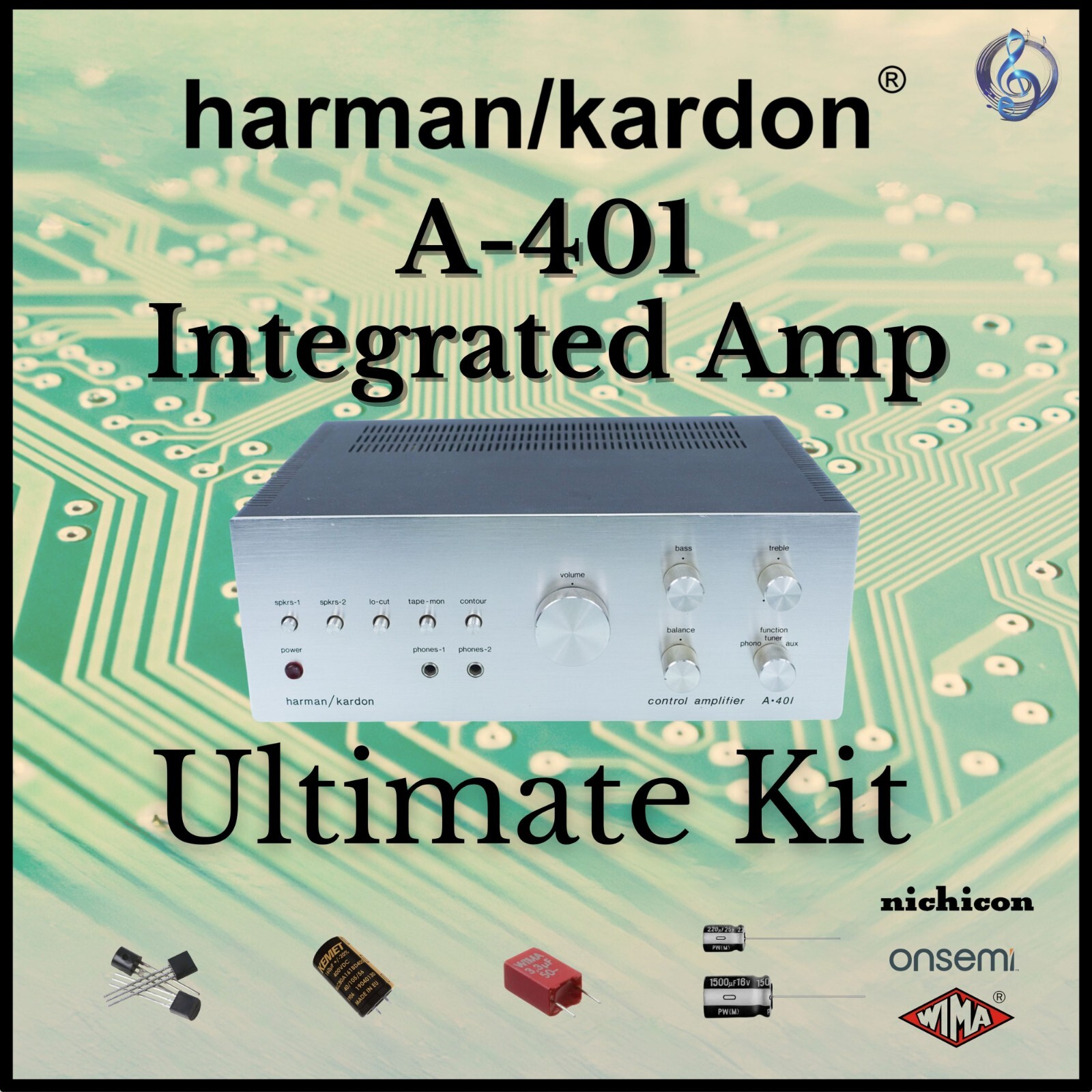
One of the first things you notice about the A-401, beyond its heft, is the speaker terminals. Owners describe them as "those crazy red and black speaker terminals" — a distinctive visual signature that set the A-401 apart from the generic binding posts found on most amplifiers of the era. They're the kind of detail that tells you this was a piece designed by engineers who cared about the user experience, not just the circuit board.
The A-401 is a heavy piece of equipment. The owner who reported on it said it "weighs a ton" — an idiomatic description, to be sure, but one that conveys the solidity and build quality that characterized Harman Kardon's flagship offerings. This wasn't a lightweight, mass-produced receiver; it was a serious integrated amplifier with a substantial power supply and chassis to match. The weight is part of the appeal for collectors — it feels like you're holding something real, something built to last decades.
That physical presence is part of what made the A-401 special. In an era when manufacturers were increasingly cutting corners to hit price points, the A-401 stood as a reminder of what Harman Kardon could do when it set out to build its best.
Historical Context
The A-401 occupied a unique position in Harman Kardon's 1970s lineup: it was the top model in the line. That's a significant distinction, especially when you consider the company's other offerings during that decade. The Twin Powered receivers — the HK 430 and HK 930 — got the attention and the marketing dollars, but the A-401 was the integrated amplifier that sat above them all, at least in terms of the company's own hierarchy. Period advertising in Studio Sound (November 1975, p.47) described the A-401 as an integrated amplifier giving 20 watts RMS per channel, both channels driven into 8 ohms, from 20 Hz to 20 kHz with less than 0.5% THD.
The same period saw Harman Kardon advertising the A-401 alongside its other products. Studio Sound (September 1975, p.19) ran an ad that grouped the A-401 with the HK 1000 cassette deck and the HK 930 receiver, describing the A-401 as "an integrated amplifier giving 20 watts RMS per channel, both channels driven into 8 ohms, from 20 Hz to 20 kHz with less than 0.5% THD." The ad's tagline — "Harman/Kardon, need we say more?" — captured the brand's confidence in its engineering during this period.
The A-401's relationship to the A-402 remains somewhat murky. The same owner who praised the A-401 mentioned, "I might have a A-402? need to check," suggesting the two models were related but distinct. No hierarchy between them is documented, but the fact that both existed in the same line speaks to Harman Kardon's commitment to offering serious integrated amplifiers at the top of its range.
Collectibility & Market
Collectors and owners consistently describe the A-401 as "a rare piece." That rarity is a double-edged sword: it makes the amplifier desirable, but it also means finding one in good working condition takes patience and persistence. The A-401 wasn't produced in the volumes of the mass-market receivers, and many of the units that survive today have been through decades of use.
The owner who reported on the A-401 noted one functional issue: "the only problem is the left channel is very low." This is a specific defect reported by a single owner, and it's not attributed to any known common failure or maintenance need. There's no technician diagnosis, no capacitor replacement guide, no repair instructions in the accessible record. What it does tell you is that a 40-50 year old amplifier may need attention — but that's true of any vintage gear, and the A-401's reputation for beautiful sound makes the effort worthwhile for those who find one.
eBay and Etsy listings for the A-401 exist, though no prices were extracted from the research. The lack of a documented market price is itself telling — this isn't a piece that trades frequently enough to establish a reliable baseline. When one does appear, it's typically a private sale or a listing that doesn't last long. For the collector who values rare, top-of-the-line integrated amplifiers from the 1970s, the A-401 represents a genuine find.
The A-401's legacy is built on a combination of factors that are increasingly hard to find in vintage audio: it was the flagship of its line, it's genuinely rare, and it has a documented reputation for beautiful sound from those who've owned it. That's a compelling trifecta. The red and black terminals, the heavy chassis, the 40 watts of clean power — all of it adds up to an amplifier that deserves its place in the archive, even if the historical record is thinner than we'd like.
eBay Listings


As an eBay Partner, we earn from qualifying purchases. This helps support our independent vintage technology research.
Related Models
- Harman Kardon 730 (1973-1979)
- Harman Kardon A 402
- Harman Kardon A660
- Harman Kardon Citation 16
- Harman Kardon Citation 24 (1986-1989)
- Eico 3150 (1967)
- Fisher CUSTOM-ELECTRA-I (K-14/K-15) (1957)
- Fisher CUSTOM-ELECTRA IV (E33/E44) (1960)
- Akai AM-2400 (1978)
- Akai AM-2600 (1977)