Grundig SATELLIT-SERIES: The Crown Jewel of Vintage Portable Radios
In the golden age of radio, when shortwave airwaves crackled with international broadcasts, clandestine signals, and the voices of distant cultures, one name stood above the rest for portable global reception: Grundig. Among their most celebrated lines, the SATELLIT-SERIES emerged in the mid-1960s as a technological marvel — a portable shortwave radio that combined German engineering precision with world-class sensitivity and a sleek, functional design. More than just a radio, the Grundig SATELLIT became a symbol of global connectivity, Cold War curiosity, and the romance of tuning into faraway stations from the comfort of a backyard, a dorm room, or a remote outpost.
Though not an amplifier or hi-fi component in the traditional sense, the SATELLIT-SERIES holds a revered place in the vintage audio world. For collectors, DXers (long-distance radio enthusiasts), and lovers of mid-century industrial design, these radios are more than functional devices — they are time capsules of a bygone era of analog exploration.
Historical Context: The Rise of the Global Listener
Introduced in 1965, the original Grundig Satellit (often referred to as the Satellit 800) arrived at a pivotal moment. The Cold War was in full swing, and shortwave radio was one of the few uncensored windows into the Eastern Bloc, Africa, Asia, and Latin America. State-run broadcasters like the BBC World Service, Voice of America, Radio Moscow, and Radio Free Europe beamed their messages across continents, and the public — especially in Western Europe and North America — was eager to listen.
Grundig, a German electronics giant founded in 1945, had already built a reputation for high-quality radios and tape recorders. With the SATELLIT-SERIES, they aimed to create the ultimate portable world receiver — compact enough to travel with, yet powerful enough to rival home consoles in performance. The result was a line of radios that would evolve through several iterations — including the Satellit 800, 850, 900, and later the Satellit 2000 — each refining the formula with improved circuitry, ergonomics, and coverage.
Technical Specifications
The SATELLIT-SERIES radios were engineered for maximum versatility and sensitivity. Below are the key specifications based on the most iconic model, the Grundig Satellit 800 (1965–1970), with notes on later variants:
| Feature | Specification |
| Model | Grundig Satellit 800 (original) |
| Year Introduced | 1965 |
| Type | Portable shortwave communications receiver |
| Frequency Coverage | LW: 150–350 kHz MW: 520–1620 kHz SW: 1.7–26 MHz (6 bands) |
| Power Source | 6 × 1.5V D-cell batteries (9V DC) or external AC adapter |
| Speaker | 4.5" dynamic speaker |
| Output Power | Approx. 1.2W audio output |
| Tuning System | Analog dial with magic eye (EM84) tuning indicator |
| Selectivity | High (double conversion superheterodyne design) |
| Dimensions | 35 × 23 × 14 cm (approx.) |
| Weight | 7.5 kg (16.5 lbs) |
| Notable Features | External antenna terminal, headphone jack, tone control, bandspread function (on later models) |
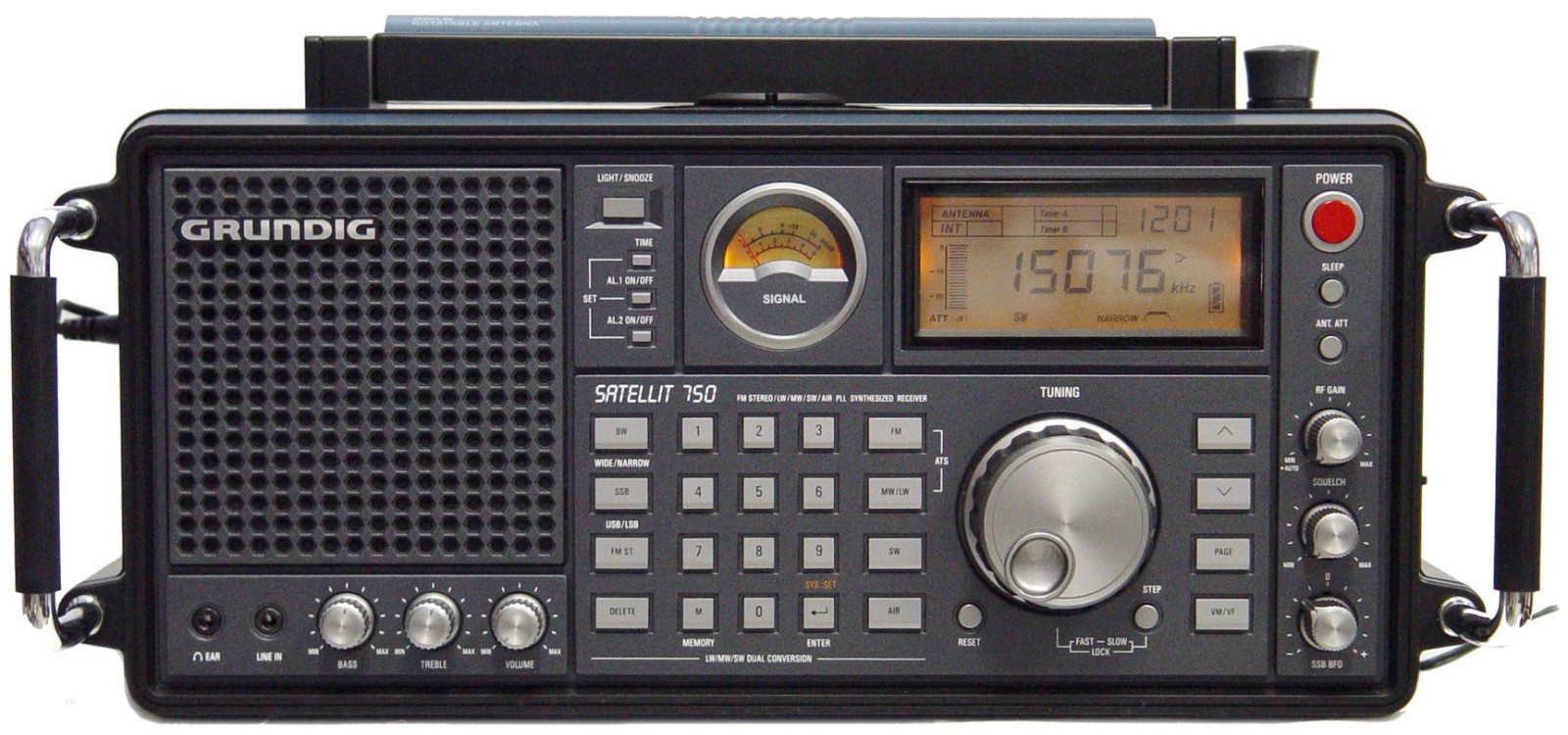
Later models like the Satellit 900 (1972) and Satellit 2000 (1977) introduced improvements such as digital frequency readout (on the 2000), enhanced filtering, and more stable oscillators, but the core philosophy remained unchanged: deliver crystal-clear reception across the global shortwave spectrum.
Sound Characteristics and Performance
The SATELLIT-SERIES was not designed for audiophile-grade music reproduction, but within its domain — voice and AM broadcast — it excelled. The 4.5-inch speaker delivered warm, clear midrange tones, ideal for speech and news programming. Bass response was limited (as expected from a portable unit), but the clarity and presence made listening fatigue-free during long DXing sessions.
What truly set the SATELLIT apart was its receiver sensitivity and selectivity. Thanks to its double-conversion superheterodyne circuitry, it could pull in weak signals from across the globe with remarkable fidelity. The magic eye tuning meter (EM84) provided visual feedback, allowing users to precisely peak signals for optimal clarity — a feature beloved by serious listeners.
With a long wire antenna connected to the external terminal, a well-positioned Satellit could receive stations from Australia, China, or South America, even under marginal conditions. Its six shortwave bands covered virtually all international broadcasting frequencies, and the bandspread function on later models allowed fine-tuning within crowded bands.
Notable Features and Innovations
The SATELLIT-SERIES was packed with features that were advanced for its time:
- All-Band Coverage: From longwave to high-frequency shortwave, it offered unmatched range for a portable.
- Magic Eye Tuner: The glowing EM84 tube gave intuitive visual tuning, a hallmark of high-end receivers.
- External Antenna Input: Enabled connection to long wires or outdoor antennas for enhanced reception.
- Headphone Output: Allowed private listening and reduced interference.
- Robust Build Quality: Die-cast chassis, metal tuning gears, and a leather-covered wooden cabinet gave it a premium feel.
- German Engineering: Precision calibration and high-quality components ensured long-term reliability.
Later models added digital tuning and frequency memory, foreshadowing the transition to modern DSP-based receivers.
Common Issues and Maintenance
As with any vintage electronics, SATELLIT radios require care. Common issues include:
- Dried-out capacitors: Electrolytic capacitors in the power supply and audio stages often fail after 50+ years. A recap (capacitor replacement) is highly recommended before powering up a long-stored unit.
- Sticky or stiff tuning: The tuning mechanism can gum up over time. Cleaning and lubrication of the dial cord and gears are essential.
- Failing magic eye tube: The EM84 tube may dim or fail. While NOS (new old stock) tubes are available, they are becoming rare.
- Speaker deterioration: Foam surrounds can rot, leading to distorted sound. Re-foaming or replacement is common.
- Battery corrosion: Old D-cell batteries can leak and damage contacts. Always inspect and clean the battery compartment.
Despite these age-related issues, the SATELLIT-SERIES is generally robust. Many units still function beautifully after restoration, a testament to Grundig’s build standards.
Current Market Value and Collectibility
Today, the Grundig SATELLIT-SERIES is highly collectible. A fully functional Satellit 800 in good condition can fetch $250–$400, while rarer variants like the Satellit 2000 with digital tuning can reach $500–$700 or more, especially if unmodified and in original condition.
Factors influencing value:
- Working condition (non-working units sell for parts or restoration)
- Originality (unmodified circuitry, original speaker, intact cabinet)
- Cosmetic state (leather covering, dial clarity, finish)
- Model rarity (Satellit 900 and 2000 are less common than the 800)
Collectors prize these radios not only for their performance but also for their iconic design — the wooden cabinet, the glowing dials, and the retro-futuristic name evoke a time when radio was adventure.
Conclusion: A Legacy of Global Listening
The Grundig SATELLIT-SERIES was more than a radio — it was a passport to the world. In an age before the internet, it brought global events, foreign music, and uncensored news directly into homes and hands. Its blend of engineering excellence, elegant design, and real-world utility cemented its place in audio history.
While modern SDRs (software-defined radios) may surpass it in technical specs, the SATELLIT retains a charm and tactile satisfaction that digital interfaces can’t replicate. Tuning the dial, watching the magic eye close, and pulling in a distant signal from across the globe — these are experiences that define the soul of vintage audio.
For collectors, historians, and radio enthusiasts, the Grundig SATELLIT-SERIES remains a shining example of what great design and purposeful engineering can achieve. It’s not just a relic — it’s a working piece of history, still capable of connecting us to the world, one shortwave broadcast at a time.
eBay Listings


As an eBay Partner, we earn from qualifying purchases. This helps support our independent vintage technology research.
Related Models
- Grundig AUDIORAMA-SERIES (1958)
- Grundig BOX-SERIES (1965)
- Grundig BOY-Series (1956)
- Grundig MAJESTIC-SERIES (1958)
- Grundig OTHER-RADIOS (1955)
- Akai AM-2850 (1975)
- Akai AP-206 (1975)
- Nakamichi BX-1 (1985)
- Acoustic Research research-ar-17 (1978)
- Acoustic Research AR-19 (1994)