Grundig Satellit 800 (2000)
A portable world band receiver introduced in early 2000, featuring double conversion superheterodyne design and FM stereo reception.
Overview
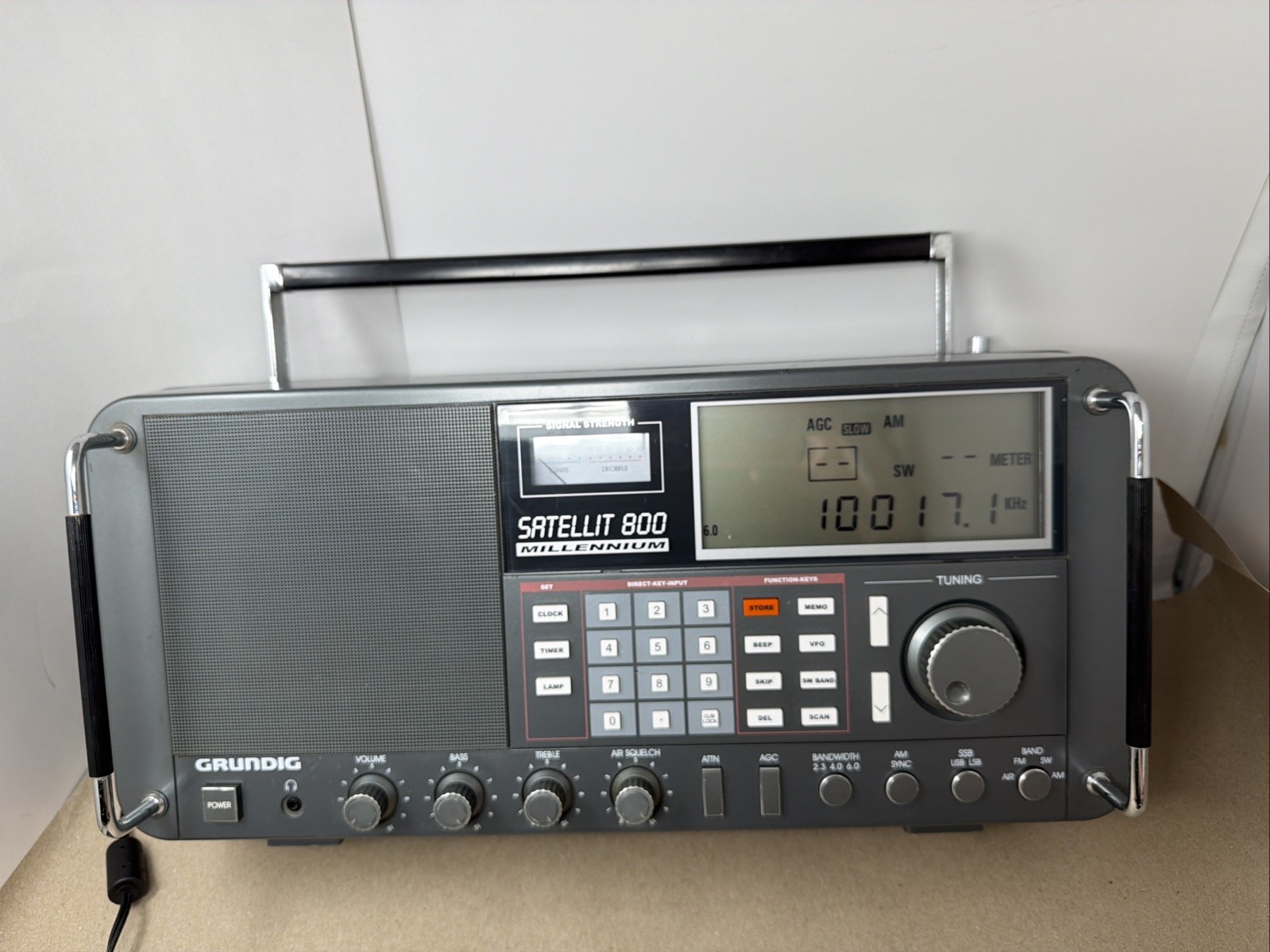
The Grundig Satellit 800 EU Millennium is a high-end portable HF receiver built for global shortwave listening. Marketed as a top-tier communications receiver, it was released in the first quarter of 2000 and represented one of the final flagship models before Grundig Germany ceased operations. It supports AM, USB, and LSB modes across a wide frequency range and includes FM stereo capability. The unit is notable for its robust feature set and anticipated successor, the Satellit 900, which was never completed due to the company's closure.
Specifications
| Frequency Range | 0.1–30 MHz AM, USB, LSB |
| Power Supply | 9 VDC @ 1 A; 120 VAC (60 Hz) or 230 VAC (50 Hz), auto-switching; |
| Dimensions (W×H×D) | |
| Weight | 6.6 kg (14.55 lbs) |
| Principle | Double conversion superhet, IF 55845 / 455 kHz, FM 10.7 MHz |
| Operation Modes | A1, A3J |
| Type | Double Conversion Superhet Communications HF Receiver with FM Stereo |
Design
The Satellit 800 uses a double conversion superheterodyne circuit topology with primary and secondary intermediate frequencies of 55.845 MHz and 455 kHz, respectively, and an FM IF of 10.7 MHz. It was not manufactured in Germany.
Context
Introduced in early 2000, the Satellit 800 was one of the most anticipated receivers of its time and marked the end of an era for Grundig’s high-performance portable radios. Its development preceded the planned Satellit 900, which was canceled when Grundig Germany shut down.
Market
User reviews indicate the Satellit 800 is regarded as a great receiver in its class, with excellent reception. Some users report issues with the direct entry keyboard. On the used market, units have sold for $180 to $250 in recent listings.
eBay Listings



As an eBay Partner, we earn from qualifying purchases. This helps support our independent vintage technology research.
Related Models
- Blaupunkt Sultan Model 2320 (1956-1958)