Garrard RC88/4 (1950s)
A high-end British record changer built for elegance, automation, and the full range of mid-century formats—from fragile 78s to the new LPs.
Overview
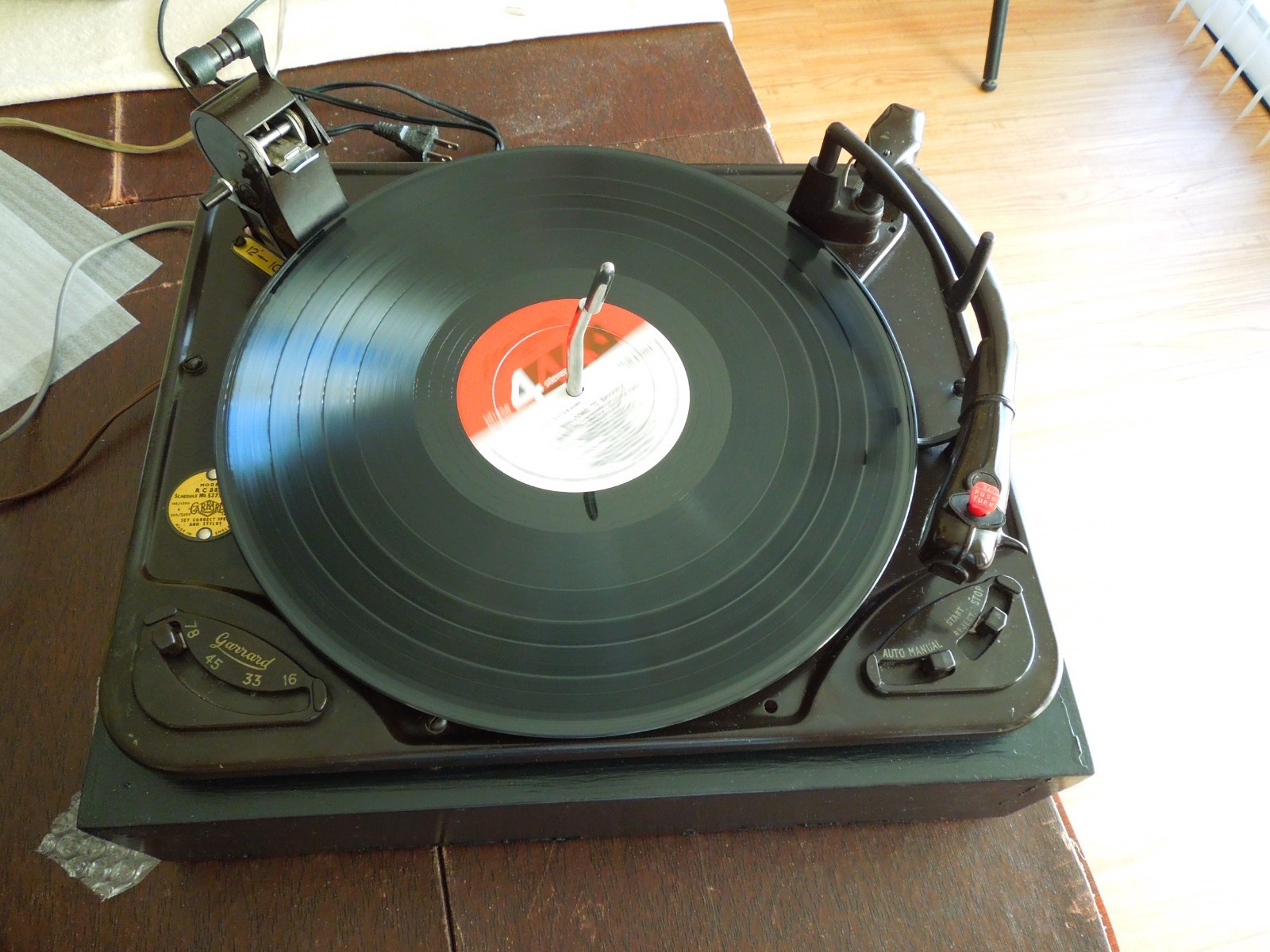
There’s something quietly commanding about the Garrard RC88/4 when it powers up—the soft whir of the motor, the deliberate clunk of the mechanism engaging, the way it lowers onto a record like it means business. This isn’t a background player; it’s a centerpiece, a statement piece from an era when home audio equipment was expected to perform with both precision and presence. Built in the 1950s, the RC88/4 was positioned as a high-end English turntable, designed for listeners who wanted the convenience of automatic playback without sacrificing build quality or versatility.
Unlike simpler changers that only handled 45s or LPs, the RC88/4 was engineered to manage the full spectrum of records available at the time: 78s, 33.33 rpm LPs, 45s, and even 16 rpm talking discs. That kind of flexibility wasn’t common, and it speaks to the RC88/4’s role as a serious machine for serious collections. It could stack up to eight records and play them in sequence, automatically cycling through speeds and sizes as needed—no manual intervention once the stack was loaded. For households with deep libraries spanning decades of formats, this was a godsend.
It’s easy to overlook the RC88/4 today in favor of Garrard’s more famous manual turntables like the 301 or 401, but this changer was no afterthought. It carried the same engineering rigor and mechanical confidence that defined the brand. While it didn’t offer the audiophile-grade isolation of a suspended subchassis design, it delivered reliable, consistent performance with the kind of robust construction that made Garrard a household name in the UK and beyond.
Specifications
| Manufacturer | Garrard Engineering and Manufacturing Company Ltd |
| Model | RC88/4 |
| Year Introduced | 1950s |
| Type | Automatic record changer |
| Playback Speeds | 78 rpm, 45 rpm, 33.33 rpm, 16 rpm |
| Record Capacity | Up to eight records |
| Compatible Record Sizes | 10 or 12-inch at 78 rpm; 7, 10, or 12-inch at 33.33 rpm; 7-inch at 45 rpm |
| Tracking Force Requirement | 4–5 grams (minimum for trip mechanism) |
| Power Supply | 100/130 V or 200/250 V AC, 50 or 60 Hz (motor pulley dependent) |
Key Features
Multi-Speed, Multi-Size Playback
The RC88/4 didn’t just play records—it managed them. With support for 78, 45, 33.33, and 16 rpm speeds, it could handle nearly every consumer disc format of the mid-20th century. The ability to stack up to eight records and play them automatically, switching between speeds as needed, was a major convenience. You could load a mix of 78s and LPs, and the changer would cycle through them without issue, making it ideal for parties, radio playback, or long listening sessions. The size compatibility is precise: 10- or 12-inch discs at 78 rpm, any of the three standard sizes at 33.33 rpm, and only 7-inch records at 45 rpm—likely due to the spindle design and drop mechanism.
Idler-Wheel Drive System
Power is delivered via an idler-wheel drive, a common but effective method in mid-century turntables. A rubber wheel connects the motor to the inside of the platter, providing direct drive characteristics with good speed stability—when everything’s in working order. These systems are known for their smooth operation but can suffer from wear over time, especially in the rubber tire, which may harden or crack after decades of disuse. When properly maintained, though, the idler wheel delivers a solid, vibration-damped rotation that avoids the belt-slip issues of later designs.
Automatic Trip Mechanism
The heart of any record changer is its trip mechanism—the system that senses the end of a record, lifts the tonearm, and drops the next disc onto the platter. For this to work reliably, the RC88/4 requires a minimum tracking force of 4 to 5 grams. That’s heavier than what most modern moving magnet cartridges are designed for, so owners often use vintage cartridges or adjust compliance accordingly. The mechanism itself is mechanical and robust, relying on the stylus encountering the lead-out groove to trigger the sequence. It’s not delicate, but it’s dependable when clean and properly lubricated.
Factory-Installed Cartridges
While the original factory cartridge isn’t definitively documented in the fact sheet, surviving units have been found with GE RPX or GE VRII cartridges, the latter featuring a dual stylus for both LPs and 78s. This makes sense given the RC88/4’s multi-speed design—switching between microgroove and standard groove records would require either manual stylus changes or a dual-tip cartridge. The use of GE cartridges aligns with common OEM practices of the era, where turntable manufacturers partnered with established audio brands for transducers.
Historical Context
The RC88/4 emerged during a transitional period in audio—when 78 rpm shellac records were still in common use, but vinyl LPs and 45s were rapidly gaining ground. Its ability to handle all formats made it a practical choice for broadcasters, institutions, and affluent home users who didn’t want to own multiple players. Positioned as a high-end English turntable, it shared design and engineering DNA with other classic Garrard models like the 301, 401, AT-60, SP-25, SL-95, GT-25, and DD-75, though it occupied a different niche as an automatic changer rather than a manual playback deck.
Collectibility & Value
Today, the RC88/4 is a machine that demands attention—and maintenance. Most units found on the market haven’t turned in decades, and they often arrive “full of dust,” as one owner reported. A thorough cleaning, lubrication, and adjustment are typically required before the changer will operate reliably. The Garrard service manual recommends using a thin grease, like petroleum jelly (Vaseline), for lubrication—a surprisingly effective solution that’s stood the test of time. However, owners are cautioned against using WD-40, which isn’t a long-term lubricant and can attract grime or even cause corrosion over time.
While specific sold prices aren’t available in the fact sheet, listings on Reverb and eBay often appear with prices “not set in stone” or open to offers, suggesting a niche market with no fixed valuation. It’s not a high-demand collector’s item like a 301, but it holds steady appeal for those restoring period-correct systems, particularly in the UK. Its complexity means it’s not for the faint of heart, but for someone who appreciates the mechanical ballet of a well-tuned record changer, the RC88/4 delivers a uniquely satisfying experience.
eBay Listings

As an eBay Partner, we earn from qualifying purchases. This helps support our independent vintage technology research.
Related Models
- Garrard 2025tc (1968)
- Garrard RC80
- Garrard 301 (1953)
- Garrard 4
- Garrard 401 (1965)
- Luxman PD-272 (1983)
- Onkyo CP-1010 (1976)
- Pioneer PL-15R (1975)
- Pioneer PL-250 (1979)
- Pioneer PL-40 (1977)