Fisher FM-1000 FM/AM Tuner (1968)
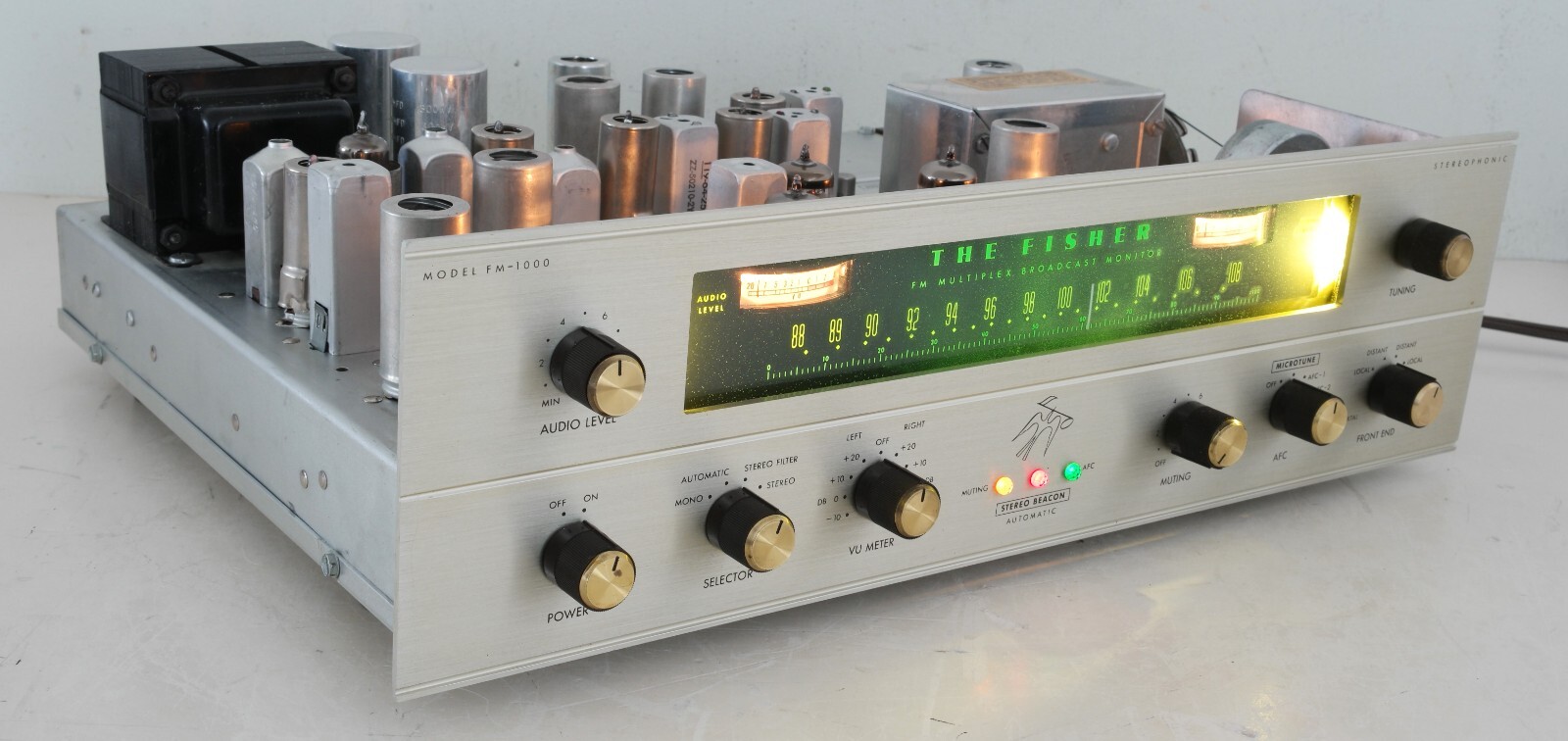
The Fisher FM-1000 stands as a hallmark of late 1960s high-fidelity tuner design, representing the pinnacle of tube-based FM reception before the widespread shift to solid-state electronics. Introduced in 1968 and produced through 1972, the FM-1000 was Fisher's flagship tuner, engineered for audiophiles who demanded exceptional sensitivity, precise tuning, and musical fidelity. Housed in a classic walnut veneer cabinet and packed with advanced circuitry for its time, the FM-1000 remains a sought-after component among vintage audio enthusiasts.
Specifications
| Feature | Specification |
| Model | FM-1000 |
| Brand | Fisher |
| Year Introduced | 1968 |
| Production Period | 1968–1972 |
| Type | FM/AM Tuner (no internal amplifier) |
| Output Power | N/A (line-level output only) |
| Output Impedance | ~1 kΩ |
| FM Sensitivity | 1.8 μV for 20 dB quieting (mono), 3.0 μV for 20 dB quieting (stereo) |
| Tuning System | 5-gang FM tuning capacitor |
| Decoder | Phase-locked loop (PLL) multiplex decoder |
| Front End | FET input stage |
| Tubes Used | 6HA5, 6BA6, 6AU6, 6BH6, 6AQ8, 6X4 (6 total) |
| Meters | Signal strength and center-tuning indicators |
| Inputs | Antenna (FM/AM), Auxiliary |
| Outputs | Line-level audio (RCA), Tape out |
| Cabinet Finish | Walnut veneer |
| Dimensions (W×H×D) | 19" × 6.5" × 14.5" |
| Weight | 22 lbs (10 kg) |
Key Features
- 5-Gang FM Tuning Capacitor: Ensures precise and stable tuning across the FM band with minimal drift.
- FET Front End: Provides high input impedance and low noise for superior signal capture.
- PLL Multiplex Decoder: Delivers accurate stereo separation and stable stereo demodulation, a cutting-edge feature at the time.
- Dual Analog Meters: Monitor both signal strength and center-tuning for optimal station alignment.
- Tube-Based Signal Path: Contributes to a warm, musical sound signature with low distortion.
- AM/FM Reception: Full-featured AM band reception in addition to high-performance FM tuning.
Historical Significance
The Fisher FM-1000 was developed during a transitional period in audio electronics, marking the end of the tube-dominated era and the dawn of solid-state technology. As Fisher's top-tier tuner in the late 1960s, it showcased the company's commitment to engineering excellence and high-fidelity performance. The use of a phase-locked loop decoder was particularly advanced, offering superior stereo decoding stability compared to earlier ratio detector or Foster-Seeley designs.
Its robust build quality, precision tuning mechanics, and rich sonic character made the FM-1000 a favorite among discerning listeners and broadcasters alike. It is often regarded as one of the finest tube tuners ever produced, embodying the peak of analog FM reception design before integrated circuits became standard.
Sound Signature
The FM-1000 delivers a warm, detailed, and highly musical listening experience. Its tube-based circuitry imparts a smoothness and richness to FM broadcasts that many modern tuners lack. Stereo separation is excellent for its era, and the low distortion characteristics ensure clear, natural sound reproduction. The FET input stage enhances high-frequency clarity without introducing harshness, making it ideal for both music and voice programming.
Maintenance and Restoration Tips
Due to its age, the Fisher FM-1000 requires careful maintenance to perform at its best:
- Capacitor Replacement: Replace all electrolytic and paper capacitors, especially in the power supply and audio coupling stages, to prevent leakage and performance degradation.
- Tube Testing and Replacement: Test all six tubes and replace any that are weak or noisy. NOS (New Old Stock) tubes can restore original performance.
- Cleaning Controls and Switches: Use contact cleaner on tuning potentiometers, switches, and input jacks to eliminate crackling and intermittent connections.
- Alignment Check: If reception sensitivity or stereo decoding is off, a professional alignment of the IF and RF stages may be necessary.
- Bias and Voltage Checks: Ensure all tube voltages are within specification after restoration to avoid premature failure.
- Cabinet Care: Clean the walnut veneer with a soft cloth and wood-safe polish to preserve its vintage luster.
Collectibility and Market Value
The Fisher FM-1000 ranks 8 out of 10 in collectibility due to its reputation, build quality, and status as a flagship model. Fully restored units in excellent working condition typically sell for $200 to $400, with higher prices for mint, all-original examples. Its appeal spans both audiophiles and vintage electronics collectors, particularly those focused on the transition from tube to solid-state technology.
Units with original packaging, manuals, or rare finishes may command premiums. Given its enduring performance and iconic design, the FM-1000 remains a wise acquisition for those building a classic hi-fi system.
eBay Listings



As an eBay Partner, we earn from qualifying purchases. This helps support our independent vintage technology research.
Related Models
- Fisher FM-100-C (1960)
- Fisher FM-200 (1971)
- Fisher FMR-1
- Fisher FM-100-B (1963)
- Fisher FM-100 (1961)
- Aiwa CS-250 (1978)
- Denon TU-1500RD (1995)
- Denon TU-280 (1976)
- Denon TU-501 (1977)
- Denon TU-550 (1978)