Fisher 800 (Late 1950s–Late 1960s)
A single chassis that carried Fisher's tube legacy into the transistor age, and one of the most confusing model numbers in vintage audio.
Overview
The Fisher 800 name covers both the company's vacuum tube receivers and its first all-transistor effort. It shows up on several distinct models - the 800B, the 800C, and the 800-T - each from a different era with a different approach to receiver design. Collectors and sellers blur these lines and use "800" as shorthand for any of them. Figure out which variant you're looking at before you buy.
The tube-era models do everything on a single chassis. The 800B, for instance, was described in Fisher's own marketing as "a self-contained stereo receiver with AM-FM tuner, stereo preamplifier and two 45-watt amplifiers." That was the whole pitch: connect a turntable and a pair of speakers, and you had a complete music system without the stack of separate components that dominated the high-end market. Fisher's advertising in High Fidelity (April 1961, p.16) called the 800 "America's Best-Selling Receiver," a 70-watt stereo FM-AM unit that put "everything you need for the foundation of a superb home music system" on one chassis.
The 800-T, arriving in the late '60s, was Fisher's first all-transistor receiver. It's a different beast entirely - solid-state, rated at 55 watts per channel, and built around Fisher's "F-900" output transistors. Owners describe it as "quite warm for a solid-state unit," though one forum user notes it doesn't quite match the FM sensitivity of the Fisher 500-T. Early transistor gear often sounds harsh or brittle by modern standards, and the 800-T apparently avoided that.
Key Features
7591 Output Tubes
Both the 800B and 800C use the 7591 output tube, a compact power pentode that became a Fisher staple during this period. The 800B's specification sheet lists IHF Music Power Output at 100 watts, with continuous power at 8 ohms rated at 45/45 watts. The 800C is rated slightly lower at 40 watts per channel. The 800B's brochure claims harmonic distortion of less than 0.5% at rated power, with frequency response from 20 to 20,000 cps ±1 db.
Nuvistor Phono Preamplifier
The 800C uses a Nuvistor in its phono section. That's a tiny metal-ceramic tube developed by RCA, with high gain and low noise, in a package about the size of a thimble. The phono stage is where signal levels are tiny and noise is the enemy, so it's a sensible place for one. The 800B's phono sensitivity is specified at 1.9 mv, which pairs well with the moving-magnet cartridges of the era.
Five-Gang FM Tuner with Three IF Stages
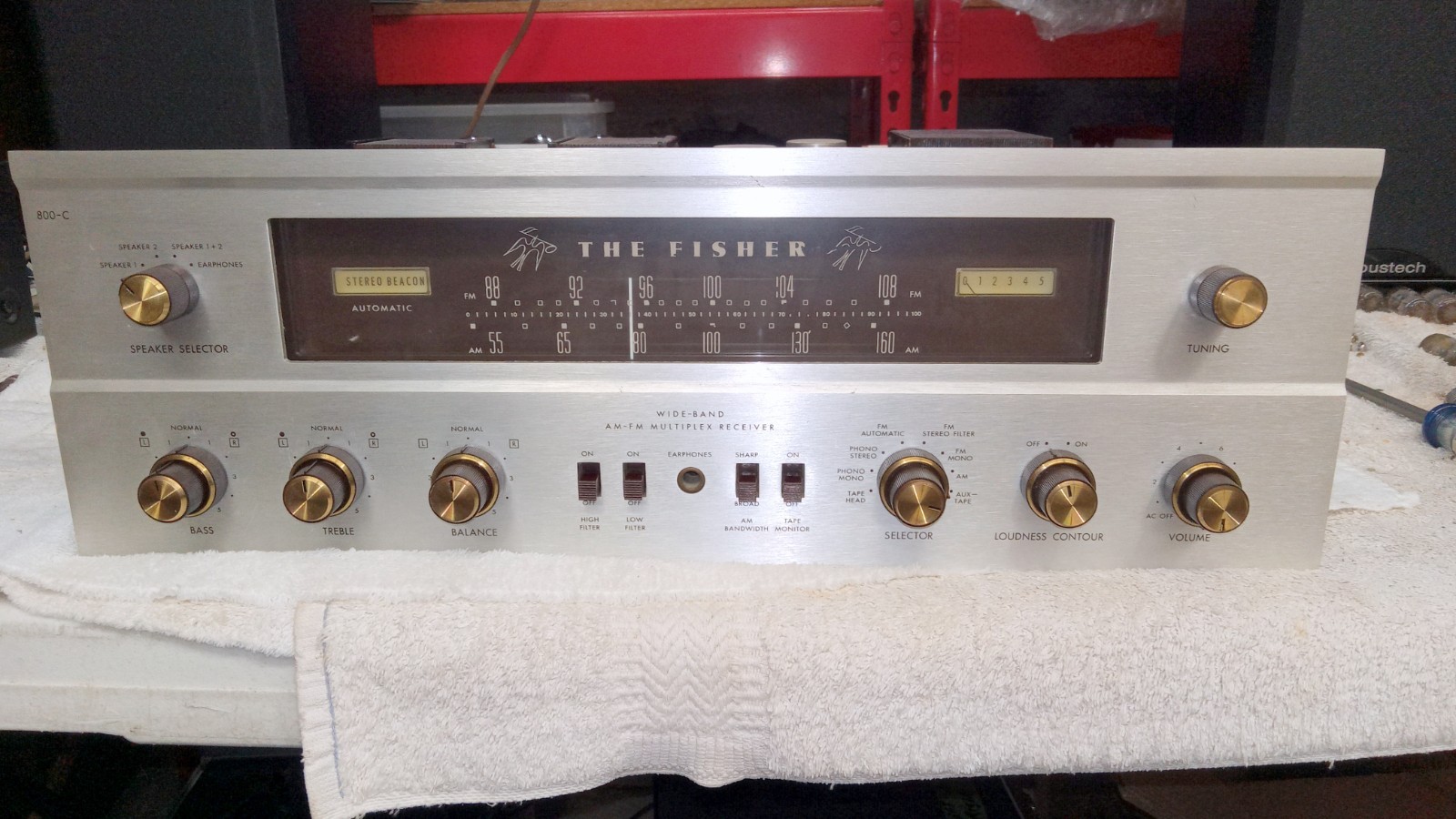
The 800C's FM section is built around a 5-gang tuning capacitor and 3 intermediate-frequency stages. That points to a focus on sensitivity and selectivity. In the early 1960s, FM was still establishing itself as a stereo medium, and a tuner that could pull in weak stations and separate them from adjacent-channel interference was a real selling point. The controls listed for the 800C are loudness contour, tape monitor, channel reverse, muting, and an FM stereo filter.
Magnetic Phono and Tape Head Inputs
The 800B's inputs include a magnetic phonograph input and a separate Tape Head input. A tape head input accepts the raw, un-equalized signal directly from a tape playback head, so no separate preamplifier is needed. That was useful at a time when reel-to-reel recorders were becoming common in serious home systems. Owners could connect a tape deck directly without an outboard preamp, which many competing receivers didn't offer.
F-900 Output Transistors
The 800-T uses Fisher's "F-900" output transistors. The fact sheet doesn't detail the specific characteristics of these devices, but their reputation among collectors suggests they were sturdy and musical, and they're behind the receiver's reportedly warm character. As Fisher's first all-transistor receiver, the 800-T carried the company's move away from tubes, so the choice of output devices was critical. Owners report the 800-T sounds "quite warm for a solid-state unit," which would have come as a relief to tube loyalists making the switch.
Historical Context
Fisher introduced a long line of famous tube receivers in the late 1950s and early 1960s, among them the 800C, according to the stereoman.com historical account. The 800C sits in a group that includes the 500C and the 800B, with the top-of-the-line Fisher 1000 above them. Fisher's own brochure describes the 800B as "the little brother of the famous Fisher 800," and collectors have debated the family relationship ever since.
The 800-T breaks hard with that lineage. Made in the late '60s, it was Fisher's first all-transistor receiver, from a company that had built its reputation on vacuum tube designs. The switch from tubes to transistors was rough for many manufacturers, with early solid-state gear often earning a reputation for harshness and unreliability. Fisher's decision to lead with the 800-T suggests confidence in the F-900 output transistors and the supporting circuitry. Collectors still describe the 800-T as "warm."
Fisher's own advertising for the 800-C in High Fidelity (April 1963, p.11) promoted the new all-in-one receivers - the 400 at $329.50, the 500-C at $389.50, and the 800-C with AM-FM at $449.50. The marketing stressed that "everything you need - on one compact chassis" was now available without compromise in quality. That pitch, repeated across multiple publications including HiFI-Stereo (July 1963, p.21), positioned the 800-C as the full-featured option for buyers who wanted AM in addition to FM. The 800-C's FM sensitivity was claimed to be equal to that of the other models in the line, and Fisher's ads made a point of saying so.
The 800-C measures approximately 17-1/2″ wide by 5-3/4″ high by 10″ deep. It was designed to sit on a shelf or in a console. The 800B's front panel width of 15-1/2 inches was slightly more compact, though the exact dimensions of that model remain only partially documented.
The 800 family shows Fisher's bet on integration. While competitors pushed separates - separate tuners, separate preamps, separate amplifiers - Fisher bet on the receiver. The 800B's brochure text, reproduced on vintagefisher.webs.com, lays out the pitch plainly: a complete stereo system on a single chassis, with the 100-watt IHF music power rating providing headroom that smaller receivers couldn't match. The damping factor greater than 20 and hum and noise better than 80 db below rated output were the other specifications it leaned on.
The 800-T's place in Fisher's lineup is less documented, but it was the company's first all-transistor receiver. The audiokarma.org forum discussion that provides most of the 800-T's details describes it as a distinct model from the 500-T, with the two sharing the F-900 output transistors. The 800-T's FM sensitivity was reportedly not quite as good as the 500-T's, a minor shortcoming that collectors weigh against its other virtues.
For contemporary collectors, the Fisher 800 family offers a fascinating study in evolution. The tube models — the 800B and 800C — represent the mature flowering of Fisher's vacuum tube design philosophy, with the 7591 output tubes, Nuvistor phono preamp, and multi-gang FM tuner representing the state of the art for the early 1960s. The 800-T, by contrast, is a leap into the solid-state future, carrying Fisher's reputation into a new technological era. Each model has its own character, its own strengths, and its own quirks — and each rewards the collector who takes the time to understand what makes it distinct.
eBay Listings



As an eBay Partner, we earn from qualifying purchases. This helps support our independent vintage technology research.
eBay Listings


As an eBay Partner, we earn from qualifying purchases. This helps support our independent vintage technology research.