Eico ST-97 (1968)
Some say it’s the best-sounding FM tuner ever made—quiet, warm, and shockingly alive, like radio was meant to be heard.
Overview
The Eico ST-97 isn’t just another vintage tuner—it’s a cult legend whispered about in service manuals and forum threads, that somehow transcends its era. Manufactured by EICO (Electronic Instrument Company), known for building solid, repairable hi-fi gear from the early 1950s through the mid-1960s, the ST-97 stands apart as a rare FM stereo tube tuner that owners claim outperforms even the most revered names in high fidelity. While EICO made its name with amplifiers like the ST-40 and ST-70, the ST-97 flew under the radar—until people started listening. And when they did, some declared it the best-sounding FM tuner ever made. Not just good for its time, but better than any of the Marantz, McIntosh, or Fisher tuners that dominate collector wish lists.
It’s not flashy, and it wasn’t mass-produced like the giants of the era. But in the right system, with a clean signal and properly restored internals, the ST-97 delivers a listening experience that feels less like reception and more like rediscovery—rich, three-dimensional, and free of the clinical edge that creeps into later solid-state designs. This is FM as it was meant to be: musical, immersive, and effortlessly clear.
Specifications
| Manufacturer | EICO (Electronic Instrument Company) |
| Model | ST-97 |
| Type | FM Stereo Tube Tuner |
Key Features
Matrix Decoding for Natural Stereo Imaging
Unlike many FM tuners of the era that used switching or sampler-type stereo decoders—which could introduce switching noise, channel imbalance, or a "toggling" effect during weak signal conditions—the Eico ST-97 employs a matrix decoding scheme. This approach blends the left and right audio channels more smoothly, avoiding abrupt transitions and preserving phase coherence. The result, according to those who’ve heard it, is a more stable, natural stereo image that doesn’t collapse or flutter when the signal wavers. It’s one of the key reasons owners rave about its sound quality: it doesn’t draw attention to the decoding process. You’re not listening to a tuner—you’re listening to music.
Shared Circuitry with the Eico MX99
The ST-97 shares its internal circuit and printed circuit board with the Eico MX99, another tuner in the company’s lineup. This isn’t just a cost-saving measure—it means that the same carefully laid-out analog path, optimized for low noise and high stability, runs through both units. For restorers and technicians, this cross-compatibility is a blessing: service documentation and troubleshooting techniques for one often apply to the other. It also suggests that EICO treated this design as a high-priority platform, refining it for consistent performance across models.
Potential Decoder Commonality with the HF-97
While not confirmed definitively, there is strong suggestion—based on circuit analysis and owner observations—that the ST-97’s decoder may be similar, if not identical, to that used in the Eico HF-97. If true, it means the ST-97 benefits from a decoding topology that prioritized sonic transparency over technical convenience, a philosophy that clearly resonates decades later.
Collectibility & Value
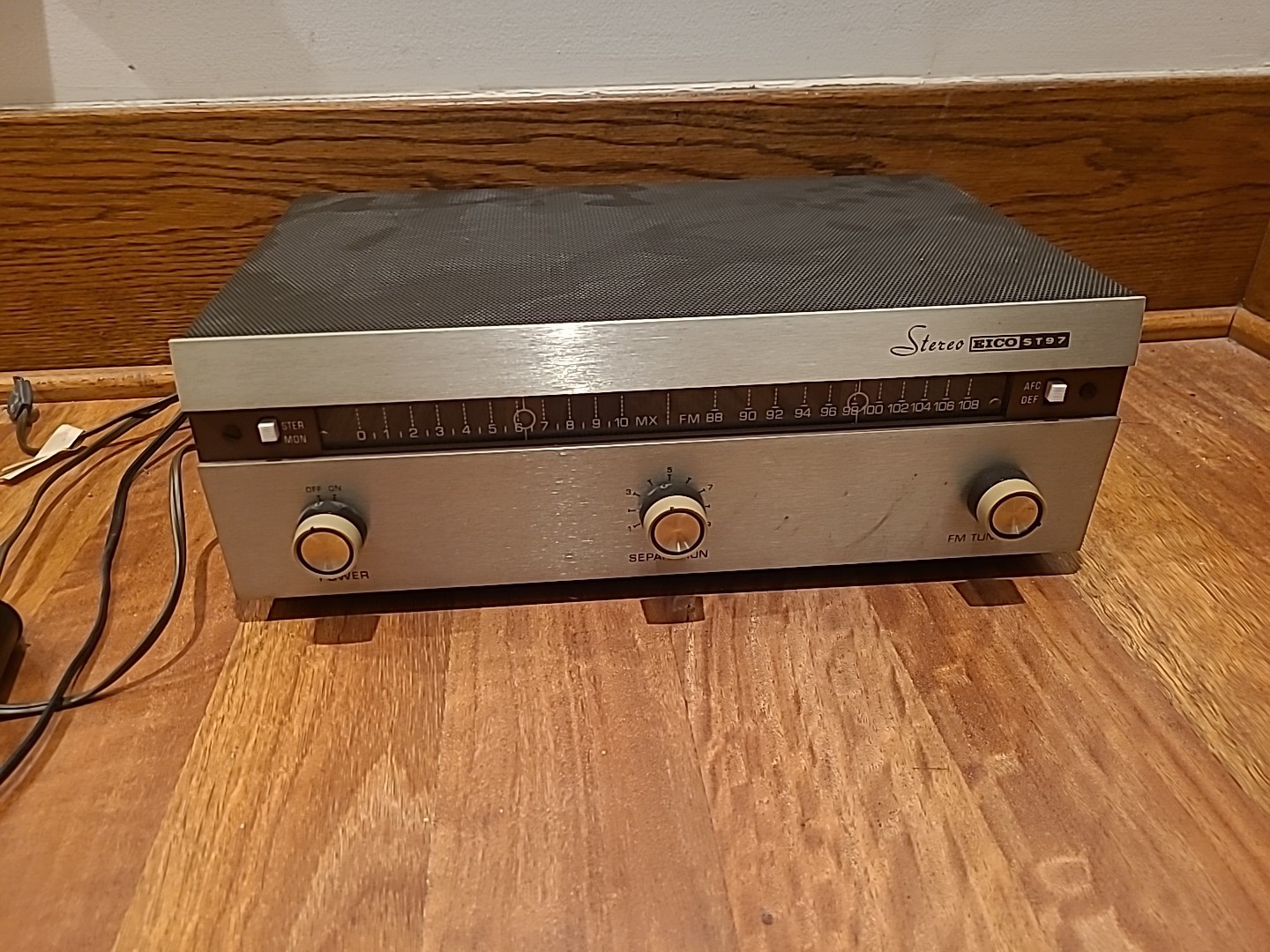
The Eico ST-97 is not a mainstream collector’s item, but its reputation ensures steady interest among analog purists and restoration enthusiasts. A working unit with original paperwork was listed on eBay for US $72.21, including standard shipping—a reminder that, for now, these are still accessible. But that price likely reflects condition and completeness more than market saturation; truly restored examples are rare.
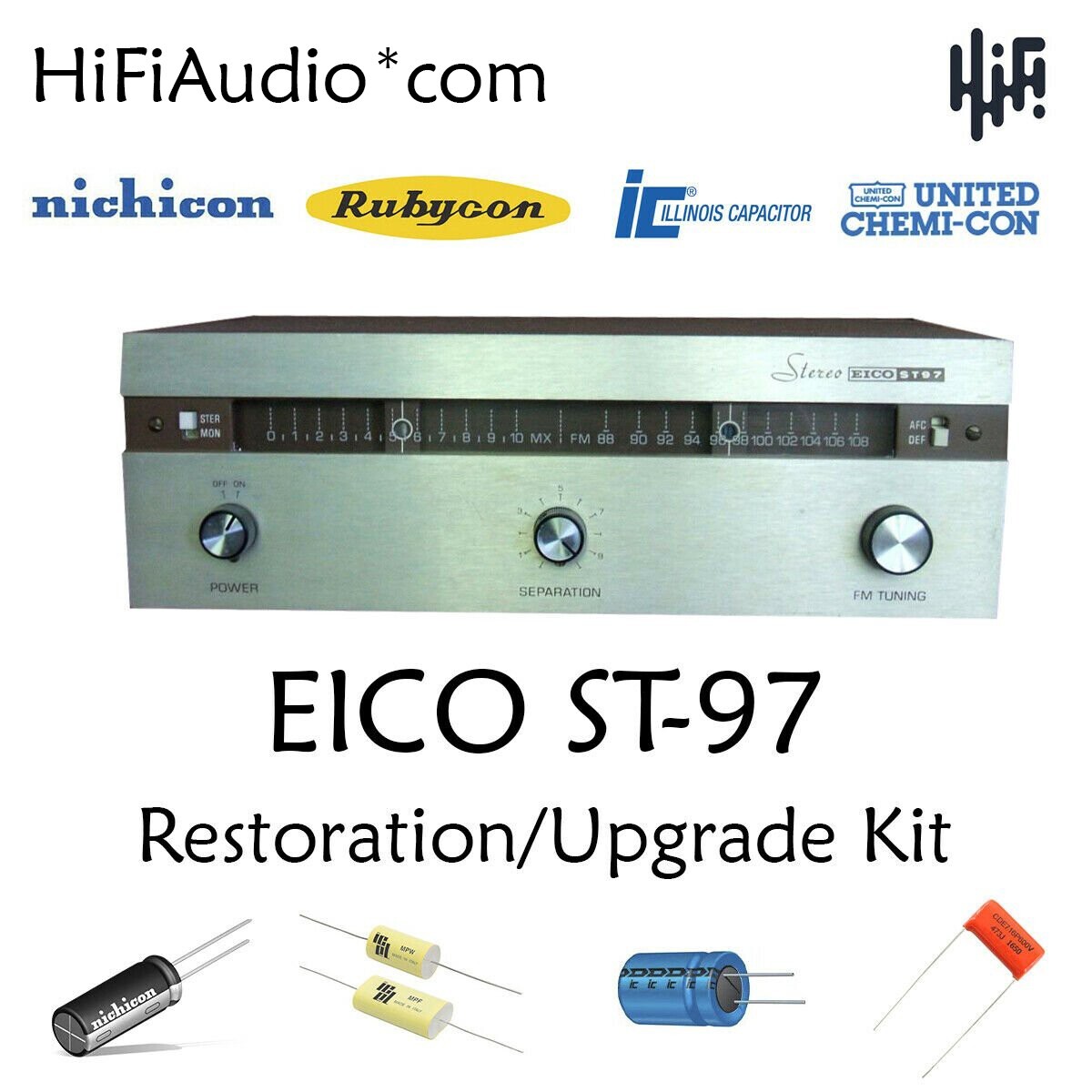
capacitor degradation is the primary concern. Restoration kits specifically for the ST-97 are available, marketed as "filter capacitor repair rebuild fix" solutions, with prices ranging from $95 (as listed on August 18, 2022) to $128.00 from specialty vendors like HiFi Audio. These kits typically include all necessary electrolytic and film capacitors, with components rated for up to 12,000 hours of lifespan—critical for long-term reliability. Owners note that a full recap, combined with tube replacement and alignment, can transform a lifeless chassis into a breathtaking performer. Given the claims of sonic superiority, the investment often feels justified.
Still, pricing data is sparse. There are no verified original prices, and current market values vary widely based on condition and whether the unit was factory-assembled or kit-built. What’s clear is that the ST-97 is undervalued relative to its reputation—those who know, know.
eBay Listings


As an eBay Partner, we earn from qualifying purchases. This helps support our independent vintage technology research.
Related Models
- Eico 2080 (1970)
- Eico HFT-80 (1957)
- Eico ST-3020 (1975)
- Eico ST-4120 (1970)
- Eico ST-96 (1965)
- Aiwa CS-250 (1978)
- Denon TU-1500RD (1995)
- Denon TU-280 (1976)
- Denon TU-501 (1977)
- Denon TU-550 (1978)