Eico ST-96 (1961)
Turn the dial, and you’re not just tuning in a station—you’re stepping into the golden age of hi-fi, where vacuum tubes hummed and every connection was earned.
Overview
The Eico ST-96 isn’t a receiver that powers your speakers or a preamp that colors your sound—it’s the quiet enabler of that entire experience. Introduced in 1961 (though some sources cite 1963), this AM/FM stereo tuner was built for the serious listener who wanted purity, precision, and the flexibility to build or own high-end gear without paying a premium. Manufactured by EICO (Electronic Instrument Co., Inc.) in Brooklyn, the ST-96 sits firmly in the lineage of kit-based electronics that defined mid-century American hobbyism—think Heathkit or Dynaco, where the joy wasn’t just in using the gear, but in assembling it yourself.
Priced at $90 for the kit and $130 fully assembled, the ST-96 was never meant to be flashy. It was a tool: a no-nonsense, metal-cased, bookshelf-style tuner with independent AM and FM sections, designed for what Eico called “Simulcast” AM-FM-Stereo operation. That meant you could listen to both bands simultaneously—useful for comparing broadcasts or ensuring seamless switching. But don’t expect built-in stereo decoding; the ST-96 requires an external decoder for FM multiplex stereo, a common limitation of its era. You were expected to pair it with other components, building a system piece by piece.
It’s not a forgotten model—far from it. The ST-96 appears in Eico’s “Classic Models Reference” as a representative of the 1960s tuner era, noted specifically for its FM capability. And while it didn’t generate the press buzz of some contemporaries, its circuit design speaks volumes: the FM RF front end and IF strip are nearly identical to those in the Eico HFT-90, a dedicated FM tuner, suggesting a shared engineering philosophy focused on performance and modularity.
Specifications
| Manufacturer | EICO (Electronic Instrument Co.Inc.), Brooklyn |
| Model | ST-96 |
| Production Year | 1961 |
| Product Type | AM/FM Stereo Tuner |
| Number of Tubes | 13 |
| Tube Types | ECC85, 6AU6, 6AU6, 6AU6, DM70, 12AU7, 6BA6, 6BA6, 6BA6, 6BE6, 12AU7, DM70, EZ80 |
| Circuit Principle | Superheterodyne |
| Intermediate Frequencies (ZF/IF) | 250000/18000 kHz |
| Wave Bands | FM, MW (AM) |
| Tuning Range FM | 87.5 to 108.5 MHz |
| Tuning Range AM | 540 to 1650 kHz |
| FM Sensitivity | 1.5 µV |
| AM Sensitivity | 3 µV for 1.0 V average output at 20 dB S/N ratio |
| AM Selectivity | 18 kHz at "wide bandwidth," 9 kHz at "narrow bandwidth" (6 dB down) |
| FM Frequency Response | 20 Hz to 15 kHz |
| AM Frequency Response | 20–9,000 Hz (wide), 20–4,500 Hz (narrow) |
| Power Supply | Alternating Current (AC) / 110 Volt |
| Dimensions (WHD) | 390 x 130 x 330 mm / 15.4 x 5.1 x 13 inch |
| External Speakers Required | Yes |
Key Features
Independent AM and FM Sections
The ST-96’s most distinctive feature is its dual, independent tuning sections—one for AM, one for FM—allowing for true Simulcast operation. This wasn’t just a gimmick; it let users monitor both bands at once, a boon for broadcasters, engineers, or audiophiles comparing signal quality. Each section has its own bandwidth settings: AM offers wide (18 kHz) and narrow (9 kHz) IF bandwidths, selectable for noise reduction or fidelity. The wide setting opens up the AM response to 9 kHz, which was generous for the time, though still short of true high fidelity. The narrow mode cuts it to 4.5 kHz, useful for pulling in weak stations buried in interference.
FM Performance with Ratio Detection
The FM section, tuned from 87.5 to 108.5 MHz, delivers a frequency response of 20 Hz to 15 kHz—solid for 1960s stereo broadcasts. It uses a ratio detector, a common FM demodulation method known for its stability and immunity to amplitude noise. While not as precise as a phase-locked loop (PLL), the ratio detector was a reliable, cost-effective choice that avoided the need for complex alignment. And because the RF front end and IF strip are nearly identical to those in the Eico HFT-90, owners can reasonably expect similar performance: clean reception, good image rejection, and solid sensitivity at 1.5 µV.
Build and Design
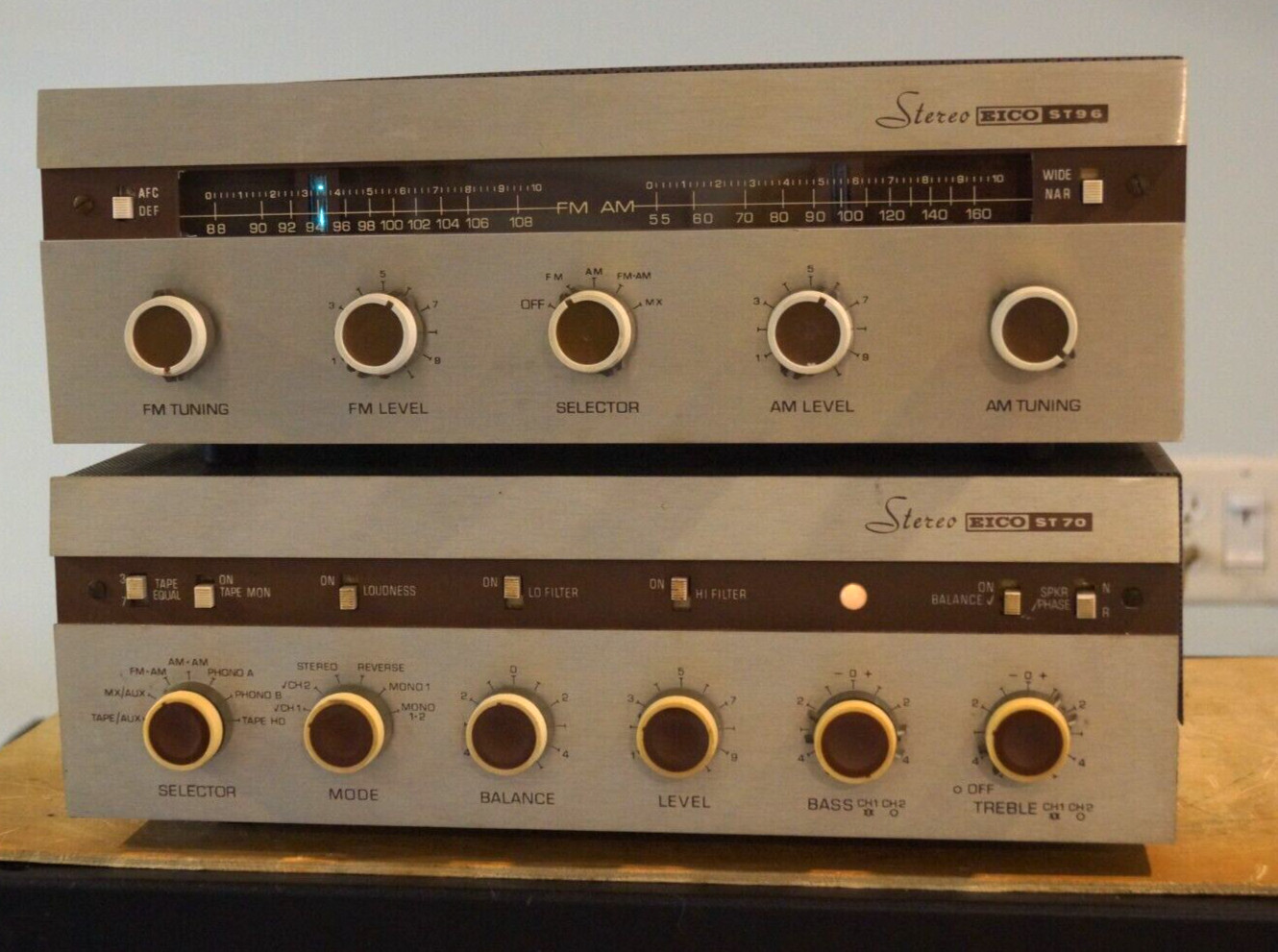
Housed in a rugged metal case and designed as a bookshelf unit, the ST-96 is utilitarian but well-proportioned. At 15.4 inches wide and just over 5 inches high, it fits neatly into modular systems of the era. The front panel is clean, with analog tuning scales and clear labeling—no frills, no chrome, just function. It requires external speakers, as it outputs only audio signals, not power. This was standard for tuners of the time, emphasizing its role as a component in a larger system rather than a standalone device.
Historical Context
Eico built its reputation on the same foundation as Heathkit and Dynaco: the do-it-yourself electronics movement. The ST-96 was available as a kit, appealing to hobbyists who wanted to learn tube circuitry while saving money. By the early 1960s, FM broadcasting was gaining traction, and stereo multiplex transmission was becoming a reality—though decoding it required additional hardware. The ST-96 arrived at that pivot point: FM was no longer a novelty, but stereo wasn’t yet integrated. Eico’s solution—offering a high-performance tuner that worked with external decoders—was pragmatic, not visionary. It didn’t try to do everything; it tried to do its job well.
The company would go on to produce solid-state equipment in the 1960s and 1970s before eventually ceasing operations in that decade. But in 1961, tube-based design was still king, and the ST-96 reflected that reality: 13 tubes doing the heavy lifting, from RF amplification to rectification (handled by the EZ80). It wasn’t the flashiest tuner on the market, but it was honest, repairable, and built for longevity.
Collectibility & Value
Today, the Eico ST-96 is a niche collectible—valued more for its utility and historical place in the DIY hi-fi movement than for its resale price. There are no current market listings for complete, working units, but restoration parts offer clues. A recap repair and rebuild kit was listed for $167 on Reverb in August 2022, indicating that full restoration isn’t cheap. Individual components like the chassis and top cage have sold for $34 and $36 respectively—suggesting that complete units, if found, are likely being parted out.
The biggest barrier to reliable operation? Capacitors. As one eBay listing notes, “A proper restoration must replace all electrolytic, paper, film, oil capacitors.” These degrade over time, leading to hum, noise, or failure. Resistors, particularly in the ratio detector circuit, are also prone to drifting out of tolerance, affecting FM stability. But the good news is that service manuals, schematics, and community knowledge are available from sources like Antique Radio Forums, Elektrotanya, and Mikesmanuals—making the ST-96 one of the more approachable vintage tuners to restore.
It’s not a showstopper at auctions, but for someone building a period-correct tube system or restoring a mid-century setup, the ST-96 is a legitimate find. It’s not rare, but it’s real—engineered with care, built to last, and representative of an era when you could understand, repair, and improve your own gear.
eBay Listings


As an eBay Partner, we earn from qualifying purchases. This helps support our independent vintage technology research.
Related Models
- Eico 2080 (1970)
- Eico HFT-80 (1957)
- Eico ST-3020 (1975)
- Eico ST-4120 (1970)
- Eico ST-97 (1968)
- Aiwa CS-250 (1978)
- Denon TU-1500RD (1995)
- Denon TU-280 (1976)
- Denon TU-501 (1977)
- Denon TU-550 (1978)