Eico ST-70: The Legendary Tube Amplifier Kit That Defined Hi-Fi DIY
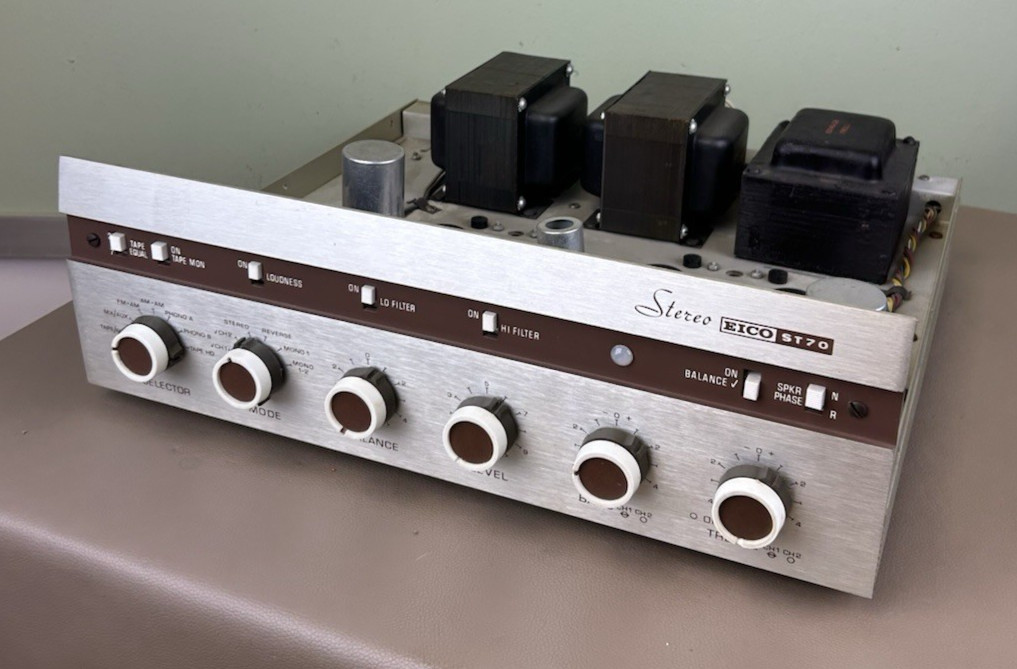
The Eico ST-70 is more than just a vintage stereo amplifier—it’s a cornerstone of American hi-fi history. Introduced in 1957 by Eico (Electronic Instrument Company), the ST-70 was one of the first high-fidelity stereo tube amplifiers available as a build-it-yourself kit, making high-performance audio accessible to hobbyists and audiophiles on a budget. At a time when stereo was just emerging from mono and home audio systems were transitioning from furniture-style consoles to component-based setups, the ST-70 offered a rare combination of affordability, performance, and educational value.
Eico, based in Long Island City, New York, had built a reputation for producing reliable, well-documented electronic kits for radio, test equipment, and audio gear. The ST-70 was their answer to the growing demand for stereo amplification, and it quickly became one of their most iconic and enduring products. With over 25,000 units sold during its production run (which lasted into the mid-1960s), the ST-70 helped democratize high-fidelity sound and inspired a generation of audio enthusiasts to roll up their sleeves and build their own gear.
Technical Specifications
| Specification | Detail |
| Manufacturer | Eico (Electronic Instrument Company) |
| Model | ST-70 |
| Year Introduced | 1957 |
| Type | Tube stereo amplifier (kit or assembled) |
| Configuration | Push-pull, Class AB |
| Output Power | 35 watts per channel (into 8Ω) |
| Frequency Response | 20Hz – 20kHz ±1dB |
| Total Harmonic Distortion | <1% at full power |
| Input Sensitivity | 1.4V for full output |
| Input Impedance | 1MΩ |
| Output Impedance | 8Ω (also compatible with 4Ω and 16Ω) |
| Tubes | 2x 7199 (input/driver), 4x 7591 (output), 1x 5AR4 (rectifier), 1x 12AX7 (phase inverter) |
| Dimensions | 19" W × 10" H × 10.5" D |
| Weight | ~40 lbs (18 kg) |
| Power Requirements | 117V AC, 60Hz, 400 watts |
Sound Characteristics and Performance
The Eico ST-70 is celebrated for its rich, warm, and detailed tube sound—a sonic signature that continues to captivate vintage audio lovers. With 35 watts per channel, it delivers ample power for efficient speakers (typically 90dB+ sensitivity), making it well-suited for classic bookshelf monitors and floor-standing speakers of the era, such as AR-3a, Klipsch Heresy, or Advents.
Its push-pull design using four 7591 power tubes (a beam power tetrode similar in performance to the 6L6 but with higher efficiency) provides a dynamic, musical presentation with strong midrange clarity and smooth high-frequency roll-off. The bass is tight and controlled for a tube amp of its era, though not as deep or punchy as modern solid-state designs. Still, many listeners find the ST-70’s bass response to be surprisingly authoritative, especially when paired with horns or transmission-line speakers.
One of the ST-70’s defining traits is its organic, "live" soundstage—instruments and vocals are rendered with palpable presence and spatial depth. This is partly due to the amplifier’s relatively low negative feedback design, which contributes to a more natural harmonic structure. Audiophiles often describe the ST-70 as having a “romantic” or “engaging” tonal balance, making it ideal for jazz, classical, and vocal recordings.
Notable Features and Innovations
The ST-70 was designed with clarity, serviceability, and user education in mind. Its modular layout and comprehensive instruction manual made it accessible even to novice builders. The kit included all components, sockets, chassis, transformers, and hardware, along with a 100+ page assembly manual that walked users through every step—from tube theory to biasing and alignment.
Key features included:
- Dual-mono construction: Separate power supplies and signal paths for each channel, minimizing crosstalk.
- Adjustable bias: Each output tube had its own bias test point and adjustment pot, allowing for fine-tuning and matching.
- High-quality output transformers: Made by Eico or subcontracted to reputable firms, these were critical to the amp’s wide frequency response and low distortion.
- Built-in metering: A front-panel meter allowed users to monitor bias current and troubleshoot tube performance.
- Expandability: Some users later modified their ST-70s with KT88 or 6550 tubes for higher power, though this required transformer upgrades.
The ST-70 also reflected the golden age of American electronics, where kits were not just cost-saving measures but tools for learning. Many engineers, technicians, and audiophiles of the 1960s and 70s got their start by building an Eico kit.
Common Issues and Maintenance
Like any vintage tube gear, the Eico ST-70 requires careful maintenance to perform safely and optimally. After 60+ years, several components are likely to need attention:
- Capacitor replacement: The electrolytic and paper capacitors (especially the power supply and coupling caps) degrade over time and should be replaced to prevent hum, distortion, or even component failure.
- Resistor drift: Carbon composition resistors can drift in value, affecting bias and gain. Checking and replacing out-of-spec resistors is recommended.
- Tube wear: The 7199 and 7591 tubes are still available (NOS or new production), but the 7199 is becoming scarce. Some builders substitute 6CG7 or 6FQ7 with minor circuit tweaks.
- Transformer health: While the power and output transformers are generally robust, they should be tested for shorts or insulation breakdown before powering up a long-dormant unit.
- Bias instability: If not properly maintained, the bias circuit can drift, leading to red-plating or premature tube failure.
Safety is paramount: The ST-70 operates at lethal voltages (over 500V DC in the power supply). Only experienced technicians should service or restore these units. Always use an isolation transformer and follow proper discharge procedures.
Current Market Value and Collectibility
Today, the Eico ST-70 enjoys a strong cult following among tube enthusiasts, DIYers, and vintage audio collectors. A fully restored, working ST-70 in good condition typically sells for $600–$1,200, depending on cosmetics, tube complement, and provenance. Original kits with manuals and unused parts can command even higher prices, especially if documented as un-built.
Its value lies not just in performance but in historical significance. The ST-70 represents a pivotal moment when hi-fi moved from the factory to the workbench. It’s a symbol of hands-on audio culture—a time when understanding your gear was part of the listening experience.
Restored ST-70s are frequently used in vintage systems and even compared favorably to modern boutique tube amps. Some audiophiles prefer the ST-70’s raw, unpolished character over more refined (but less engaging) contemporary designs.
Conclusion and Legacy
The Eico ST-70 is more than a vintage amplifier—it’s a piece of audio history. As one of the first affordable stereo tube amps available as a kit, it empowered a generation to build, learn, and listen deeply. Its warm, dynamic sound, robust construction, and educational design have ensured its survival long after most of its contemporaries faded into obscurity.
While it lacks the convenience of modern gear, the ST-70 offers something increasingly rare: a tangible connection to the craft of audio. For those willing to restore and maintain it, the ST-70 delivers not just music, but a full-bodied, emotionally resonant experience that few amplifiers—old or new—can match.
Whether you're a collector, a DIYer, or a lover of tube magic, the Eico ST-70 remains a must-hear classic—a true icon of the golden age of hi-fi.
eBay Listings



As an eBay Partner, we earn from qualifying purchases. This helps support our independent vintage technology research.
Service Manuals & Schematics
- Manual — archive.org
Related Models
- Eico HF-61 (1956)
- Eico 2536 (1970)
- Eico 3150 (1967)
- Eico HF-12A (1957)
- Eico HF-14 (1952)
- Luxman L-530 (1975)
- Luxman R-404 (1975)
- Luxman RV-371 (1975)
- Luxman SQ-38U (1975)
- Luxman T-14 (1972)