Eico HF-94: The Vintage Tube Audio Oscillator for the Serious Audiophile and Technician
In the golden era of vacuum tube electronics, precision test equipment was not just the domain of professional engineers—it was also a vital tool for the dedicated hobbyist and audiophile. Among the most respected names in DIY and affordable test gear of the 1950s and 60s was Eico, a company renowned for offering high-quality, kit-based electronic instruments that brought professional capabilities into home workshops. One of their standout offerings in the test equipment category was the Eico HF-94 High-Frequency Audio Oscillator, a versatile and robust tube-based signal generator designed for audio alignment, amplifier testing, and general laboratory use.
Though not a consumer audio component like a receiver or amplifier, the Eico HF-94 holds a special place in the world of vintage audio for those who restore, maintain, or simply appreciate the craftsmanship of mid-century electronics. It represents an era when understanding and servicing audio gear was part of the audiophile experience—not outsourced, but mastered at home.
Historical Context
Introduced in 1955, the Eico HF-94 was part of a broader wave of post-war electronics innovation. As home hi-fi systems, tube amplifiers, and tape recorders became more common, the need for accurate alignment and troubleshooting tools grew. Eico, founded in 1947, capitalized on this demand by offering affordable, well-documented kits that allowed users to build their own test gear with confidence.
The HF-94 was marketed as a precision audio oscillator, capable of generating stable, low-distortion sine waves across the entire audio spectrum and slightly beyond. It was commonly used for aligning FM discriminators, testing amplifier frequency response, checking filter networks, and servicing tape recorder electronics. Its build-it-yourself format made it accessible to technicians and serious hobbyists alike, and its performance rivaled more expensive commercial units.
Technical Specifications
The Eico HF-94 is a vacuum tube-based oscillator built around proven circuit design principles of the time. It features continuous frequency coverage from 20 Hz to 200 kHz, far exceeding the standard audio range (20 Hz – 20 kHz), making it useful for testing ultrasonic circuits and IF stages in radio equipment.
| Specification | Detail |
| Frequency Range | 20 Hz – 200 kHz in 10 overlapping bands |
| Frequency Accuracy | ±2% (calibrated against standard) |
| Output Waveform | Sine wave (low distortion) |
| Output Level | Continuously variable, up to 20 V peak-to-peak into high impedance |
| Output Impedance | 600 Ω, 50 kΩ, and 1 MΩ selectable |
| Distortion | Less than 0.1% (typical at mid-band) |
| Tubes Used | 6C4 (oscillator), 6SN7GT (output buffer/amplifier) |
| Power Supply | 117 VAC, 60 Hz, ~30 watts |
| Dimensions | 10" × 7" × 5" (approx.) |
| Weight | ~7 lbs |
| Construction | Kit-based, steel chassis with aluminum front panel |
The oscillator employs a Wien bridge configuration, known for its stability and low harmonic distortion. A precision dual-ganged potentiometer controls frequency, while calibrated dials with a magnifying lens allow for accurate setting. The output is buffered by a 6SN7GT dual triode, ensuring minimal loading effects and consistent signal delivery across various test loads.
Sound Characteristics and Performance
While the Eico HF-94 doesn’t "produce sound" in the traditional sense, its signal purity and stability are critical to accurate audio testing. The oscillator delivers an exceptionally clean sine wave with minimal harmonic distortion—essential when measuring frequency response or distortion in amplifiers.
Its wide frequency range allows users to sweep from subsonic rumbles to ultrasonic highs, making it ideal for testing the bandwidth of vintage preamps, graphic equalizers, and even early transistorized audio gear. The variable output control enables precise signal injection, from microvolts (with external attenuation) to several volts, accommodating everything from phono stage testing to power amplifier evaluation.
When paired with a vacuum tube voltmeter (VTVM) or oscilloscope, the HF-94 becomes a cornerstone of any vintage audio lab. For example, one could use it to plot the frequency response of a classic Marantz or Fisher receiver, or align the playback head on a Revox or Ampex tape deck.
Notable Features and Innovations
What made the Eico HF-94 stand out in its era—and still admired today—was its combination of precision, versatility, and accessibility:
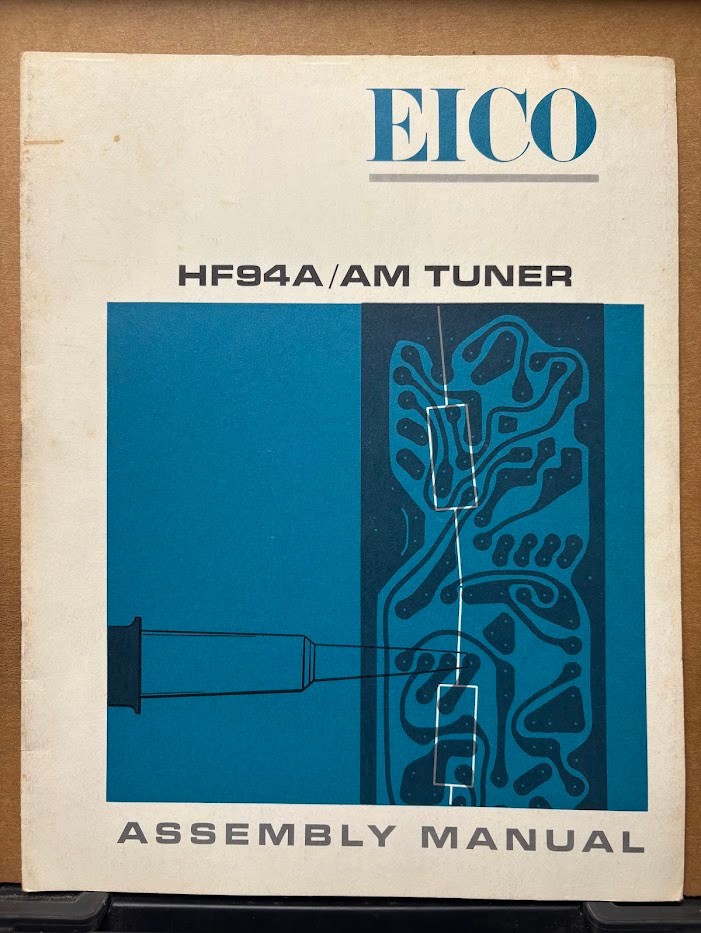
- Kit-Based Design: Eico kits came with detailed manuals, wiring diagrams, and alignment instructions. The HF-94 could be assembled by a skilled hobbyist in a weekend, fostering a deep understanding of its inner workings.
- Multi-Ranging Output: With selectable output impedances, it could interface seamlessly with a wide range of equipment, from low-Z professional gear to high-Z tube inputs.
- Fine Frequency Control: The calibrated dial and vernier control allowed for precise frequency selection, crucial for alignment tasks.
- Robust Build Quality: Steel chassis, high-quality potentiometers, and military-grade tube sockets ensured long-term reliability.
- Educational Value: Building and using the HF-94 taught users about oscillator design, impedance matching, and signal integrity—skills that are rare in today’s plug-and-play world.
Common Issues and Maintenance
Like all vintage tube equipment, the Eico HF-94 requires some care to remain functional and safe:
- Capacitor Aging: The paper and electrolytic capacitors inside often degrade over time. A full recap (replacing all capacitors) is highly recommended before powering up a long-unused unit.
- Tube Replacement: The 6C4 and 6SN7GT tubes are still available (NOS or new production), but should be tested or replaced if noisy or microphonic.
- Potentiometer Noise: The output level and frequency pots can develop crackle. Cleaning with contact cleaner may help, but replacement with modern equivalents may be necessary.
- Calibration Drift: Over decades, resistors can drift in value, affecting frequency accuracy. Recalibration using a modern frequency counter is advised for precision work.
- Power Supply Safety: The HF-94 uses a transformerless "hot chassis" design in some versions—extreme caution is required when operating. Using an isolation transformer is strongly recommended.
Restoring an HF-94 is a rewarding project, and original manuals are available through online archives like the World Radio History library or BAMA (Boat Anchor Manual Archive).
Current Market Value and Collectibility
The Eico HF-94 is not a mainstream collectible like a McIntosh amplifier, but it holds strong appeal among vintage test equipment enthusiasts, tube restorers, and audio historians. Complete, working units in good condition typically sell for $150–$300, depending on cosmetics and functionality. Kits still in original packaging with manuals can fetch higher prices from collectors.
Its value lies not in nostalgia alone, but in practical utility. For those restoring 1950s and 60s audio gear, the HF-94 is not just a museum piece—it’s a working tool that performs as well today as it did 70 years ago (after proper servicing).
Conclusion and Legacy
The Eico HF-94 is more than just a signal generator—it’s a symbol of a time when audio enthusiasts were also technicians, builders, and tinkerers. In an age of disposable electronics, the HF-94 stands as a testament to durability, precision, and user empowerment.
While it may not amplify music or spin records, the HF-94 helped ensure that the music played through vintage systems was as clear, balanced, and faithful as possible. For the true vintage audio aficionado, owning and using an Eico HF-94 is a way to connect with the roots of high-fidelity—where understanding the circuit was just as important as enjoying the sound it produced.
Whether you're aligning a classic tube preamp, teaching yourself about analog signal generation, or simply appreciating the craftsmanship of mid-century test gear, the Eico HF-94 remains a quietly essential piece of audio history.
eBay Listings



As an eBay Partner, we earn from qualifying purchases. This helps support our independent vintage technology research.
Related Models
- Eico 3570 (1972)
- Eico 3200 (1970)
- Eico HF-65A (1958)
- Eico 2716 (1970)
- Eico 3070 (1969)
- Akai AM-2850 (1975)
- Akai AP-206 (1975)
- Nakamichi BX-1 (1985)
- Acoustic Research research-ar-17 (1978)
- Acoustic Research AR-19 (1994)