Eico HF-86: The Classic Tube Amplifier Kit That Defined DIY Hi-Fi
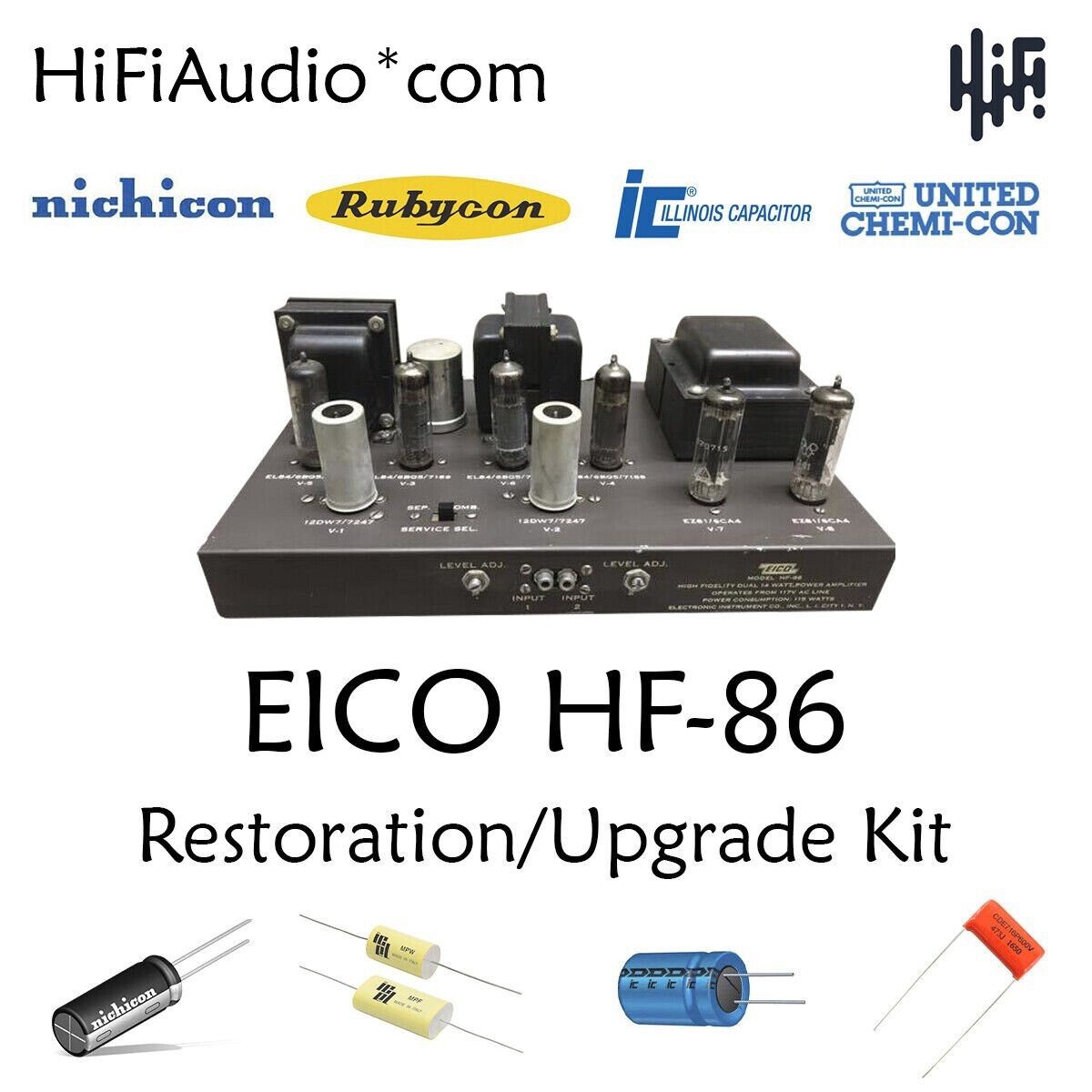
In the late 1950s, as stereo audio began to captivate the American public, a new breed of audio enthusiast emerged—tinkerers, hobbyists, and music lovers who wanted both high-fidelity sound and the satisfaction of building their own gear. Few products embodied this spirit more perfectly than the Eico HF-86, a vacuum tube stereo amplifier kit introduced in 1959 by Eico (Electronic Instruments Company). More than just an amplifier, the HF-86 became a rite of passage for generations of audiophiles and electronics hobbyists, combining solid engineering, excellent sound, and an accessible price point—all in kit form.
A Pioneer in the Kit Hi-Fi Movement
Eico, founded in 1947, was one of the leading manufacturers of electronic kits during the mid-20th century. The company specialized in test equipment, radios, and amplifiers, all sold as kits to be assembled by the buyer. The HF-86 was one of their most ambitious and celebrated audio projects, designed specifically for the burgeoning stereo market. At a time when factory-built stereo amplifiers could cost hundreds of dollars, the HF-86 offered a high-performance alternative for under $100—around $1,000 in today’s money—making it an attractive option for budget-conscious audiophiles.
The HF-86 was not just a cost-saving measure; it was a statement. Building the amplifier from a kit gave users intimate knowledge of its circuitry, fostered a deeper connection to the equipment, and instilled pride in ownership. Many HF-86s are still in use today, a testament to their robust design and the care taken by their builders.
Technical Specifications
The Eico HF-86 is a push-pull, class AB stereo amplifier using vacuum tubes to deliver warm, dynamic sound. It was designed to be paired with a preamplifier (such as the Eico HF-20 or HF-55) and passive volume control. Below are the key technical specifications:
| Feature | Specification |
| Year Introduced | 1959 |
| Configuration | Stereo (dual mono) |
| Output Power | 35 watts per channel (into 8Ω) |
| Frequency Response | 10 Hz – 60 kHz (+/- 1 dB) |
| Total Harmonic Distortion | Less than 0.5% at full power (1 kHz) |
| Input Sensitivity | 1.4 volts for full output |
| Input Impedance | 1 MΩ |
| Output Impedance | 8Ω (also compatible with 4Ω and 16Ω speakers) |
| Tubes Used | 2x 7193 (or 6DJ8), 2x 6SN7GT, 2x 6LQ6 (or 6550) |
| Power Supply | Dual rectified high-voltage supply with choke |
| Dimensions | 19" W × 9" H × 10" D |
| Weight | Approx. 35 lbs |
| Assembly Time | Estimated 20–30 hours |
The HF-86 uses a classic tube amplifier topology with a differential input stage, phase inverter, and push-pull output stage. The use of 6LQ6 beam power tubes (later often replaced with more robust 6550s or KT88s) allowed for high power output with low distortion. The 6SN7GT dual triodes served as voltage amplifiers and phase splitters, while the 7193/6DJ8 low-noise dual triodes handled the input stage.
Sound Characteristics and Performance
The Eico HF-86 is renowned for its rich, warm, and detailed sound, typical of well-designed tube amplifiers. Its wide frequency response and low distortion allow it to reproduce music with remarkable clarity and presence. The amplifier delivers a smooth high end, full-bodied midrange, and tight, controlled bass—especially when paired with efficient speakers.
Unlike many modern solid-state amplifiers that aim for clinical neutrality, the HF-86 imparts a subtle harmonic richness that many listeners describe as “musical” or “lifelike.” This characteristic makes it particularly well-suited for jazz, classical, and vocal recordings, where tonal accuracy and spatial imaging are paramount.
Despite its age, the HF-86 holds up impressively against modern amplifiers in blind listening tests when properly maintained. Its 35 watts per channel is more than sufficient for most listening environments, especially with high-sensitivity speakers (90 dB or higher).
Notable Features and Innovations
While not the first tube amplifier on the market, the HF-86 stood out for several reasons:
- Kit-Based Design: Eico provided comprehensive, step-by-step instructions, making it accessible even to those with limited electronics experience. The manual included wiring diagrams, alignment procedures, and troubleshooting tips.
- Modular Construction: The amplifier used a point-to-point wiring layout on terminal strips, a common practice at the time, which facilitated repairs and upgrades.
- Dual-Mono Architecture: Each channel was fully independent, minimizing crosstalk and improving stereo separation.
- High Build Quality: Components were robust for the era, including high-quality transformers, paper-in-oil capacitors, and precision resistors.
- Upgrade-Friendly: The HF-86 has become a favorite among tube amplifier modders. Common upgrades include replacing original capacitors, using modern rectifiers, and substituting KT88 tubes for increased headroom and reliability.
Common Issues and Maintenance
Like all vintage electronics, the Eico HF-86 requires careful maintenance to perform safely and optimally. The most common issues include:
- Capacitor Aging: The original electrolytic and paper capacitors degrade over time and should be replaced. Failure to do so can result in hum, distortion, or even damage to tubes and transformers.
- Tube Wear: Tubes have a finite lifespan. The 6LQ6/6550 output tubes are particularly prone to wear and should be tested or replaced if performance declines.
- Resistor Drift: Carbon composition resistors can drift in value over decades, affecting bias and gain. Checking and replacing out-of-spec resistors is recommended.
- Transformer Health: The power and output transformers are critical and generally long-lasting, but should be inspected for signs of overheating or insulation breakdown.
- Safety Concerns: The HF-86 operates at lethal voltages (over 400V DC). Only experienced technicians should service or modify the unit.
Restoration typically involves a full recapping, tube replacement, bias adjustment, and thorough cleaning. Many online communities and forums, such as the Antique Radio Forums and DIY Audio, offer detailed guides and support for HF-86 restorers.
Current Market Value and Collectibility
The Eico HF-86 is highly collectible among vintage audio enthusiasts and DIYers. A fully restored, working unit typically sells for $400–$800, depending on condition, tube complement, and provenance. Original, unmodified kits in excellent condition can command higher prices, especially if accompanied by original manuals, tubes, and packaging.
While not as rare as some boutique tube amps, the HF-86’s historical significance, sound quality, and educational value ensure strong demand. It is particularly prized by those who appreciate the craftsmanship of the tube era and the satisfaction of hands-on electronics.
Conclusion: A Legacy of Sound and Craftsmanship
The Eico HF-86 is more than just a vintage amplifier—it’s a symbol of an era when hi-fi was both an art and a craft. It empowered a generation to build, learn, and listen deeply. Its combination of performance, affordability, and educational value made it a cornerstone of the DIY audio movement.
Today, the HF-86 continues to deliver beautiful sound in homes around the world. Whether you’re a seasoned tube enthusiast or a newcomer to vintage audio, building or restoring an HF-86 is a rewarding journey into the heart of analog fidelity. In a world of mass-produced digital gear, the Eico HF-86 stands as a testament to the enduring appeal of hand-built, soulful sound.
eBay Listings



As an eBay Partner, we earn from qualifying purchases. This helps support our independent vintage technology research.
Related Models
- Eico HF-61 (1956)
- Eico 2536 (1970)
- Eico 3150 (1967)
- Eico HF-12A (1957)
- Eico HF-14 (1952)
- Luxman L-530 (1975)
- Luxman R-404 (1975)
- Luxman RV-371 (1975)
- Luxman SQ-38U (1975)
- Luxman T-14 (1972)