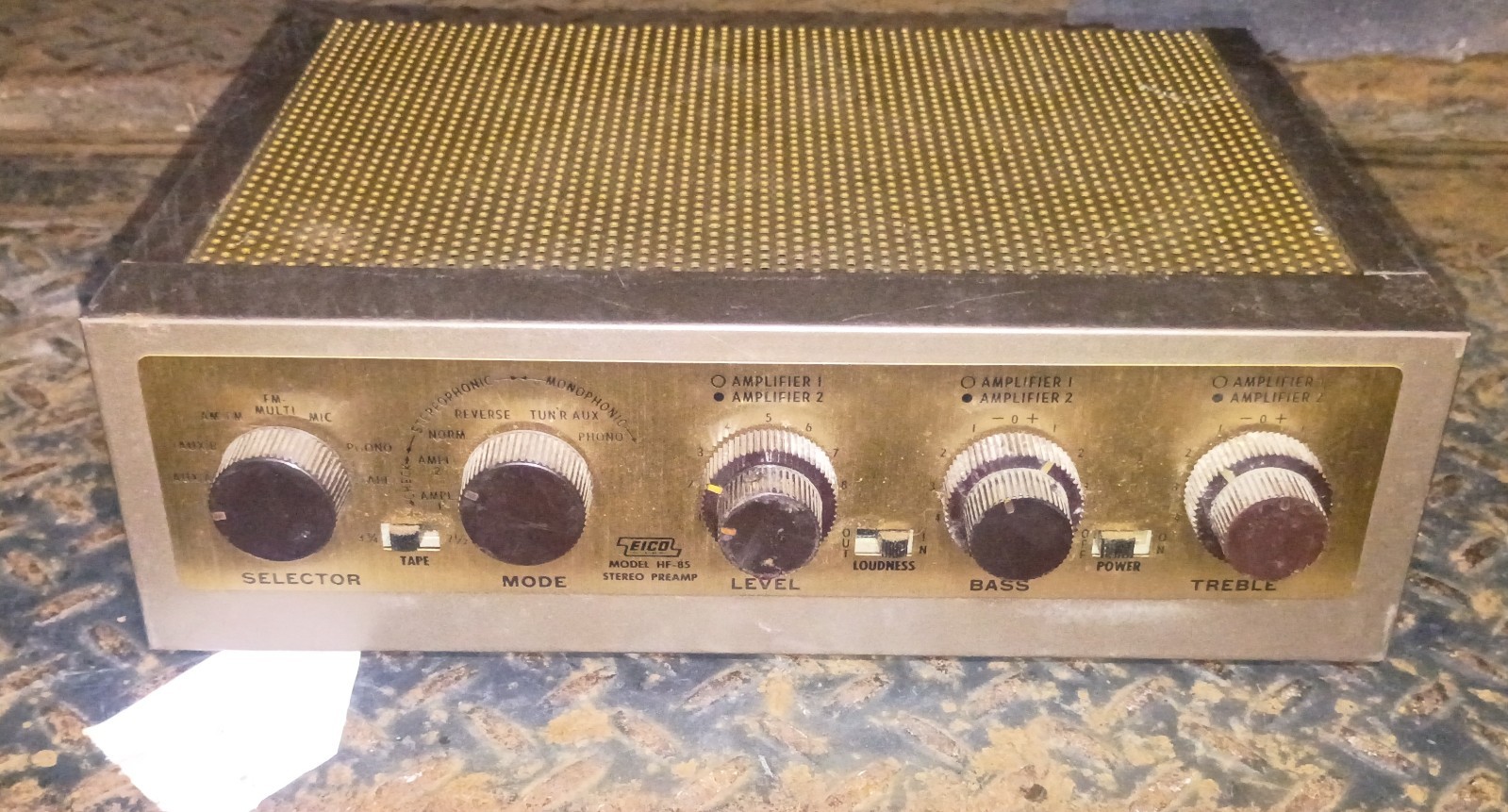
Eico HF-85: The Audiophile’s Vintage Kit Amplifier
In the golden age of vacuum tube electronics, few names resonated with home audio enthusiasts quite like Eico. Known for its high-quality, affordable kits, Eico empowered a generation of hobbyists to build their own sophisticated audio equipment. Among their most celebrated offerings was the HF-85, a high-fidelity stereo vacuum tube amplifier introduced in 1955. More than just an amplifier, the HF-85 represented a philosophy—combining performance, education, and craftsmanship in a single, do-it-yourself package.
At a time when commercial stereo systems were either rudimentary or prohibitively expensive, the Eico HF-85 offered audiophiles and electronics tinkerers a rare opportunity: to construct a true high-fidelity stereo amplifier with professional-grade performance, all from a kit. With its elegant design, robust construction, and exceptional sound quality for its era, the HF-85 remains a prized find among vintage audio collectors and tube amplifier enthusiasts.
Historical Context
The mid-1950s marked a turning point in consumer audio. Monophonic AM radio still dominated, but the seeds of stereo were being sown. Record companies began experimenting with stereo recordings, and new high-fidelity components promised richer, more immersive sound. Eico, founded in 1947, positioned itself at the forefront of this movement by offering well-engineered, kit-based electronics that made advanced audio technology accessible.
The HF-85 was introduced as a stereo companion to Eico’s earlier monaural amplifiers. It was one of the first commercially available stereo amplifier kits, designed to drive two separate speaker channels with balanced performance. Marketed to both serious listeners and electronics hobbyists, the HF-85 came with detailed assembly manuals, alignment instructions, and even troubleshooting guides—making it a complete educational experience.
Priced affordably (around $100 for the kit, equivalent to roughly $1,100 today), the HF-85 democratized high-end audio. It wasn’t just a product—it was a gateway into the world of electronics, acoustics, and the art of sound reproduction.
Technical Specifications
The Eico HF-85 was a push-pull, class AB stereo amplifier built around vacuum tube technology. Each channel operated independently, ensuring true stereo separation. It was designed to deliver clean, low-distortion power suitable for the high-efficiency speakers of the era.
| Specification | Detail |
| Model | HF-85 |
| Manufacturer | Eico |
| Year Introduced | 1955 |
| Configuration | Stereo (dual mono) |
| Output Power | 15 watts per channel (RMS) |
| Frequency Response | 20 Hz – 20 kHz (+/- 1 dB) |
| Total Harmonic Distortion | Less than 0.5% at full power |
| Input Sensitivity | 0.3 volts for full output |
| Input Impedance | 1 MΩ (high impedance) |
| Output Impedance | 4Ω, 8Ω, and 16Ω taps (per channel) |
| Tubes (per channel) | 2x 6SC7 (dual triode), 2x 6V6GT (output), 1x 5Y3GT (rectifier) |
| Power Supply | Vacuum tube rectified, LC filtered |
| Dimensions | 19" W × 7.5" H × 10.5" D |
| Weight | Approximately 35 lbs (16 kg) |
| Kit or Pre-built | Kit only (no factory-assembled option) |
The amplifier used a parafeed output design, which eliminated the output transformer’s DC saturation issues by using a coupling capacitor. This contributed to its wide frequency response and low distortion. The HF-85 also featured individual volume and balance controls, tone controls (bass and treble), and separate inputs for phono and auxiliary sources—advanced features for its time.
Sound Characteristics and Performance
The Eico HF-85 delivered a warm, rich, and dynamic sound signature typical of well-designed tube amplifiers. Its 15 watts per channel may seem modest by modern standards, but it was more than sufficient for the high-sensitivity horn or dynamic speakers common in the 1950s.
Listeners often describe the HF-85’s sound as musical, smooth, and detailed, with excellent midrange clarity and a natural presentation of vocals and acoustic instruments. The wide frequency response ensured faithful reproduction of both deep bass and extended highs, while the low distortion preserved the integrity of the original recording.
Because it was hand-assembled by the user, performance could vary slightly depending on build quality, tube selection, and component tolerances. However, when properly constructed and aligned, the HF-85 rivaled or even surpassed many factory-built amplifiers of the era in both technical performance and sonic character.
Notable Features and Innovations
The HF-85 was more than just an amplifier—it was a milestone in DIY audio. Its standout features included:
- True stereo design: One of the first kits to offer discrete left and right channels with full control over balance and volume.
- Educational value: The detailed 100+ page manual taught users about amplifier theory, tube operation, and circuit alignment.
- Modular construction: Point-to-point wiring on terminal strips made assembly accessible to intermediate hobbyists.
- High-quality components: Eico used robust transformers, durable pots, and reliable capacitors, ensuring longevity.
- Tone and input flexibility: Dual inputs (phono and line) with RIAA equalization for magnetic cartridges, plus bass and treble controls.
The inclusion of a test point jack and alignment instructions allowed users to fine-tune the amplifier using an oscilloscope or signal generator—features usually reserved for professional gear.
Common Issues and Maintenance
As with any vintage tube equipment, the Eico HF-85 requires careful maintenance to perform reliably today. Common issues include:
- Aging capacitors: The electrolytic and paper capacitors degrade over time and should be replaced (recapped) to prevent hum, distortion, or component failure.
- Tube wear: 6V6GT and 5Y3GT tubes have finite lifespans and may need replacement. NOS (New Old Stock) tubes are often sought after for authenticity.
- Resistor drift: Carbon composition resistors can change value over decades, affecting bias and performance.
- Dusty controls: Pots and switches can become noisy; cleaning with contact cleaner or replacement is recommended.
- Transformer health: While Eico used high-quality transformers, checking for shorts or overheating is essential before powering up a long-dormant unit.
Restoration should be performed by someone experienced with tube electronics, especially due to the high voltages present (over 400V DC). Safety is paramount.
Current Market Value and Collectibility
The Eico HF-85 is a sought-after piece among vintage audio collectors, particularly those interested in DIY culture, tube amplifiers, and mid-century hi-fi. Complete, unrestored kits in good condition can fetch $300–$600, while fully restored, working units with original documentation may sell for $800–$1,200 or more, depending on condition and provenance.
Original manuals, schematics, and unused tubes significantly increase value. Because the HF-85 was only sold as a kit, no “factory original” assembly exists—each unit is unique, reflecting the builder’s craftsmanship.
Its collectibility is enhanced by its historical significance as one of the earliest stereo amplifier kits, and its role in educating a generation of audiophiles and engineers.
Conclusion and Legacy
The Eico HF-85 stands as a landmark in the history of high-fidelity audio. More than just an amplifier, it was a hands-on journey into the heart of sound reproduction. It empowered users to understand, build, and fine-tune their own equipment—a philosophy that resonates strongly with today’s maker movement and audiophile community.
While modern amplifiers offer greater power and convenience, few match the emotional connection and sonic charm of a well-restored HF-85. For vintage audio enthusiasts, owning an HF-85 isn’t just about nostalgia—it’s about preserving a legacy of craftsmanship, education, and the pure joy of listening.
Whether you’re a restorer, a listener, or a historian, the Eico HF-85 remains a shining example of how passion, precision, and tubes can create something truly timeless.
eBay Listings



As an eBay Partner, we earn from qualifying purchases. This helps support our independent vintage technology research.
Related Models
- Eico HF-61 (1956)
- Eico 2536 (1970)
- Eico 3150 (1967)
- Eico HF-12A (1957)
- Eico HF-14 (1952)
- Luxman L-530 (1975)
- Luxman R-404 (1975)
- Luxman RV-371 (1975)
- Luxman SQ-38U (1975)
- Luxman T-14 (1972)