Eico HF-52: The Pioneer of DIY Hi-Fi Amplification
In the golden age of vacuum tube electronics, when home audio was transitioning from basic AM radios to high-fidelity stereo systems, the Eico HF-52 emerged as a groundbreaking achievement in accessible audio engineering. Introduced in 1955 by Eico (Electronic Instrument Company), the HF-52 was not just another amplifier—it was one of the first commercially successful stereo vacuum tube amplifier kits aimed at the do-it-yourself (DIY) market. For audiophiles and electronics hobbyists of the 1950s and 60s, the HF-52 represented both a technical challenge and a gateway to true high-fidelity sound reproduction.
Eico, based in Long Island City, New York, built its reputation on offering well-engineered, affordable electronic kits for radio, test equipment, and eventually, hi-fi audio. The HF-52 was a bold step into the burgeoning stereo era, arriving just as stereo LP records were gaining popularity. At a time when factory-built stereo amplifiers were prohibitively expensive, the HF-52 offered a cost-effective, educational, and sonically rewarding alternative for the technically inclined.
Technical Specifications
The Eico HF-52 was designed as a dual-channel (stereo) vacuum tube amplifier, with each channel operating in push-pull Class AB1 configuration. It was intended to be paired with a preamplifier (such as the Eico HF-20 or HF-35) and used with dynamic loudspeakers of the era. The amplifier was entirely tube-based and required manual assembly from a kit, including chassis wiring, tube socket installation, and careful alignment.
| Specification | Detail |
| Manufacturer | Eico (Electronic Instrument Company) |
| Model | HF-52 |
| Year Introduced | 1955 |
| Type | Stereo vacuum tube power amplifier (kit) |
| Configuration | Dual monaural channels (stereo) |
| Output Power | 14 watts per channel (RMS) |
| Output Impedance | 3.2Ω, 8Ω, and 16Ω taps |
| Frequency Response | 20 Hz – 20 kHz (±1 dB) |
| Total Harmonic Distortion | Less than 0.5% at full power |
| Input Sensitivity | 1.4 volts RMS for full output |
| Input Impedance | 1 MΩ |
| Tubes (per channel) | 2 x 6SC7 (dual triode), 2 x 75 (output triode) |
| Rectifier | 5Y3-G (shared) |
| Power Requirements | 117 VAC, 60 Hz |
| Dimensions | 17" W × 7" H × 10" D (chassis only) |
| Weight | Approx. 25 lbs (with tubes and transformers) |
| Assembly Time | 30–40 hours (estimated) |
The HF-52 used the 75 triode as its output tube—a somewhat unusual choice compared to the more common 6L6 or EL34—but carefully implemented in a push-pull configuration to deliver clean, linear power. The 75 tube, though not as powerful as later output tubes, was known for its reliability and smooth sonic character when properly biased.
Sound Characteristics and Performance
Despite its modest power rating by modern standards, the Eico HF-52 delivered remarkably transparent and dynamic sound for its era. Its wide frequency response and low distortion made it a favorite among early stereo adopters. The amplifier's all-tube signal path contributed to a warm, rich tonal balance, with a smooth high end and well-defined bass—ideal for the acoustic and jazz recordings of the 1950s.
Because the HF-52 was designed for high sensitivity and low feedback, it responded well to high-efficiency speakers of the time, such as Altec Lansing, JBL, or Klipsch models. Its open, natural midrange made vocals and instruments sound lifelike, and the stereo separation—rare in consumer gear at the time—was impressive.
Many owners report that a properly restored and biased HF-52 can still hold its own in a vintage audio setup today, especially when paired with appropriate speakers. The lack of negative feedback (a design choice for simplicity and stability) gives the amplifier a slightly "romantic" character—less clinical than modern solid-state gear, but more emotionally engaging.
Notable Features and Innovations
The Eico HF-52 was not just an amplifier—it was an educational experience. Every kit came with a detailed instruction manual that walked users through every step of assembly, from soldering to tube testing and alignment. This made the HF-52 not only a functional piece of audio equipment but also a hands-on electronics course in vacuum tube theory, circuit design, and safety practices.
Key features included:
- Dual independent channels for true stereo operation
- High input impedance for compatibility with early preamps and phono stages
- Multiple speaker taps for impedance matching
- Conservative design with proven tube types for reliability
- Point-to-point wiring on terminal strips (no printed circuit boards)
- Built-in bias test points for proper tube alignment
Eico’s emphasis on modularity and serviceability meant that repairs and upgrades were straightforward. The chassis was spacious, and components were clearly labeled. This design philosophy contributed to the long lifespan of many HF-52 units still in operation today.
Common Issues and Maintenance
As with any vintage tube equipment, the Eico HF-52 requires careful maintenance to operate safely and reliably. Common issues include:
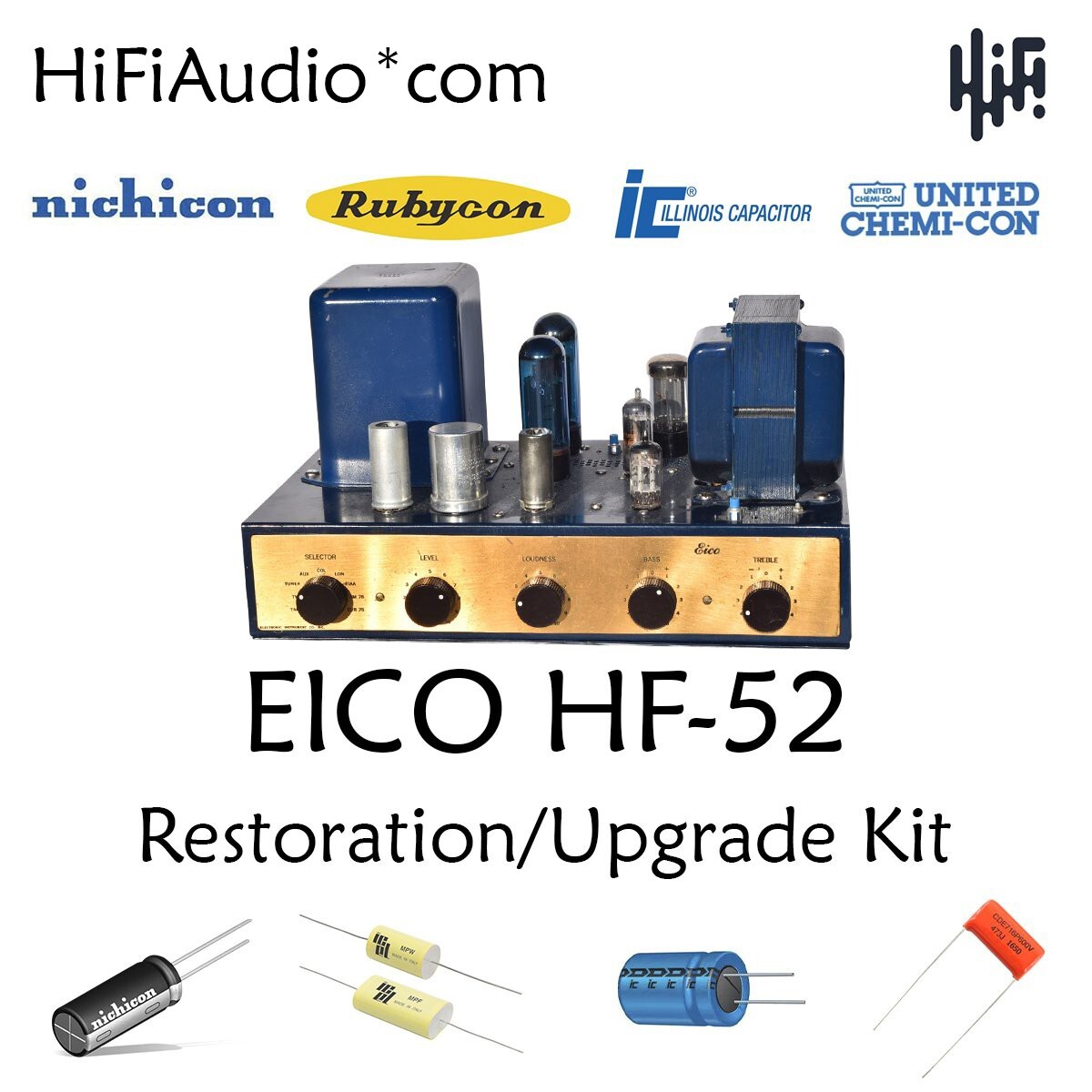
- Aging capacitors: The paper and electrolytic capacitors from the 1950s are prone to leakage, shorting, or drying out. A full capacitor replacement (recapping) is essential before powering up a long-stored unit.
- Resistor drift: Carbon composition resistors can drift in value over time, affecting bias and gain. Checking and replacing out-of-spec resistors improves performance.
- Tube wear: The 75 output tubes are still available (NOS or used), but should be tested for balance and emission. The 5Y3 rectifier should also be checked for proper voltage delivery.
- Wiring fatigue: Decades of thermal cycling can weaken solder joints or cause wire insulation to crack. A thorough inspection is recommended.
- Bias instability: Unlike modern amps, the HF-52 lacks automatic bias control. Manual adjustment using a multimeter and the built-in test points is required during setup.
Safety is paramount: the HF-52 operates at lethal voltages (over 400V DC on the plates). Only experienced technicians should attempt restoration without proper training and equipment.
Current Market Value and Collectibility
The Eico HF-52 is a highly collectible item among vintage audio and tube amplifier enthusiasts. Complete, unrestored kits in good condition can fetch $300–$600, while fully restored and tested units may sell for $800–$1,200, depending on originality and performance.
Factors that increase value:
- Original packaging and manuals
- All-original components (especially tubes)
- Factory-correct labeling and finishes
- Demonstrated working condition
The HF-52 is particularly prized by DIY audio historians and kit restoration hobbyists. Its role in democratizing high-fidelity audio and inspiring a generation of engineers gives it significant cultural and technical importance.
Conclusion and Legacy
The Eico HF-52 stands as a monument to the golden age of DIY electronics. More than just an amplifier, it was a symbol of accessibility, education, and the joy of building something with your own hands. In an era before mass-produced consumer electronics, the HF-52 empowered hobbyists to enter the world of stereo sound without breaking the bank.
Its legacy lives on in today’s vibrant tube audio and kit-building communities. Modern DIY amplifier kits, from Bottlehead to Dynaco reissues, owe a debt to pioneers like Eico. The HF-52 wasn’t the most powerful or flashy amplifier of its time—but it was honest, well-designed, and deeply influential.
For collectors, restorers, and vintage audio lovers, the Eico HF-52 is more than a relic. It’s a working piece of audio history—a testament to the belief that great sound isn’t just heard, it’s built.
eBay Listings


As an eBay Partner, we earn from qualifying purchases. This helps support our independent vintage technology research.
Related Models
- Eico HF-61 (1956)
- Eico 2536 (1970)
- Eico 3150 (1967)
- Eico HF-12A (1957)
- Eico HF-14 (1952)
- Luxman L-530 (1975)
- Luxman R-404 (1975)
- Luxman RV-371 (1975)
- Luxman SQ-38U (1975)
- Luxman T-14 (1972)